The Customer Is God: The Phrase Japan Itself Misremembers
Okyakusama wa kamisama desu is a real, everyday Japanese phrase, but Japan itself misremembers where it came from: a 1961 stage line about honouring an audience, not ancient retail scripture. Here is the honest provenance, why the service bar is genuinely high, and how a European company meets it without essentialising it.
Part of our Cross-Cultural Marketing series. Start with the full guide: Cross-Cultural Marketing: What Most Agencies Get Wrong
- The service behaviour is genuinely high. Say so with confidence. Japanese retail and service culture holds a higher, more consistent baseline than most European markets, delivered without tipping
- The phrase itself is real and everyday. Okyakusama wa kamisama desu, "the customer is god", is used and misused by Japanese people all the time. It is not foreign, and it is not invented
- What is misremembered is domestic, held inside Japan. Both the origin (people take it for an ancient service creed when it is a 1961 Minami Haruo stage line about honouring his audience) and the meaning (stretched from an artist's sincerity into "the customer is always right")
- Kasuhara is Japanese customers weaponising a Japanese phrase. That is why Minami's own family publicly pushed back, and why the new customer-harassment rules manage the excess without lowering the service bar
voice-gate-allow: timeless -- the essentialising stereotype the piece argues against
- The stereotype to avoid is the outsider one: reading the phrase as proof of timeless, in-the-DNA customer-worship. For a European company the move is to meet the high service bar, know the honest provenance so you are the credible one in the room, and not essentialise it
Sooner or later, someone quotes it at you. Usually a European colleague who has read one article about Japan, sometimes a Japanese counterpart, half in earnest and half ironic. The customer is god. Okyakusama wa kamisama desu. It gets deployed to explain why service in Japan feels different, and why you had better raise your game before you sell there.
The service difference is real, and it is high. The phrase is real too: a normal, everyday Japanese expression that Japanese people use and misuse constantly. What is mistaken is not the words but the story behind them, and that mistake is domestic. Japan itself has misremembered where the phrase came from and quietly stretched what it means. The trap for a foreigner is to hear all this and conclude that Japan runs on some timeless, in-the-DNA worship of the customer. It does not. This piece separates the real trait from the story Japan tells about it, so you can meet the first without swallowing the second.
Where the phrase actually comes from
Okyakusama wa kamisama desu is not an ancient retail doctrine. It is a stage catchphrase from 1961. The enka singer Minami Haruo (三波春夫, 1923 to 2001) was asked during a performance in the Kansai region how he regarded his audience. His answer, roughly, was that he sang as though the audience were gods. He meant it as a statement about his own discipline: to give a flawless performance he had to empty his mind of stray thoughts and reach a pure state, as if in sacred prayer. The comedy trio Let's Go Sanbiki then imitated him with the tagline, and the line lodged itself in popular speech.
The detail that matters is who the "customer" was. Minami was talking about the people in the seats, the audience of a performance. He was not talking about a diner, a taxi passenger, or a purchasing manager. The phrase is about a performer's sincerity towards the people he performs for, not about a paying client's right to be obeyed.
The migration into retail happened later, and it happened inside Japan. Japanese marketers and Japanese shoppers lifted the line out of context and re-read it as "the customer is to be worshipped", eventually merging it with the imported "the customer is always right". This is the point most outsiders miss: the misremembering is not a Western mistranslation of a Japanese idea, it is Japan misremembering its own phrase. In that stretched form the line now gets cited, domestically, as a cultural excuse for customer abuse, which is roughly the opposite of what the singer meant.
Minami's own family has said so publicly. His daughter, Minami Miyuki, who runs the office that manages his legacy, has stated in interviews and on the official Minami Haruo site that the "customer" in the phrase is the audience, and that it is "completely different in kind and meaning" from the Western "customer is king". There is a dedicated page on the official site correcting the misreading. When the family of the man who coined a phrase maintains a standing correction against the way it is used, that is a strong signal the popular version is wrong.
Minami Haruo was singing to the people in the seats, not a diner, a taxi passenger, or a purchasing manager. The phrase is about a performer's sincerity, not a client's right to be obeyed.
The service reality is real, and it is high
None of this means the service difference is imaginary. It is not. Japanese retail and service culture holds a materially higher and more consistent baseline than most European markets: broad, standardised attentiveness, high staff diligence, and a high floor of service delivered without tipping. This is the part you should state with confidence, because even the scholars most critical of the mythology around Japanese service concede that the observable behaviour is real. They argue about the story told on top of it, not about whether the service is good.
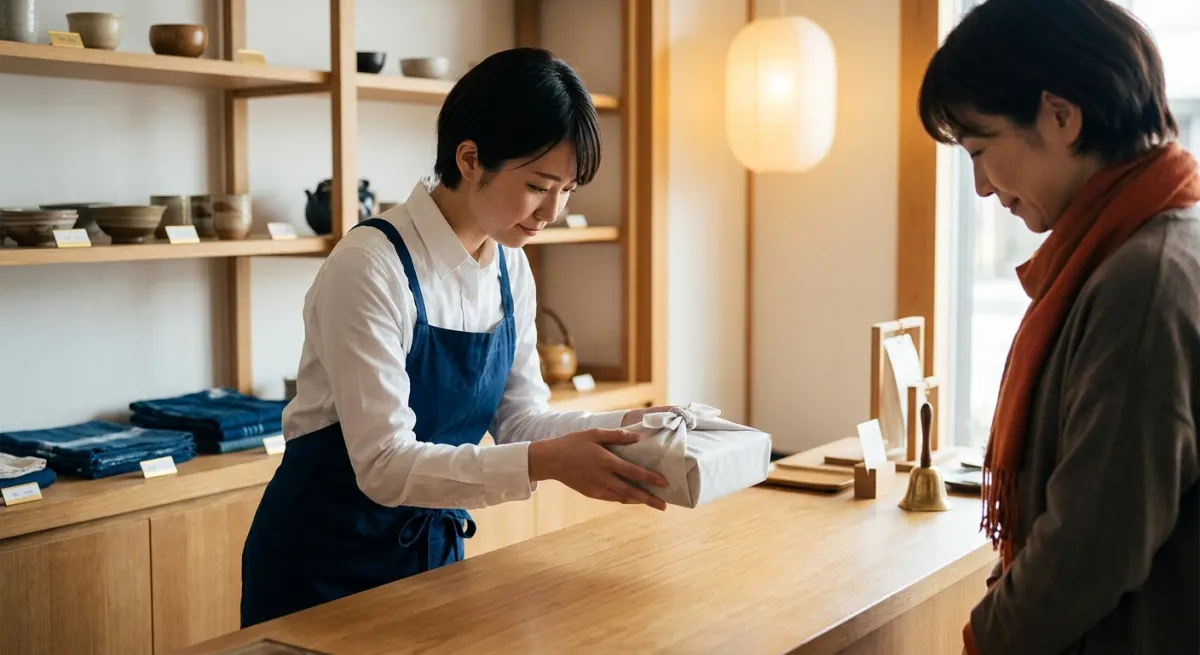
For a European company, that floor is the operative fact. The politeness of a convenience-store transaction, the wrapping, the precision of a delivery window, the way a problem gets resolved without argument: these set a baseline expectation that your Japanese customers carry into every interaction with you, including business-to-business ones. You will be measured against it whether or not anyone says so out loud.
What is actually constructed: the eternal-essence story
So if the behaviour is real and the phrase is real, what exactly is off? The framing built on top of them. Specifically, the idea of omotenashi as a uniquely Japanese, timeless, almost spiritual essence of hospitality that no other culture can reach.
That framing is recent, and it is largely a branding artefact. The word omotenashi exploded into public use only after Christel Takigawa's "o-mo-te-na-shi" presentation to the International Olympic Committee in Buenos Aires in September 2013, part of the successful Tokyo 2020 bid. After that it became the de facto slogan for promoting Japanese tourism. Scholars who study it read the eternal-essence version as nation-branding rather than description: Ryoko Nishijima's 2017 UCLA anthropology dissertation analyses omotenashi as an "ardent discourse" freighted with national pride, closer to self-image than to a neutral account of how service actually works.
The distinction is practical, not academic. The behaviours are genuinely high and worth taking seriously. The story that they are an ancient soul unique to Japan is a modern marketing narrative, and treating it as literal truth is how outsiders end up mystifying something they should simply be preparing to meet. This is where the outsider stereotype does its damage: it turns a real, meetable standard into a mystical trait you assume you can never match. Respect the service bar. Hold the eternal-essence story at arm's length.
Kasuhara: why the bar is not softening
There is a development a careless reader could mistake for the service bar coming down. It is not. If anything it confirms how high the bar sits.
Kasuhara, a contraction of "customer harassment", is the Japanese term for customer behaviour that crosses from demanding into abusive: tirades, threats, humiliating staff, forced apologies, unreasonable demands. This is a domestic dynamic, Japanese customers invoking a Japanese phrase against Japanese staff, which is precisely the misuse Minami Haruo's family objected to. It has moved from a workplace grievance to a mainstream policy topic. Tokyo passed the first customer-harassment prevention ordinance by a Japanese prefecture in October 2024, and it came into force on 1 April 2025 as an awareness and prevention measure with no penalties. At the national level, an amendment making anti-harassment measures a mandatory employer duty was passed in June 2025 and is due to take effect around 1 October 2026.
Here is how to read it, and it matters that you read it correctly. You do not pass laws to protect staff from customers unless the expectation on staff is extraordinarily high to begin with. Legislation appears when a norm becomes strong enough to be weaponised: the very intensity of the service expectation is what makes "the customer is god" abusable, and what eventually forces a formal line between good service and abuse. The reforms manage the excess. They do not lower the norm. A shopfloor in Tokyo in 2026 is not less attentive than it was a decade ago; the country has simply started to say out loud that attentive does not mean limitless.
For a European company the signal is cultural, not a compliance checklist. The specifics of what any employer must do are a legal question for proper local advice; the cultural reading is the part that concerns your go-to-market. Japan is drawing a sharper line between the service you should expect to receive as a customer and the treatment staff are entitled to as workers. Read it as evidence that the service standard is taken seriously enough to defend by law, and calibrate how you behave as a client in the market accordingly.
What this means if you sell to or operate in Japan
Three things follow for a European SME selling into or operating in Japan.
First, the service bar is real and you have to meet it. This is not about performing an exotic ritual. It is about reliability, precision, and follow-through at a level European business-to-business habits do not always reach: reply speed, accuracy of documentation, keeping to the delivery window, handling a complaint without defensiveness. Your Japanese customer's baseline was set by the market around them. Meet it as an operating standard, not a charm offensive.
Second, knowing the phrase's honest provenance makes you the credible one in the room, and it stops you essentialising the market. When someone reaches for the phrase as proof that customer-worship is baked into the Japanese soul, being able to note lightly that the line comes from a 1961 Minami Haruo stage act about an audience, not from ancient retail scripture, signals that you have done more than skim a listicle. It also keeps you from a strategic error: treating a real, meetable service standard as a mystical trait you could never reach.
Third, read the kasuhara shift as a rising standard, not a falling one. If you conclude that Japan is relaxing its service culture, you will misjudge the market. The bar is being defended, not lowered. The customer is not god. The customer is, however, operating inside a service culture that is unusually high, increasingly self-aware, and worth respecting on its actual terms rather than through a phrase Japan itself half-remembers.
Get the phrase right and you get the market right: not a mystical hierarchy with the customer on top, but a real, high, deliberate service standard, one that Japan sometimes mislabels and a well-run European company can absolutely meet, once it stops essentialising the slogan and starts reading the reality.
Sources
- Origin and meaning of the phrase. The official Minami Haruo site carries a standing page dating okyakusama wa kamisama desu to a 1961 stage moment and explaining the performer-to-audience, "as if in sacred prayer" meaning. The family's rejection of the retail reading, via daughter Minami Miyuki, is reported by Bengo4.com News (2024) and Oricon News (2024). Unseen Japan gives an English-language account of the origin and the misappropriation.
- The omotenashi framing as recent construct. The popular explosion of the word traces to Christel Takigawa's "o-mo-te-na-shi" presentation at the September 2013 IOC session for the Tokyo 2020 bid. Ryoko Nishijima, "Aporia of Omotenashi: Hospitality in Post-Oriental and Post-Imperial Japan" (UCLA anthropology dissertation, 2017), documents that surge and reads omotenashi as an "ardent discourse" of national pride rather than a neutral description of practice.
- Kasuhara reforms. The Japan Times on Tokyo passing the nation's first customer-harassment ordinance (October 2024, in force 1 April 2025, no penalties). Nippon.com on the national policy trajectory and union survey evidence, and the Government of Japan Public Relations Office on the customer-harassment employer duty from October 2026.
Related Resources
- Honne and Tatemae: Reading What Japanese Partners Actually Mean, how to read the gap between the public position and the real one
- Silent Churn: Why Japanese Customers Leave Without Complaining, the retention side of the same high service expectation
- Marketing in Japan: A Practical Guide for European Companies, the broader market context for positioning and go-to-market
- Cross-Cultural Communication Training, Silkdrive's approach to bridging expectation gaps across cultures
- Training Programmes, structured preparation for teams working with Japanese partners and customers
- Expert Network, connect with Japan market specialists for hands-on guidance
Stay Ahead in Cross-Cultural Marketing
Get monthly insights on international growth strategies, cultural intelligence, and digital marketing trends delivered to your inbox.
We respect your privacy. Unsubscribe at any time.