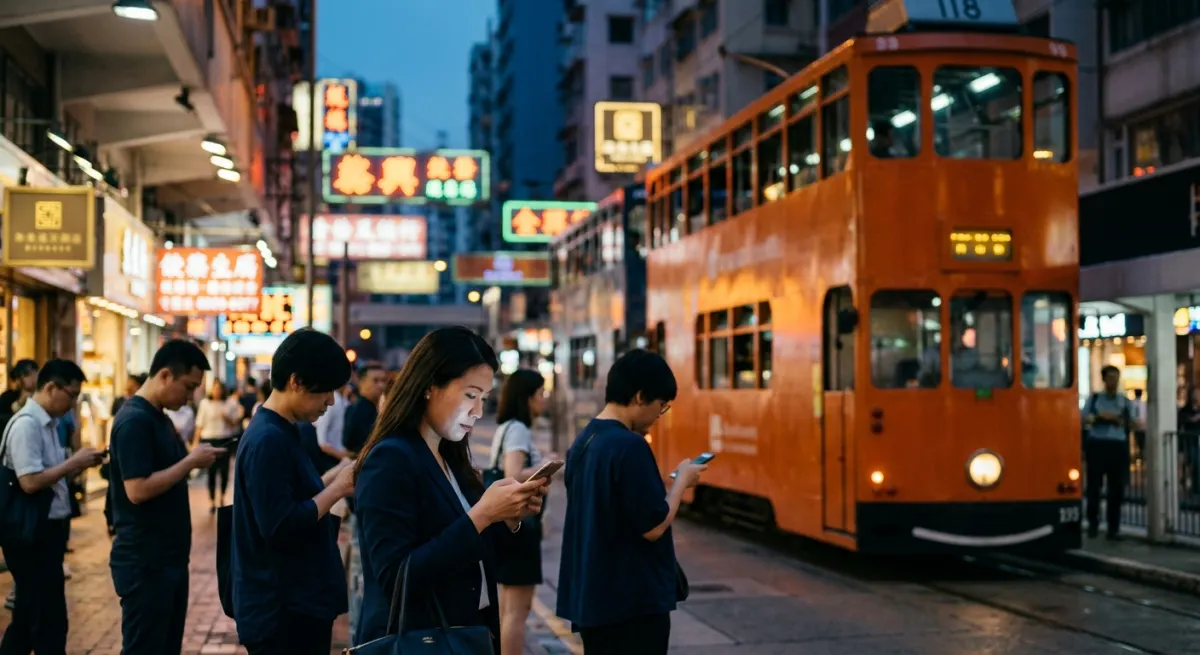
Hong Kong Social Media Statistics 2026: LinkedIn at 56.8%
Hong Kong runs Western platforms alongside WeChat, and LinkedIn reaches 56.8%. How to plan for a genuine East-meets-West market.
Part of our Search & AEO series. Start with the full guide: Search Marketing in Japan: Ranking Is Now Only Half the Job
- 6.24 million social media user identities in Hong Kong (DataReportal Digital 2026, 84.4% of the population); 7.16 million internet users at 96.8% penetration
- Hong Kong is a rare East-meets-West market: Western platforms (YouTube, Facebook, Instagram) run alongside WeChat, so both a global and a mainland-facing plan work
- LinkedIn reach is unusually high at 4.20 million (56.8%), reflecting Hong Kong's role as a finance and professional-services hub (DataReportal Digital 2026: Hong Kong)
- WhatsApp is the dominant messenger, with WeChat important for reaching mainland Chinese visitors and business, a dual-track messaging reality
- YouTube leads at 6.24 million (84.4%); Facebook 4.70 million (63.6%); Instagram 4.05 million (54.8%) (DataReportal Digital 2026)
If you are planning a marketing campaign into Hong Kong, it is one of the most useful markets in the region to understand, because it is genuinely dual-natured. The global platforms you know run freely here, and WeChat and mainland tactics run alongside them. This page collects the current social media usage numbers for Hong Kong into one cite-ready reference, with the source named for every figure.
The data is drawn from DataReportal's Digital 2026: Hong Kong report (the We Are Social / Meltwater / Kepios dataset, based on late-2025 data)1. Where platform numbers are based on advertising-audience reach rather than a company's reported active users, that is the standard methodology for these reports, and we flag which source each figure comes from.
Hong Kong is where the Western internet and the Chinese internet meet: YouTube and Facebook run freely, WeChat runs alongside, and LinkedIn reaches over half the population. Few markets need both playbooks at once.
How to cite this page
If you use these figures, please attribute them to the underlying source with a link:
Source: Silkdrive, Social Media in Hong Kong: Usage Statistics (2026), https://www.silkdrive.com/insights/hong-kong-social-media-statistics (compiled from DataReportal Digital 2026: Hong Kong)
Each statistic below also names its own source so you can trace it to the primary record.
The headline numbers
| Metric | Figure | Source |
|---|---|---|
| Population | 7.40 million | DataReportal, Digital 2026: Hong Kong |
| Internet users | 7.16 million (96.8% penetration) | DataReportal, Digital 2026: Hong Kong |
| Social media user identities | 6.24 million (84.4% of population) | DataReportal, Digital 2026: Hong Kong |
| Mobile connections | 20.9 million (283% of population) | DataReportal, Digital 2026: Hong Kong |
Platform by platform
| Platform | Users in Hong Kong | Reach | Source |
|---|---|---|---|
| YouTube | 6.24 million | 84.4% | DataReportal, Digital 2026: Hong Kong |
| 4.70 million | 63.6% | DataReportal, Digital 2026: Hong Kong | |
| 4.20 million | 56.8% | DataReportal, Digital 2026: Hong Kong | |
| 4.05 million | 54.8% | DataReportal, Digital 2026: Hong Kong | |
| 3.35 million | 45.3% | DataReportal, Digital 2026: Hong Kong | |
| Messenger | 1.85 million | 25.0% | DataReportal, Digital 2026: Hong Kong |
| Threads | 1.55 million | 21.0% | DataReportal, Digital 2026: Hong Kong |
Platform figures are advertising-audience reach as compiled by DataReportal / Kepios for Digital 2026: Hong Kong. WhatsApp and WeChat, the leading messengers, are not in the advertising-reach dataset; their roles are described below. (The report's raw X/Twitter figure exceeded the population and is a known data anomaly, so it is omitted here.)
What makes Hong Kong different

The global internet works here. Unlike mainland China, Hong Kong uses YouTube, Facebook, Instagram, and WhatsApp freely. A brand can run a recognisably global social plan and reach most of the market.
WeChat runs alongside it. For reaching mainland Chinese visitors, cross-border shoppers, and business partners, WeChat is essential, including for payments. Many Hong Kong brands maintain both a WhatsApp presence for locals and a WeChat presence for the mainland-facing audience.
LinkedIn is a serious channel. At 56.8% of the population, LinkedIn reach is far above regional norms, a direct reflection of Hong Kong's finance and professional-services economy. For B2B and recruitment, it is a primary channel, not an afterthought.
Bilingual and compact. The audience moves between Cantonese and English, and the market is small and dense, which rewards precise, well-crafted campaigns over broad-reach spending.
What the platform mix means for marketing
- 1
Run a dual-track plan
Global platforms (YouTube, Facebook, Instagram, WhatsApp) for the local and expat audience; WeChat and mainland tactics for cross-border reach. Decide early which audience each campaign is for.
- 2
Take LinkedIn seriously for B2B
With over half the population on LinkedIn, professional and financial-services marketing works here in a way it does not elsewhere in Asia.
- 3
Bilingual creative, done properly
Cantonese and English coexist. Match the language to the audience and context rather than defaulting to one, and avoid machine-translated copy.
- 4
WhatsApp for direct and service
As the default messenger, WhatsApp is a strong channel for customer service, bookings, and direct relationships with local customers.
The cultural layer
Hong Kong is international and Westernised on the surface, but it remains a high-context, relationship-oriented Chinese culture underneath, especially in business. Marieke de Mooij's cross-cultural work is a useful guide: high-context markets favour more symbolic and relationship-led creative over the literal, benefit-first style of low-context markets, and social proof and in-group trust carry heavy weight2. For the mainland-facing side of a Hong Kong plan, the same adaptation that applies to China applies here: face, relationships (guanxi), and visible social endorsement shape decisions more than a direct sales pitch.
Related references
Part of a set of East-Asia social-media references built the same way: Social Media in Japan, South Korea, Taiwan, and China. For the wider corridor picture, see the EU-Japan and Netherlands-Japan business statistics reference.
These are public, verifiable sources. Figures are point-in-time and refreshed on the DataReportal annual cycle.
References
-
DataReportal, Digital 2026: Hong Kong (We Are Social / Meltwater / Kepios), published November 2025, based on late-2025 data. Platform numbers are advertising-audience reach as compiled in that report. WhatsApp and WeChat, the leading messengers, are not in the advertising-reach dataset; their roles are described from well-established market knowledge. The report's X/Twitter figure exceeded 100% of the population (a known reporting anomaly from multiple accounts) and is omitted. ↩
-
Cultural creative adaptation: Marieke de Mooij, Global Marketing and Advertising: Understanding Cultural Paradoxes (high-/low-context creative direction; relationship and social-proof effects). Underlying dimension research is Hall (high-/low-context) and Hofstede. ↩
Stay Ahead in Cross-Cultural Marketing
Get monthly insights on international growth strategies, cultural intelligence, and digital marketing trends delivered to your inbox.
We respect your privacy. Unsubscribe at any time.