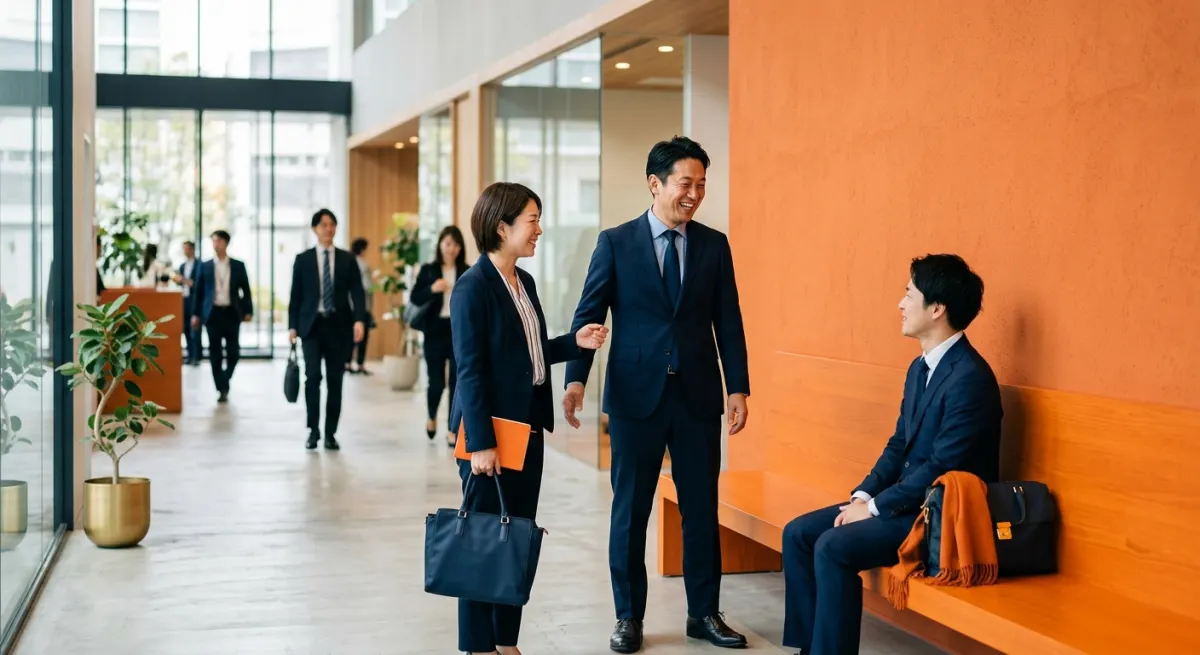
Japanese Business Culture: A Working Guide for Europeans
How Japanese business culture actually works, hierarchy, nemawashi, ringi, wa, and the specific operating differences European companies need to understand before engaging with Japan.
- Japanese business culture operates on three layers: work culture (hierarchy, decision flow), business etiquette (visible protocols), and cultural concepts (nemawashi, ringi, wa) that govern how decisions actually get made
- Decisions are made before meetings, not in meetings, through informal one-on-one consultation (nemawashi) followed by formal document circulation (ringi)
- The Hofstede masculinity gap between Japan (95) and the Netherlands (14) is the widest of any EU-Japan bilateral pair, Dutch directness needs deliberate translation
- The NL↔Japan corridor has $190B+ combined FDI stock, making the Netherlands the #1 EU investor in Japan and Japan's #1 European investment destination
- European executives over-invest in etiquette (Layer 2) and under-invest in cultural concepts (Layer 3), this guide weights toward the layers that determine whether partnerships last
European companies that struggle in Japan rarely struggle because Japan is exotic. They struggle because they assume their existing operating model, fast decisions, direct feedback, individual accountability, hire-fire fluency, will translate. It does not translate. Japanese business culture is internally coherent and operationally efficient on its own terms, but those terms are different in specific, identifiable ways that compound over the lifetime of a relationship.
This is the working guide we hand to European leadership teams before they take a Japan posting, sign a Japanese partnership, or attempt a market entry from headquarters in Amsterdam, Frankfurt, or Brussels. It is structured around four areas that produce the most expensive misunderstandings: how work itself is organised, how meetings actually function, the cultural concepts that govern decisions, and how all of this intersects with European management defaults.
It is opinionated. After eight years of cross-cultural growth marketing work between the EU and Japan, and through work delivered as an EU-Japan Centre for Industrial Cooperation expert, we have seen the same patterns repeat across food, tech, professional services, manufacturing, and consumer goods. The specifics differ. The cultural failure modes do not.
What "Japanese business culture" actually refers to
The phrase covers three different layers, and treating them as one is the first mistake.
Layer 1, work culture. How time, hierarchy, communication, and authority are organised inside a Japanese company. This shapes daily operations: how a deadline is communicated, what a meeting is for, how decisions are escalated, what counts as good performance.
Layer 2, business etiquette. Visible behavioural norms during external interactions. Greetings, business cards, gift-giving, dining protocol, written correspondence. These are the things books and language schools teach, and they matter, but they are not the substance.
Layer 3, cultural concepts that govern decisions. A small set of operating principles, nemawashi, ringi, wa, honne-tatemae, uchi-soto, that explain why Japanese organisations behave the way they do. They are the load-bearing logic.
European executives tend to over-invest in Layer 2 (which is the easiest to study) and under-invest in Layer 1 and Layer 3 (which is what determines whether a partnership lasts past the second year). The material below is weighted toward Layers 1 and 3 because that is where the real advantage sits.
Japanese work culture: how the organisation actually operates

A Japanese company is a slower, more consensus-driven organism than its European counterpart on most decisions, and a faster one on others. Knowing which is which is the difference between productive partnership and a stalled project.
Hierarchy is structural, not symbolic
In a typical European management culture, hierarchy is a reporting line. Decisions can move horizontally between peers, escalate by exception, and individual contributors are expected to bring opinions upward. In a Japanese company, hierarchy is structural: it organises who can speak in what order, whose endorsement is required, and which documents pass through which desks before a decision is sealed. The seniority signal, senpai-kohai, age, tenure, role, is the protocol by which the system functions.
This has practical consequences. A junior counterpart in a Japanese organisation cannot agree to a price change in a meeting, even if that person is the one running the project, because the agreement is not theirs to make. Pressing them to commit anyway asks them to violate the protocol that keeps their organisation coherent. They will refuse politely (more on that below) and the deal will erode rather than progress.
The role of the meeting is to confirm, not to decide
This is the single largest operational difference. In most European meetings, decisions get made in the room. Disagreement is voiced; positions are debated; the senior person calls it. In most Japanese meetings, the decision has already been made, usually informally, through a process called nemawashi (literally "going around the roots"), and the meeting exists to formally confirm it.
If you walk into a Japanese meeting expecting to negotiate the outcome, you will find a room that appears polite, attentive, slightly opaque, and almost impossible to actually move. That is because the moveable part already happened, last week, in one-on-ones, over lunch, in a deputy director's office. By the time you are in the formal meeting, you are presenting the agreed answer, not finding it. (For a deeper treatment, see our work culture cluster page →.)
Working hours and the long arc
The cliché of Japanese overwork is partly outdated. Government reform from 2018 onwards capped overtime, and younger employees' expectations have shifted, particularly in international firms and the Tokyo tech sector. But the underlying logic, that visible commitment matters, that arriving last and leaving first signals lack of engagement, that the team's rhythm sets the individual's, remains. Working hours map to a longer organisational arc: the assumption that this employee, this partner, this customer will be in the system for years, and the rate of return on relationship investment is annual, not quarterly.
For European partners, this changes how you scope effort. A two-quarter market test that European leadership treats as decisive will look like a flicker to a Japanese partner. They are calibrating you on a five-year curve.
Communication: high-context, low-volume, asymmetric
Japanese workplace communication runs at lower verbal volume and higher information density than most European equivalents. Subordinates do not contradict superiors directly. Disagreement is signalled through pause, qualification ("we will study this"), or third-party feedback. The cultural model is honne (the real opinion) versus tatemae (the public-facing position), which works as social lubrication that allows the group to function without open conflict.
A European who reads only the tatemae and not the honne will leave meetings believing things are agreed when they are not. The first six months of any Japan engagement are spent calibrating this gap. Direct feedback from Japanese counterparts is rare; absence of feedback is data; small shifts in delivery (slightly later replies, slightly shorter emails) are data; and the most important signals come from who attends the next meeting rather than from what is said.
Reading these signals is a trained skill. (See our cross-cultural training programs for Japan →)
Japanese business etiquette: the visible layer
Etiquette is real, but its weight is signalling, not gatekeeping. A European who fumbles a business card exchange but otherwise demonstrates careful preparation, deference, and patience will be treated kindly. A European who executes the etiquette flawlessly but pushes for a same-day decision will not.
That said, the protocols are tight enough that getting them visibly wrong telegraphs to the Japanese side that the European has not bothered to prepare, which is its own signal.
The first meeting
The first meeting is heavily ritualised because it is the moment relationship infrastructure gets installed. The opening exchange of meishi (business cards) is the moment each person learns the other's full title and seniority and stores that in working memory for the rest of the conversation. Cards are received with two hands, read carefully, placed on the table in seating order, and never written on or folded.
The seating itself encodes hierarchy. The most senior visitor sits furthest from the door (the kamiza, "upper seat"); the most junior host sits closest to the door (the shimoza). Improvisation here looks careless.
The opening twenty minutes are deliberately not about business. Weather, the visitor's flight, mutual introductions, observations about Tokyo or the visitor's home country. It is the period during which both sides are reading each other for cues about formality, character, and whether substantive conversation is appropriate. Cutting short this phase to "get to the agenda" is a recurring European mistake.
Gifts, dining, written correspondence
Gift-giving is contextual: small, well-presented, regionally specific gifts on first visits and after long absences are appreciated; conspicuously expensive gifts are uncomfortable and can read as bribes. Wrapping matters more than monetary value.
Business dining (nomikai) is a continuation of the relationship work, not a break from it. The hierarchy of the meeting is preserved at the table; you do not pour your own drink, you pour for the senior people present, and they pour for you. Significant strategic conversations happen at dinner, sometimes the conversations that the meeting could not hold. Skipping or shortening dinner because the European visitor is tired sends the wrong signal.
Written correspondence is more formal than European norms suggest. Email opens and closes follow conventions; first-name address is rare in business; speed of response matters less than evident care.
For the granular protocol, the seven-deep treatment of meishi exchange, gift-giving by occasion, dining hierarchy, written correspondence templates, see our business etiquette cluster →.
The concepts that actually run the system
If you internalise three concepts you understand 80% of why a Japanese organisation behaves the way it does. None of them are exotic. All of them have functional analogues in European business culture; they are simply far more central in Japan.
Nemawashi, preparing the ground
Nemawashi (root-binding, from gardening) is the informal one-on-one consultation that shapes a proposal and settles objections quietly, before anything is put to a group. The implication for a European partner is blunt: if your proposal has not been discussed individually with each Japanese stakeholder beforehand, you are not in the meeting that matters.
The full treatment is in Nemawashi: How Japanese Decision-Making Really Works.
Ringi, the document that records consensus
Ringi (or ringi-sho) is the formal companion to nemawashi: a document proposing a decision that is passed up through every level of relevant management, each stamping or signing it, until the whole chain of authority has approved. It explains both the long lead time on Japanese decisions and the fact that, once made, they are not reopened, which is why a partner who tries to renegotiate afterwards is treated as breaching the agreement.
The full treatment is in Ringi: The Japanese Approval Process, Explained.
Wa, group harmony as functional principle
Wa (often translated "harmony") is the cultural commitment to group cohesion over individual self-expression in a business setting. It runs deeper than simple conflict-aversion: the unit of analysis is the group, not the individual, and the cost of overt disagreement inside the group is measured in damage to the working relationship rather than just to the immediate position.
Practically: a Japanese counterpart will not openly disagree with a colleague in front of you; will not want to be put in a position where they have to. If you ask "do you agree with what your colleague just proposed?", you are asking them to publicly side with or against a teammate. They will deflect. The information you wanted is real, but you have to ask for it differently, privately, indirectly, or via a senior who can convene it without forcing positions.
These three concepts also map directly to honne-tatemae: the gap between the formally stated position and the underlying view. The group's tatemae is what gets said in the meeting; the operating honne is what nemawashi reveals to those who have access to it. The full treatment is in Honne and Tatemae: What Japanese Partners Really Mean, and the reporting rhythm that carries updates between all of them is in Horenso: The Japanese Reporting Cadence, Explained.
Hofstede applied to Japan vs Europe
Geert Hofstede's six cultural dimensions remain the most useful first-pass framework for comparing Japan with European business cultures. The numbers do not predict individual behaviour, but they explain group tendencies that European leadership teams keep encountering and misreading.
| Dimension | Japan | Netherlands | Germany | UK | What this predicts |
|---|---|---|---|---|---|
| Power distance | 54 | 38 | 35 | 35 | Japanese organisations expect more deference; flat-org European norms feel disrespectful |
| Individualism | 46 | 80 | 67 | 89 | Japan is collectivist relative to all major Western European cultures; loyalty runs to the group |
| Masculinity (achievement-orientation) | 95 | 14 | 66 | 66 | Japan tops the global ranking on this dimension; the Netherlands is at the opposite extreme |
| Uncertainty avoidance | 92 | 53 | 65 | 35 | Japanese organisations strongly prefer detailed plans, explicit roles, well-defined processes |
| Long-term orientation | 88 | 67 | 83 | 51 | Japan and Germany favour long-term thinking; UK skews short-term |
| Indulgence | 42 | 68 | 40 | 69 | Japan is restraint-leaning; expressions of personal enjoyment in business contexts feel out of place |
Source: Hofstede Insights country comparison, accessed 2026.
The most operationally important number for a Dutch company is the masculinity-femininity gap (95 vs 14). Almost no other bilateral pair has a larger spread on this dimension. Dutch business culture is uniquely consensus-oriented, egalitarian, comfortable with informal pushback, and oriented toward quality of life, the opposite end of the achievement/competition axis from Japan. Dutch directness reads to a Japanese counterpart as coldness or rudeness; Japanese reserve reads to a Dutch counterpart as evasiveness or disengagement. Both are misreadings of dimension scores that are simply far apart.
For German and British companies the gap is narrower but still significant on uncertainty avoidance and individualism, enough to produce friction on planning detail and team-vs-individual accountability.
Hofstede's framework is necessary but not sufficient. It explains the shape of the difference; it does not give you the operational protocols (those come from nemawashi, ringi, wa, and the etiquette layer). Use it as the orientation map; do not treat it as the playbook.
Two assumptions the research contradicts
Almost every European team we work with arrives carrying at least one of these, and both are wrong in ways that cost money.
"Japan is westernising, so this will converge." It is not converging, and planning on the assumption that it will is a slow, expensive error. Beugelsdijk, Maseland and van Hoorn (2015) found that while Japanese society is individualising in absolute terms, Japanese values are not converging on American values, and the relative gap between them is expected to persist. Absolute movement and relative convergence are different things, and conflating them is how a five-year market plan quietly assumes a change that will not arrive.
"Indirect communication means a slow, soft, low-performance culture." The GLOBE study contradicts this directly. Japan, alongside Korea, records high performance ethics and scores medium-to-high on performance orientation despite non-explicit communication norms (Javidan, 2004). Indirectness is a communication convention, not a statement about standards or urgency. European managers who read Japanese indirectness as a lack of drive consistently misjudge both the pace and the demands of their counterparts.
A third worth holding lightly, because it is qualitative rather than measured: Japanese business reasoning tends toward a holistic cause-and-effect model that admits many causes producing a joint effect, rather than the single-variable causal chain a European business case is usually built around. Edward Hall made the same observation about the intuitive rather than polar structure of Japanese thought (Hall, 1984). In practice this is why a European proposal built on one clean argument often lands as thin rather than focused.
What changes for Dutch and European companies specifically
Most cross-cultural Japan content treats the European side as if it were a US business. That conflation produces bad advice. The relationship between Japan and the European Union, and between Japan and the Netherlands specifically, has structural features that change the calibration of everything above.
The corridor is institutional. The Netherlands is the largest European investor in Japan and the historical European partner since 1609. Roughly 610 Japanese companies have a Dutch presence, and Dutch companies have an outsized presence in Japan relative to the country's population. This is not a cold market for either side. The infrastructure, chambers of commerce, Dutch and Japanese diplomatic presence, the EU-Japan Centre, JETRO Amsterdam, is mature. Use it. (See our Japan-Netherlands corridor analysis →).
The Economic Partnership Agreement (EPA, in force since 2019) shifts the trade calculation. Tariff reductions on Dutch agricultural products, dairy, and processed food; liberalisation of services; mutual recognition on certain professional qualifications. These changes alter market entry economics for specific sectors, but the cultural work above is unaffected by trade policy.
Dutch directness needs deliberate translation. The Dutch communication norm, direct, low-deference, comfortable with disagreement, pragmatic about hierarchy, is the European cultural extreme furthest from Japanese norms. German and Belgian directness is closer to a workable middle. Dutch leadership preparing for Japan engagement should expect more re-tooling than they assume going in. The reason is the width of the gap, not any flaw in Dutch culture.
Long-term orientation is shared. Japan (88) and Germany (83), and to a lesser extent the Netherlands (67), all score high on long-term orientation. This is the dimension where European companies often have the easiest time aligning with Japanese counterparts: both sides understand that this is a multi-year project. The friction lives elsewhere.
Common European mistakes (and the fixes)
Five patterns that produce avoidable damage in the first eighteen months of a Japan engagement, observed repeatedly across our client work and synthesised from EU-Japan Centre case material.
1. Treating the first quarter as decisive. A common European leadership instinct is to set Q1 milestones (signed LOI, identified distributor, first paying customer) and treat any slippage as a signal to question the whole investment. In Japan, Q1 is calibration. The Japanese side is reading you on professionalism, patience, and seriousness. Setting Q1 commercial milestones front-loads pressure that costs you the next eight quarters.
Fix: set Q1 milestones around relationship infrastructure (number of meetings, breadth of stakeholder coverage, depth of mutual understanding), not commercial output. Move commercial milestones to Q3+.
2. Sending a junior to "scope" the partnership. European companies sometimes send a director-level person to do reconnaissance before sending a senior. In Japan, the seniority of the first envoy is read as a signal of how seriously the European side takes the relationship. A director-only first visit can be a permanent ceiling on the meeting's seniority, the Japanese side will mirror, and the relationship gets stuck at that altitude.
Fix: C-level on the first visit, even if briefly. This opens up Japanese senior engagement that is hard to retrofit later.
3. Asking for direct feedback in the room. "What do you think? Do you see any problems?" produces tatemae answers ("we will study"). This is the only acceptable response in the meeting format.
Fix: gather feedback through nemawashi, one-on-ones, lunches, side-channels. Ask questions that do not require public position-taking.
4. Hiring the wrong first Japan employee. A common error is to hire a fluent-English Japanese hire who can communicate easily with European HQ. This often filters for the personality least connected to traditional Japanese networks, which is exactly the network the company needs. The hire is comfortable for HQ and isolated in Japan.
Fix: hire for connectedness in the Japanese market first, English fluency second. Bridge to HQ via interpretation and longer reporting cycles, not via the new hire's personality fit.
5. Using a US Japan playbook. Many cross-cultural Japan resources are written from a US perspective: US business norms as the baseline, Japan as the exotic counterparty. For a European company, the contrast is different, particularly for Dutch, Scandinavian, and German firms, where the cultural distance to Japan runs through different dimensions than the US-Japan distance does.
Fix: use European-perspective material and advisors. The EU-Japan Centre's webinar archive (the source material this guide draws from) is one of the few repositories of European-framed practitioner knowledge on this; we extract the patterns into operational frameworks for our client engagements.
Where to go from here
That is the orientation. If you want it delivered to a team rather than read, that is what our cross-cultural training for Japan and Japan business culture training programmes do, and the commercial side sits with our cross-cultural marketing agency work.
The operational depth lives in the deeper guides.
- Japanese business etiquette: the working protocols →
- Japanese work culture: hierarchy, hours, decision flow →
- Nemawashi: how Japanese companies actually make decisions →
- Ringi: the Japanese internal approval process →
- Honne and tatemae: reading what is actually meant →
Eight single-concept reference pages cover the vocabulary in one page each, short enough to hand to a colleague before a first meeting.
- Meishi: the Japanese business card exchange, explained →
- Uchi and soto: the Japanese in-group boundary →
- Omotenashi: Japanese hospitality as a service standard →
- Amae: the Japanese concept of dependency, and its limits →
- Aizuchi: why a Japanese listener keeps nodding →
- Chinmoku: how silence works in a Japanese meeting →
- Hanko: why Japan signs with a seal →
- Giri: the Japanese ledger of obligation →
If you are preparing a team or an individual leader for Japan engagement, the next step is structured training. We design and run cross-cultural training programmes for European companies engaging with Japan, built around the European-side starting point, not a US-baseline playbook.
→ See our cross-cultural training for Japan → → Browse our directory of vetted Japan-cross-cultural training providers →
Further reading
For European executives who want to go deeper before training, the EU-Japan Centre for Industrial Cooperation maintains a public library of practitioner webinars and publications. Selected sources we draw on most heavily:
- Glisby, M. (2022). Cross-Cultural webinar series, parts 1–5: communication, decision-making, trust, strategy, virtual communication. EU-Japan Centre.
- Part 1. Communicating effectively →
- Part 2. Influencing decision-making →
- Part 3. Trust & networking →
- Part 4. Aligning strategy →
- Part 5. Virtual communication →
- Glisby, M. (2023). Rethinking strategy for Japan. EU-Japan Centre.
- Kessel, P. van. (2018). Cross-cultural issues webinar series, parts 1–4.
- Part 1. Getting in touch →
- Part 2. A first encounter →
- Part 3. Following up & sustaining →
- Part 4. Negotiations & closing →
- Jackson, K. (2019). Cross-cultural issues webinar series.
- Organising a business trip to Japan →
- Following up on a business trip →
- Hosting a Japanese business delegation →
- EU-Japan Centre (2024). Building a Professional Network in Japan. →
- Hofstede Insights. Country Comparison Tool →
- JETRO. Doing Business in Japan →
Related Resources
- Nemawashi: How Japanese Companies Actually Make Decisions, a close look at the informal consensus-building process
- Ringi: How Japanese Companies Approve Proposals, the formal documentation step that follows nemawashi
- The Complete Guide to Japan Market Entry for European Companies, full EU-Japan entry framework
- The Real Cost of Entering the Japanese Market, budget reality for European companies
- The Netherlands-Japan Business Corridor, bilateral relationship in numbers
- International Business Expansion: A Strategic Guide, broader cross-border expansion playbook
- Hofstede's Cultural Dimensions Applied to Digital Marketing, the framework underlying every cultural friction point
- EU-Asia Communication Mistakes That Kill Business Deals, operational examples of the patterns described here
- The EU-Japan EPA: A Marketer's Guide, trade-policy context that shapes the commercial side of the cultural reality
Last updated: 2026-04-26.
Stay Ahead in Cross-Cultural Marketing
Get monthly insights on international growth strategies, cultural intelligence, and digital marketing trends delivered to your inbox.
We respect your privacy. Unsubscribe at any time.