Japanese Business Etiquette: The Manners and Protocol That Matter
Japanese business etiquette protocol by protocol: greetings and bows, meishi exchange, meeting seating, gifts, dining, correspondence, and dress, with an EU-country delta table for Dutch, German, French, and UK executives.
Part of our Cross-Cultural Leadership series. Start with the full guide: Japanese Business Culture: A Working Guide for Europeans
- Japanese business etiquette is the protocol system through which counterparts read how much preparation you invested, and it rests on hierarchy: respect derives primarily from age, status, and rank
- The meishi (business card) exchange is where relative status gets established; the higher-level people exchange first, and titles are checked on the spot (JETRO)
- Seating is not arbitrary; each seat in a Japanese meeting room is assigned by the occupant's rank and experience in the firm (Routledge Handbook of Japanese Business and Management, 2016)
- Gift-giving is prescribed behaviour rather than a nicety, and gift choice varies by season and purpose, with Ochugen and Oseibo the two formal seasons
- The size of the adjustment differs by European baseline: on Hofstede's masculinity dimension the Netherlands sits 81 points from Japan, France 52, Germany and the UK 29
Japanese business etiquette is the protocol system, greetings, meishi exchange, seating order, gifts, dining, and correspondence, through which Japanese counterparts read how seriously you take a relationship. It rests on hierarchy: respect derives primarily from age, status, and rank (Katz, Negotiating International Business: Japan, 2008).1 Protocol errors are forgiven; the carelessness behind them is not.
Most articles on the subject read like travel guides. Bow at the right angle. Do not stand your chopsticks upright in rice. Hand over your card with two hands. The advice is accurate and the mechanics are covered below, but the mechanics are not what decides the meeting.
A European executive who fumbles the card exchange but has studied the company, brought the right level of seniority into the room, and does not push for a decision will be treated with patience. One who executes every protocol flawlessly and then asks for a signed contract by Friday will not get a second meeting.
What is Japanese business etiquette, and why does it decide outcomes?
It is an information-gathering system rather than social lubrication. In most European business cultures etiquette makes interactions pleasant but rarely changes the verdict; a Dutch executive who skips small talk and opens with pricing is abrupt, and the proposal is still judged on its merits. Japan works differently.
When a Japanese executive watches you enter, exchange cards, choose a seat, and handle the first twenty minutes, they are reading three things:
- Do you know who is senior? Handing your card to the wrong person first suggests you did not research the attendees.
- Do you understand the meeting structure? Jumping to your pitch before the introductory formalities are complete suggests you do not know how Japanese meetings work.
- Are you patient? Filling every silence or pressing for commitments signals that you are not prepared for the timeline Japanese decisions require.
The etiquette itself is forgivable. Minor errors with card handling, seating, or bow depth are expected from foreign visitors and are met with quiet helpfulness. What is not easily forgiven is the attitude those errors reveal when they come from carelessness rather than unfamiliarity, and Japanese professionals are skilled at reading the difference.
How should you greet Japanese counterparts: bow or handshake?
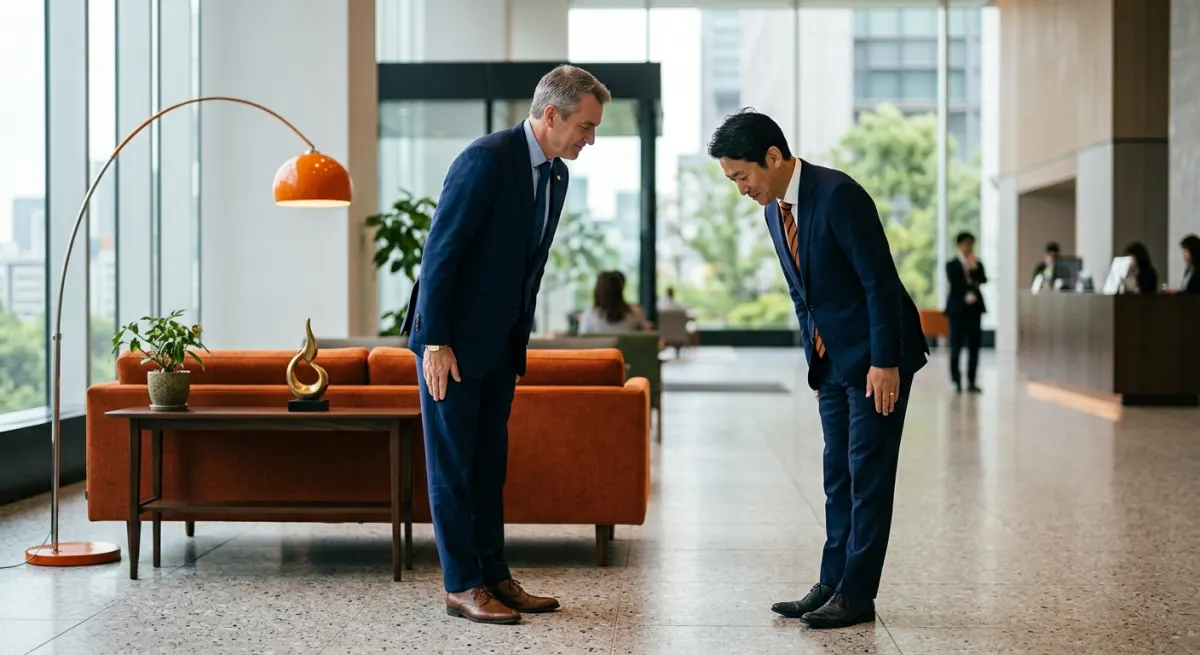
Either, and usually both. Japanese professionals who deal with Europeans will often offer a handshake, sometimes with a slight bow attached, so you rarely need to perform a formal bow. Reciprocate with a modest nod or slight bow of the head when you greet, thank, or leave. Do not attempt deep formal bows you are unsure of.
Bow depth is itself a status signal: when Japanese bow to each other, the person of lower status bows more deeply (JETRO, Communicating with Japanese in Business, 1999).2 That is the reason an over-deep bow from a visiting managing director reads as odd rather than respectful, and why a sincere, modest acknowledgement is the safer default.
What matters far more than the gesture is the order and the clock. Greet the most senior person on the Japanese side first, and arrive five minutes early. Being two minutes late without advance notice is one of the few etiquette failures that is not easily forgiven, because it reads as carelessness rather than unfamiliarity. If circumstances make you late, call ahead immediately.
The opening sequence of a Japanese first meeting runs roughly like this: you are escorted in and offered tea (accept it); you stand when the delegation enters, and the most senior person often enters last; cards are exchanged; everyone is seated by hierarchy; each side gives a short jikoshoukai self-introduction covering company, role, and why you are here; and only then does the substantive discussion begin. If you are used to German, Dutch, or Scandinavian meetings where the deck appears within three minutes, recalibrate. Those first twenty minutes are the meeting.
How does the meishi (business card) exchange work?
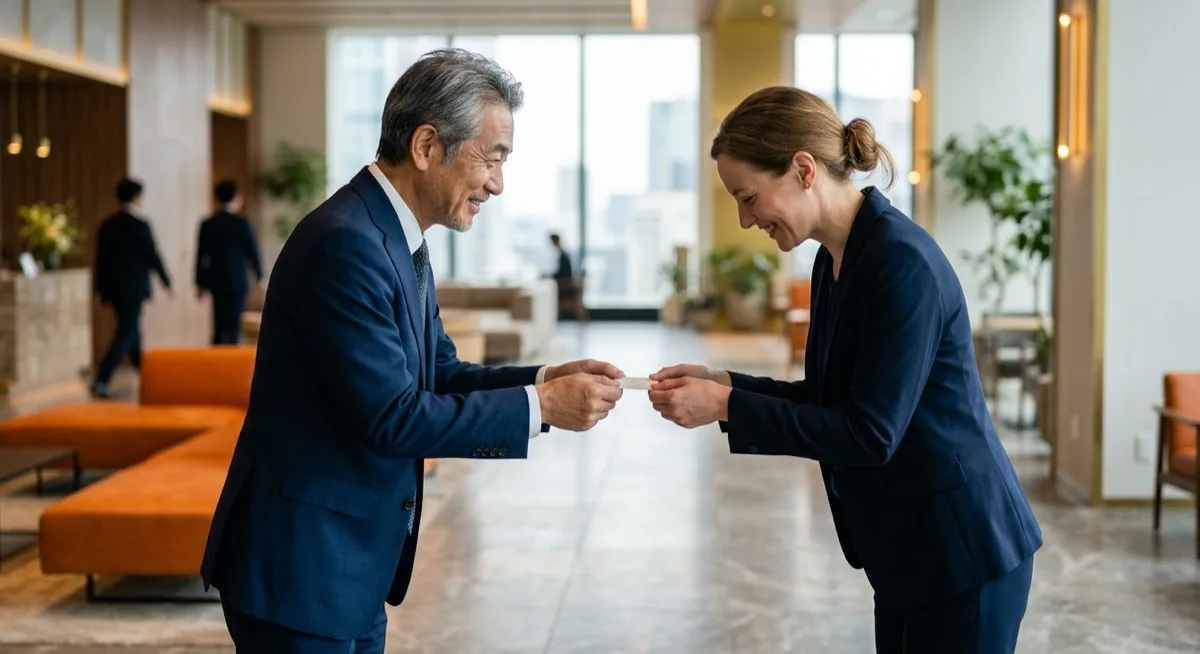
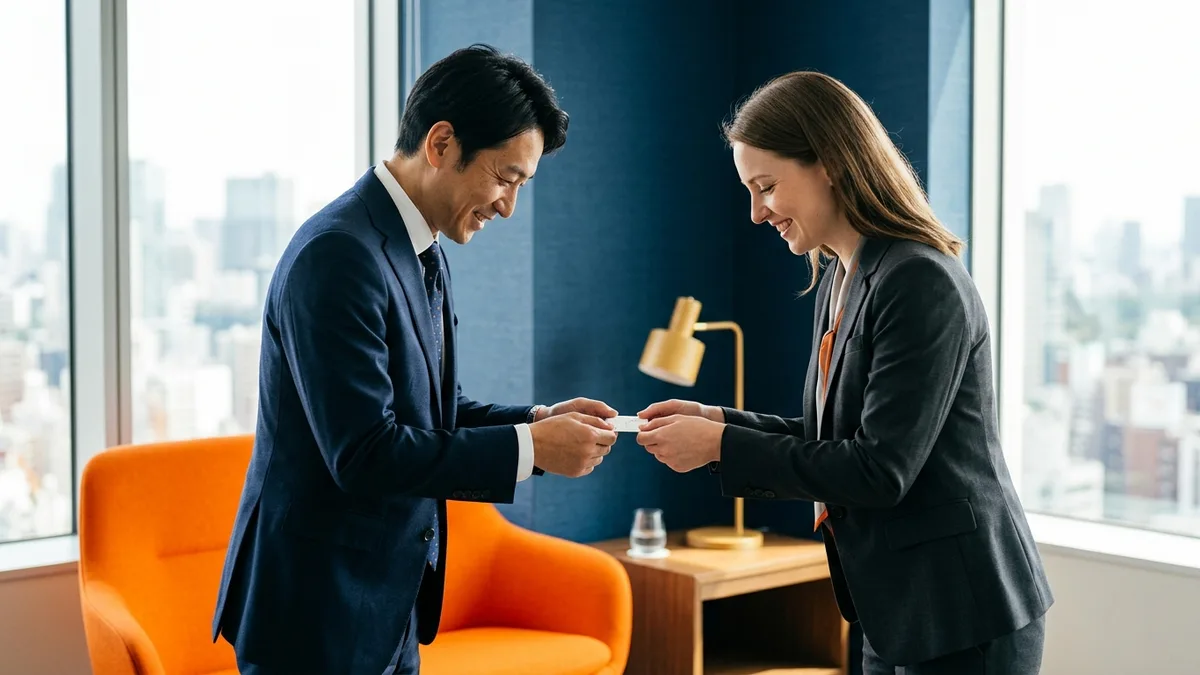
Cards are exchanged one at a time at the start of the meeting, and the higher-level people on each side exchange first; the title on a received card is checked to establish relative status (JETRO, 1999).2 That is the function the mechanics exist to serve. The card is an identity document for the meeting: it establishes your exact title, your department, where you sit in your company's hierarchy, and how you will be addressed for the rest of the conversation.
Preparation. Carry far more cards than you think you need; fifty for a two-day trip to Tokyo is not excessive. Print English on one side and Japanese on the other, on quality stock. Having the Japanese side ready before you arrive is itself a preparation signal.
The exchange.
- Stand and face the other person directly.
- Hold your card with both hands, Japanese side facing the recipient, readable from their perspective.
- Present with a slight bow. As the visitor, present yours first to the most senior person on the host side.
- Receive their card with both hands.
- Read it. Actually read it: name, title, department. Do not glance and pocket it.
- If you are unsure how to pronounce a name, ask. Asking signals consideration.
Afterwards. Place received cards on the table in front of you, arranged to mirror the seating positions opposite, with the most senior person's card at the top of the arrangement. They stay on the table for the duration of the meeting.
What not to do. Do not write on a card in front of its owner, do not slide cards across the table, do not fold or fidget with them, and do not push a card into a back pocket. The card stands in for the person.
Most European professionals treat business cards as a convenience, something handed over so the other side has your email. Treating one casually reads as treating the person casually. The good news is that Japanese counterparts do not expect a foreign visitor to execute the sequence perfectly. Two hands and a careful read carry most of the respect signal on their own.
Where do you sit in a Japanese meeting room?
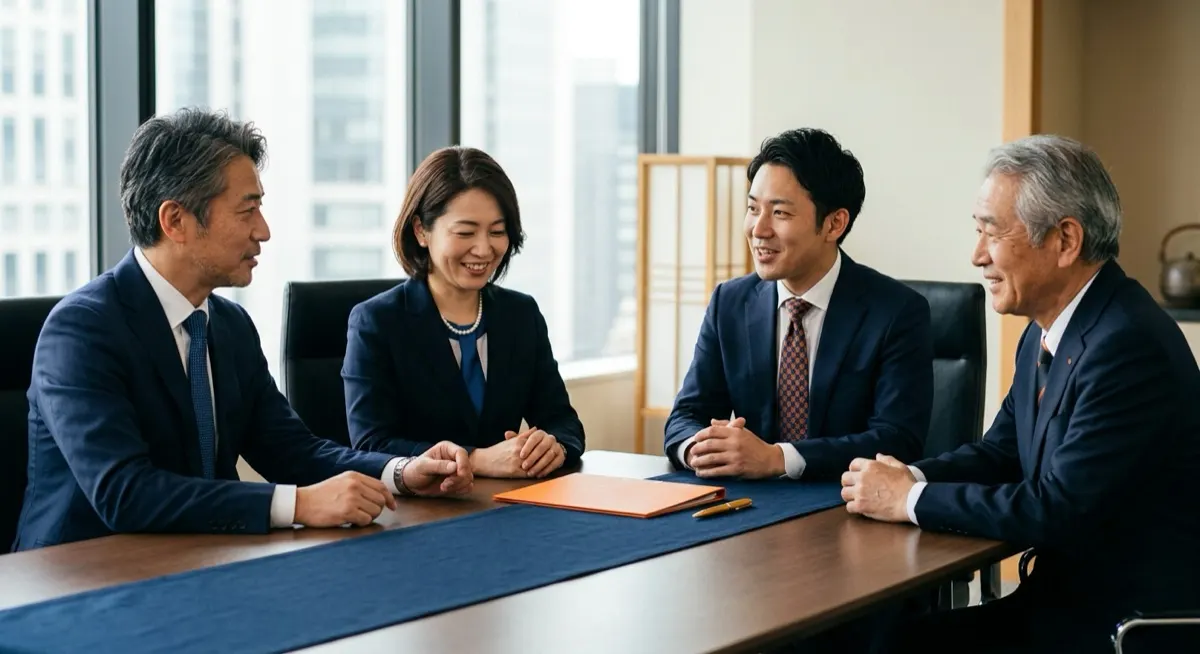
Not wherever is convenient. Each seat in a Japanese meeting room is assigned to a particular person, and it is chosen on the basis of that person's rank and experience in the firm (Routledge Handbook of Japanese Business and Management, 2016).3 Hierarchy is more visible in the seating plan than in almost anything else that happens in the room.
The rule is simple enough to memorise once and apply everywhere. The kamiza (上座), the upper seat, is furthest from the door and is the position of honour. The shimoza (下座), the lower seat, is closest to the door and is where the most junior person, or the host managing logistics, sits.
- The most senior visitor takes the kamiza.
- The most senior host sits across from them.
- Junior members on each side fill in toward the door.
- The host who pours tea, runs the projector, or takes notes sits nearest the door.
The same logic governs restaurants, taxis, and lifts: status sits furthest from the entrance. In practice your hosts will gesture you to the right seat, and accepting the direction gracefully is the whole skill. Where European visitors create awkwardness is by sitting in the shimoza out of false modesty and forcing a correction, or by a junior team member taking the kamiza because it looked comfortable. Neither causes lasting damage; both create a correction your hosts would rather not have to make.
Teams that will do this repeatedly, rather than once, tend to work through it as a group. That is the substance of our Japan business etiquette training, which rehearses the protocol against a team's own home-country defaults instead of teaching it as a list.
What gift should you bring, and what should you avoid?
Something regional, modest, and properly wrapped. Gift-giving is not optional politeness in Japan: custom prohibits arriving at an affiliate's home empty-handed, and bringing a gift is prescribed behaviour whose absence is often read as rude (Routledge Handbook of Japanese Business and Management, 2016).3 In a business setting the obligation is softer, but the underlying expectation is the same, and a first meeting, a milestone, or a first visit to someone's office all warrant one.
What to bring. Something from your home region: Dutch stroopwafels, Belgian or French chocolates, German confectionery, a small piece of Scandinavian design. Specificity beats expense. A EUR 15 to 40 regional specialty signals more thought than a EUR 100 generic item. Bring enough for the team, ideally individually wrapped so it can be shared, rather than a single gift for the most senior person.
How to present it. With both hands, at the beginning or end of the meeting, with a one-line explanation of what it is and where it is from. Do not oversell it and do not apologise for it.
What to avoid. Sets of four, because the number four (shi) sounds like the word for death. Anything that needs an explanation of why it is good. Anything expensive enough to create an uncomfortable obligation to reciprocate at equal value.
One thing European visitors rarely account for is the calendar. Gift choice in Japan varies by season and by purpose, and there are two traditional formal gift-giving seasons, Ochugen and Oseibo, whose function is to broaden and maintain relationships with the people in one's network (Routledge Handbook, 2016).3 Once a relationship is running, those are the two windows your Japanese counterpart is already planning around.
What are the rules for business dining and after hours?
Treat the dinner as part of the work, because it is. Business dining, particularly the nomikai drinking gathering, is a continuation of business by other means. Conversations the formal meeting room could not hold happen at the table, and honne, the real opinion, becomes more accessible than the tatemae position presented in formal settings. The distinction is not deception: the Japanese separate true feeling from what is appropriate to say publicly as a way of keeping the group functioning (JETRO, 1999).2
The working protocols are short:
- Accept the invitation. Declining after a meeting day signals disinterest. If you genuinely cannot attend, give a specific reason and propose an alternative.
- Pour for others before yourself, and keep an eye on the glasses around you. The reciprocal attention is the social mechanism of the evening.
- Wait for the toast. Do not drink before the senior person initiates the first kanpai.
- Follow the host on ordering. If asked for preferences, keep them simple.
- The inviting party pays. Offer once, then accept, and reciprocate by hosting next time.
- Seating still follows hierarchy. The most senior guest sits furthest from the door, exactly as in the meeting room.
European professionals who switch into purely social mode, talking about holidays and football without ever circling back to business themes, miss the part of the evening that was doing the work. The formal, host-paid version of this evening has its own name and its own norms, including how the practice is changing; we cover those in the guide to settai, nomikai, and Japanese business after hours.
How formal should email and written correspondence be?
More formal than most European professionals expect, and more prompt. Japanese business correspondence carries a fixed shape: the recipient's company, department, and full name with title; your own self-identification; a formulaic opening; the substance; a closing formula; and a full signature block with company, department, title, phone, and email.
Politeness in Japanese is a graded system rather than a tone of voice. Japan's 2007 Keigo Guidelines, issued by the Council for Cultural Affairs under the Agency for Cultural Affairs, classify honorific language into five categories, sonkeigo, kenjogo I, kenjogo II, teineigo, and bikago, refining the three-way division taught in schools.4 You are not expected to operate that system in Japanese. It is worth knowing it exists, because it explains why the register of a Japanese counterpart's correspondence is deliberate, and why matching the formality they set is a better instinct than matching the speed your own inbox rewards.
The conventions that matter in practice:
- Family name plus san in all correspondence until you are explicitly invited to do otherwise, which may never happen. "Tanaka-san" is safe.
- Reply promptly even without the answer. A brief acknowledgement with a date by which you will respond properly beats silence.
- Be specific about timelines. "Soon" creates anxiety; "by Friday 3 May" creates confidence.
- Avoid a casual tone. Exclamation marks, informal greetings, and emoji do not belong in initial business correspondence.
- CC deliberately. Japanese organisations often expect relevant stakeholders to be copied. If you are unsure who, ask your primary contact.
European email culture prizes speed, and a fast reply signals engagement. Japanese email culture prizes speed and precision together, so a fast reply carrying errors, gaps, or a casual register can work against you. The German executive who fires off a two-line answer in ten minutes may feel efficient; their counterpart may read the brevity as carelessness.
What should you wear to a Japanese business meeting?
Conservatively, and without personal signature. Rank in the Japanese business world is often indicated non-verbally, and the uniform-style way of dressing is one of the main carriers of that signal, alongside the frequent exchange of visiting cards; both let people establish rank at a glance (Norbury and Bownas, Business in Japan).5
The practical read for a visitor is that clothing does different work in the two settings. In Amsterdam or Milan an unusual jacket says something about you as an individual; in a Tokyo meeting room the dominant reading of dress is positional. A dark suit, a plain shirt, and quiet accessories keep the attention where you want it, which is on what you say and on the seniority you brought with you.
How much does this differ by European country?
Enough to change what you should practise. The protocol is fixed, but the distance you travel to reach it depends on where you start, and the clearest measure of that distance is Hofstede's masculinity dimension, on which Japan scores 95.6
| European baseline | Masculinity score (Japan: 95) | Distance from Japan | What the gap changes in the room |
|---|---|---|---|
| Netherlands | 14 | 81 points | The widest of the four. Dutch directness and flat-hierarchy instincts need deliberate translation: cushion disagreement, follow the rank order strictly, and expect the decision to be made outside the meeting. |
| France | 43 | 52 points | Relationship-building and comfort with formality transfer well. The adjustments are specific: drop the cheek-kiss greeting, and stop treating debate as a signal of engagement. |
| Germany | 66 | 29 points | Preparation, precision, and respect for hierarchy already align. The trap is Klartext plain-speaking: a flat "this will not work" lands as aggression. |
| United Kingdom | 66 | 29 points | Level with Germany here, but the furthest of the four on uncertainty avoidance (35 against Japan's 92) and the most individualist (89 against 46), which produces friction over planning detail and over team-versus-individual accountability. |
Masculinity, uncertainty avoidance, and individualism scores from the Hofstede Insights country comparison; the framework is Hofstede's.6 The Dutch, German, and French behavioural deltas are drawn from our element-by-element treatment in Japanese etiquette for European executives, which covers each baseline in detail.
Two cautions on reading a table like this. It describes group tendencies, not the person sitting across from you. And a short distance is not the same as an easy meeting: a German team starts closest on preparation and still has Klartext to solve, while a Dutch team that knows how far it has to move can make that move deliberately.
What do European companies get wrong most often?
Five patterns account for most of the avoidable damage, and none of them is about bow depth.
1. Sending the wrong level of seniority. If the Japanese side fields a director and two managers and you send three junior sales representatives, the message received is that you do not consider the relationship important enough to commit decision-makers. Confirm who will attend in advance and match your delegation. Title equivalence is not straightforward between European and Japanese structures, so ask your local contact. Also mind the calendar: avoid proposing dates inside the three major closure seasons, New Year, Golden Week, and Obon, when many businesses close or run light.7
2. Treating the first meeting as a sales pitch. A 40-slide deck and closing questions create discomfort, because the Japanese side is evaluating whether they want a relationship with your company before they evaluate your product. Prepare a five to ten minute company introduction, explain why you are interested in working with them specifically, and spend most of the meeting listening.
3. Pushing for a decision in the room. Japanese organisations decide through consensus built before the meeting, so the person across from you almost certainly cannot say yes, regardless of rank. End by summarising what was discussed, confirming next steps, and asking when you might hear back. A timeline that feels long by European standards usually means the proposal is being circulated properly.
4. Confusing politeness with agreement. "That is very interesting" and "we will consider this carefully" mean exactly what they say. Specific follow-up questions, requests for materials, and introductions to other team members are the positive signals. Polite generalities with no concrete next step are neutral at best.
5. Neglecting the follow-up cadence. After a promising first meeting, European companies often wait for the Japanese side to make the next move while the Japanese side waits for a demonstration of continued interest. Send a thank-you email within 24 hours with a summary, the materials you promised, and a proposed timeline, then follow up again in one to two weeks. Consistent, polite follow-up is not pushy in this context.
Where to go next
The protocols above are the visible layer. The decisions they surround are made by machinery that sits underneath, and that machinery is where most European deals actually stall.
- Japanese etiquette for European executives: the country-by-country delta, the element-by-element delta for Dutch, German, and French baselines, with omotenashi and the service standard you are measured against
- Nemawashi: how Japanese decision-making really works, the informal consensus-building that happens before the meeting you are invited to
- Ringi: the Japanese approval process, explained, the document that circulates afterwards and collects the approval stamps
- Horenso: the Japanese reporting cadence, explained, the report, contact, and consult rhythm your counterpart is running internally
- Honne and tatemae: what Japanese partners really mean, how to tell a real position from a public one
- Japanese business terms: a glossary for European executives, the vocabulary index behind all of the above
- Japanese business culture: a working guide for Europeans, the cultural layer the protocols sit on
- Japan business etiquette training, the rehearsed version for teams with a Japan engagement ahead of them
References
-
Katz, L. (2008). Negotiating International Business: Japan. On respect deriving primarily from age, status, and rank. ↩
-
JETRO (1999). Communicating with Japanese in Business (Gundling). On bow depth and status, the order of the business-card exchange and the checking of titles, and the honne / tatemae distinction. ↩ ↩2 ↩3
-
Haghirian, P. (ed.) (2016). The Routledge Handbook of Japanese Business and Management. On seats in a meeting room being assigned by rank and experience (ch. 29), on gift-giving as prescribed behaviour (ch. 19), and on gift choice varying by season and purpose, including Ochugen and Oseibo (ch. 19). ↩ ↩2 ↩3
-
Agency for Cultural Affairs, Council for Cultural Affairs (2007). Keigo no Shishin (Keigo Guidelines). On the five-category classification of honorific language: sonkeigo, kenjogo I, kenjogo II, teineigo, and bikago. ↩
-
Norbury, P. and Bownas, G. (eds.). Business in Japan. On rank being indicated non-verbally through uniform-style dress and the frequent exchange of visiting cards. ↩
-
Hofstede, G. (2011). Dimensionalizing Cultures: The Hofstede Model in Context. Dimension scores from the Hofstede Insights country comparison (https://www.theculturefactor.com/country-comparison-tool). ↩ ↩2
-
JNTO (Japan National Tourism Organization), on the major closure seasons (New Year, Golden Week, and Obon) when many businesses close or slow. ↩
Stay Ahead in Cross-Cultural Marketing
Get monthly insights on international growth strategies, cultural intelligence, and digital marketing trends delivered to your inbox.
We respect your privacy. Unsubscribe at any time.