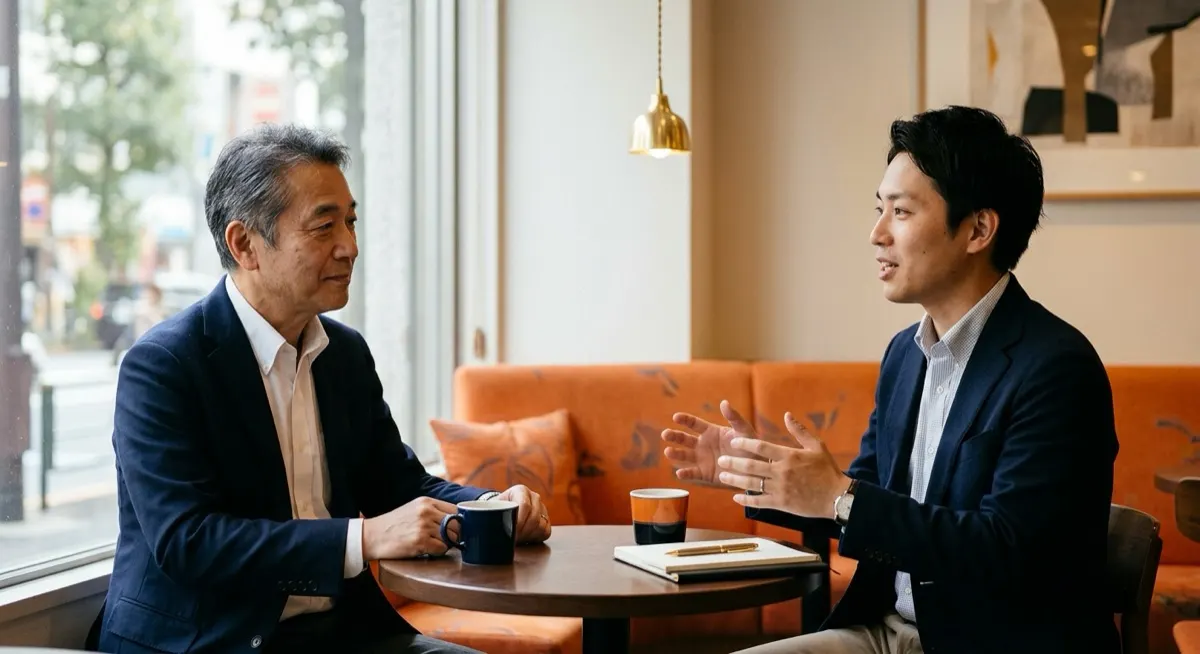
Japanese Management Style: What the Manager Opposite You Actually Does
Japanese management style is hierarchical and consensual at once. What a title licenses, why consensus is the manager's output, and what European managers unlearn.
Part of our Cross-Cultural Leadership series. Start with the full guide: Japanese Business Culture: A Working Guide for Europeans
- Japanese management style is hierarchical and consensual at the same time. Erin Meyer calls Japan the remarkable exception: strongly hierarchical, yet one of the most consensual societies in the world, deciding bottom-up
- A Japanese title is a routing position rather than a decision right. The Routledge Handbook of Japanese Business and Management is blunt about the top of the chart too: company presidents in Japan do not have the authority to make quick independent decisions on their own, founders and majority owners excepted
- The manager's output is agreement, not direction. A survey by the Japanese Management Association found Japanese managers spend about 40 per cent of their time in meetings and conferences, and the return on that spend is that resistance after a decision is minimal
- Managers are generalists on a schedule. Rochelle Kopp describes jinji ido, the annual spring reshuffle planned centrally by HR, moving people into areas far outside their normal expertise
- What a European manager unlearns: asking one person to decide, giving corrective feedback face to face and unprompted, and reading a quiet team as an aligned one
Japanese management style is hierarchical and consensual at once. Erin Meyer calls Japan the remarkable exception: strongly hierarchical, yet one of the most consensual societies in the world, deciding bottom-up. So the manager opposite you outranks their team and still cannot decide alone. Read the title as a routing position, not a decision right.
That single reframing resolves most of what European managers find baffling about their Japanese counterparts, but it is not the whole job description. This guide covers the rest: what a Japanese manager actually produces, how far a title reaches, why the person you trust keeps changing departments, and the specific habits a European manager has to unlearn in both directions, managing Japanese staff and reporting to a Japanese parent. The cultural layer underneath sits in our working guide to Japanese business culture; the org-chart mechanics of seniority and the bucho and kacho ladder are in Japanese work culture. This piece is about the role.
Hierarchical and consensual at the same time
European management models tend to bundle two things that Japan keeps separate. We assume that a steep hierarchy implies top-down decisions, and a flat one implies consultative decisions. Meyer's framework treats leadership style and decision style as independent axes, which is why Germany can be hierarchical in bearing and consensual in deciding. Japan sits at the extreme of that independence.
The mechanics are documented plainly. The Routledge Handbook of Japanese Business and Management describes decision processes in Japanese organisations as bottom-up, beginning at a lower subunit that reaches agreement before the process spreads upward through management. Rank does not disappear in that process. It governs the sequence: who is consulted first, whose objection stops the document, whose stamp closes it.
The Hofstede scores make the same point from a distance and are easy to misread. Japan sits at 54 on power distance against 38 for the Netherlands, a real gap but not a dramatic one. On individualism the difference is larger, 46 against 80. Power distance is not what makes Japanese decisions slow. Collective ownership of the decision is. A European team reading only the power-distance number expects an autocrat and meets a coordinator.
Where the hierarchy is doing visible work is in how people are placed. It matters to a Japanese counterpart to establish the rank and status of the other side and where they stand in relation to it, and JETRO's guidance records the expectation that each side sends people of the same age and position. Katz puts the underlying rule as plainly as anyone: the respect a person enjoys depends primarily on age, status and rank. The vertical ordering itself has Confucian roots, in which relationships are ordered vertically by default rather than horizontally.
What a title tells you, and what it does not
A Japanese business card gives you accurate information about where a person sits in the routing. It gives you almost no information about what they can approve on their own.
The handbook is explicit at the very top of the chart: company presidents in Japan do not have the authority to make quick and independent decisions on their own, with founders and those who own a majority of the stock as the exception. If that is true of the president, the section chief you are dealing with is not holding a hidden reserve of unilateral authority either. When a European negotiator concludes that they are simply not talking to the right person, and asks to be escalated, they are usually wrong about the diagnosis and about the cure.
So what does the title license? Three things. It sets the seniority at which the counterpart organisation will mirror you, which is why sending a junior to open a relationship caps the altitude of every subsequent meeting. It defines whose agreement is structurally required, which is the map you actually need. And it determines the order of consultation, which is the schedule you are on whether you know it or not.
The corollary is that the useful question changes. Not "can you approve this", which produces a polite non-answer, but "who else needs to see this, and in what order". That question is answerable, it is not rude, and a Japanese manager will usually answer it accurately, because you have asked them about the process rather than asking them to break it.
The manager's real output is agreement
If a European manager's output is decisions and direction, a Japanese manager's output is agreement that holds. That is not a softer job. It is a different one, and it is expensive: a survey by the Japanese Management Association, reported in the Routledge Handbook, found that Japanese managers spend about 40 per cent of their time in meetings and conferences.
Two concepts carry that work, and both have their own treatment here rather than a summary in this piece. Nemawashi is the informal groundwork, the one-to-one consultation that settles objections before anything is proposed formally. Ringi is the document that circulates afterwards and collects the approvals. Read those two if you want the sequence. What matters for the management question is what the pair produces.
It produces a specific kind of consensus, and the word does not mean what a European reader assumes. In the Japanese business context, consensus means all members being able to accept a solution even if they do not fully agree with it. A 1980 guide to Japanese business practice made the same distinction: consensus signals that an issue has been considered by all concerned so that execution can proceed, not that views are identical. Nobody is waiting for enthusiasm. They are waiting for acceptability.
The cost is time. The handbook says the ringi process is complicated and time-consuming, can take several weeks, and that business opportunities can be lost to it. The return is on the other side of the decision: resistance after ringi completes is minimal, because the relevant people were involved in shaping the outcome. A European organisation typically pays the same bill in the opposite order, deciding in an afternoon and then spending two quarters on internal buy-in that keeps reopening.
The cadence that holds it together
Consensus that is assembled once decays. What keeps it current is a reporting rhythm, and the Japanese version of it is hou-ren-sou: report, inform, consult. The full treatment, including the part most training gets backwards, is in Horenso: the Japanese reporting cadence.
The management-relevant fact is the one about who it belongs to. The term is widely credited to Tomiji Yamazaki, then president of Yamatane Securities, who launched it as an in-house campaign in 1982 and spread it with a 1986 book. He framed it as a tool for managers, whose job was to build a workplace open enough that even junior or non-elite staff could report, contact and consult freely, particularly with unwelcome news. It was not meant as a subordinate's reporting quota, which is exactly how it is now usually taught.
For a European manager the practical version is short. Consultation before a plan is finished is normal, not a sign that someone cannot cope. An interim progress report is not an interruption. And if bad news is not reaching you, that is a fact about the climate you have built, not about your team's competence.
Generalists on a schedule
The other structural feature of the Japanese manager's job is that the job keeps moving. Rochelle Kopp of Japan Intercultural Consulting describes jinji ido, the wide-scale redistribution of personnel that arrives in spring: planned centrally by the human resources department, which surprises many non-Japanese, and moving people widely, including into areas far outside their normal expertise.
That produces a manager who is a coordinator of a group rather than the deepest technical expert in it, and it explains behaviour that reads oddly from outside. A manager who defers heavily to the specialists below them is not being weak. A manager who asks for a written summary of something they arguably should already know is not being obstructive. The role assumes rotation.
Underneath sits an older logic. A 1980 account of Japanese business practice put it as employment that is not regulated by a contract hiring a skill but is a relationship attaching a person to a specific organisation. That framing is dated as a description of the 2026 labour market, and should be read as the logic rotation sits on rather than as current fact. But it explains why moving a person across functions is unremarkable in a system that hired the person rather than the skill.
The consequence for a foreign partner is operational. Kopp notes that a counterpart cultivated for years can suddenly move to another department, and that the abruptness and the resulting lack of continuity are a standing frustration for foreigners working with Japanese organisations. Two countermeasures are cheap. Write down what was agreed, in Japanese, so the record survives the person. And know the second and third name on the account before you need them.
What a European manager has to unlearn
The habits below are competent management in Amsterdam and counterproductive in a Japanese context. They are also the ones our intercultural leadership training for Japan spends most of its time on.
Managing Japanese staff. Stop asking an individual to own an outcome the group has not accepted yet; you will get agreement in the room and no movement afterwards. Stop giving corrective feedback face to face and unprompted as your default: JETRO's guidance records that Japanese will sometimes use an intermediary, a third person, to deliver feedback, and the handbook describes a general effort to avoid conflict between parties in order to sustain harmonious relationships. Build a route instead, a regular private one-to-one where small corrections are routine, plus one senior Japanese colleague who can carry the harder message in a form that does not cost anyone standing. And stop reading a quiet team as an aligned team. Silence is the default state of a group that has not been consulted individually.
Being managed by a Japanese parent. The distance is the problem, and it is not neglect. A study of a Japanese-European joint venture by Misa Fujio found two obstacles for the Japanese managers posted there: occasional use of the local European language in meetings, and insufficient understanding of the local situation by the Japanese parent company. One case study is not a measurement, but the failure mode is familiar to anyone who has run a European subsidiary of a Japanese group. The countermeasures follow from everything above. Report upward more often and in smaller pieces than feels warranted. Consult the parent while a plan is still forming, because a finished plan arriving from Europe is a plan nobody in Tokyo has had the chance to co-own. And when a decision matters, ask who needs to see it and in what order, then supply the material in a form that survives translation into a proposal you will never read.
Neither list is about deference. It is about supplying a different organisation with the inputs it actually runs on.
How it is changing
The rules have changed faster than the logic. The 2018 Work Style Reform Act introduced binding overtime caps for the first time, 45 hours a month and 360 a year in normal circumstances, and Japanese work culture covers the hours picture in detail.
Hiring has got harder in the same period. JETRO's 2024 survey of foreign-affiliated companies in Japan found that 42.4 per cent were struggling to secure talent despite their recruitment efforts, and that among those companies sales and marketing was the hardest category to fill, at 57.3 per cent. That is a statement about foreign-affiliated employers rather than about Japanese companies, and it should be read as such. What it tells a European parent is narrow but useful: a subsidiary looking for Japanese managers is competing for them, not selecting from a queue, and the manager you eventually hire will have been trained in the system described above rather than in yours.
What has not visibly moved is the consensus mechanism itself. The handbook's 2016 account and the practitioner accounts from 1999 and 2008 describe the same procedure, and our reading of the evidence, set out in the business culture guide, is that betting a five-year plan on convergence is the expensive version of this mistake. Assume the rules keep changing and the procedure stays.
One honest caveat on all of the above. Everything here describes established Japanese organisations. Where the person across the table is a founder or a majority owner, the handbook's own exception applies and they can decide in the room. Running a slow consensus play at a founder-led Japanese company reads as indecision, and it wastes the one situation where speed is available to you.
Sources
- Hierarchical and consensual at once, and the independence of leading and deciding. Erin Meyer, The Culture Map (PublicAffairs, 2014), the Leading and Deciding scales.
- Bottom-up decision processes, presidential authority, the meaning of consensus, ringi duration and post-decision resistance, meeting time, status assessment, conflict avoidance. Parissa Haghirian (ed.), The Routledge Handbook of Japanese Business and Management (Routledge, 2016), chapter 29. The 40 per cent meeting figure is a Japanese Management Association survey as reported there.
- Cultural dimension scores. Hofstede Insights country comparison, as tabulated in our Japanese business culture guide.
- Hierarchy and Confucian ordering, matching age and position across the table, feedback via an intermediary. JETRO, Communicating with Japanese in Business (author Ernest Gundling, Meridian Resources; JETRO, 1999).
- Respect by age, status and rank. Lothar Katz, Negotiating International Business: Japan (2008).
- Jinji ido: spring timing, central HR planning, rotation outside expertise, discontinuity for foreign counterparts. Rochelle Kopp, Jinji Ido: the Japanese Organizational Refresh Button, Japan Intercultural Consulting.
- Employment as a relationship rather than a contract for a skill, and consensus as considered acceptance. Paul Norbury and Geoffrey Bownas (eds.), Business in Japan (Macmillan, revised 1980). Cited as period framing only.
- Hou-ren-sou as a manager's tool. Origin and sourcing in our horenso guide.
- Japanese-European joint venture obstacles. Misa Fujio, Challenges Facing Globally-Minded Leaders in a Japanese-European Joint Venture Company, Business Communication Research and Practice, 2018.
- Overtime caps. 2018 Work Style Reform Act, as detailed in our Japanese work culture guide.
- Talent market. JETRO, 2024 Survey on Business Operations of Foreign-affiliated Companies in Japan.
Claim-by-claim provenance for this article, including the rows that were rejected for lack of support, is in content/blog/research/japanese-management-style-claims.md.
Related Resources
- Japanese Business Culture: A Working Guide for Europeans, the cultural layer this management style sits on
- Japanese Work Culture: Hierarchy, Hours, Decision Flow, the org-chart mechanics, senpai-kohai, and the hours picture
- Nemawashi: How Japanese Companies Actually Make Decisions, the informal groundwork a manager runs before proposing anything
- Ringi: The Japanese Approval Process, Explained, the document that turns agreement into an approved decision
- Horenso: The Japanese Reporting Cadence, Explained, the rhythm that keeps consensus current
- Working in Japan as an Expatriate: An Onboarding Guide, the same system seen from inside an assignment
- Intercultural Leadership Training for Japan, the programme built around the unlearning list above
Stay Ahead in Cross-Cultural Marketing
Get monthly insights on international growth strategies, cultural intelligence, and digital marketing trends delivered to your inbox.
We respect your privacy. Unsubscribe at any time.