
Ringi: The Japanese Approval Process, Explained
A practitioner guide to *ringi*, the Japanese internal approval system, written for European sales teams selling into Japanese B2B accounts. Covers the *ringi-sho* document, *hanko* stamp chain, reading the routing list, the relationship to *nemawashi*, and the document trail European sellers should be providing at each stage.
Part of our Cross-Cultural Leadership series. Start with the full guide: Japanese Business Culture: A Working Guide for Europeans
- Ringi seido is the formal internal approval system most mid-sized and larger Japanese companies use; the ringi-sho is the document that circulates and collects approval stamps from every relevant manager up the chain
- The system is the downstream visible artefact of nemawashi, the informal consensus-building that happens before circulation; European sellers who treat ringi as a single stage to influence will miss the more important upstream stage
- The standard routing is junior staff drafts the document, peers review, the kacho (section chief) signs first, then the bucho (department head), then any cross-department reviewers, then up the executive line as far as the spend authority requires; each hanko stamp on the document is one approval node
- European sales teams misread ringi in five recurring patterns: pushing for shortcuts, escalating outside the chain, providing the wrong document trail, sending the wrong people to meetings, and pricing the deal for European decision speed
- The right document trail to feed into ringi includes a Japanese-language summary, a quantified business case, security and compliance evidence (ISMS, APPI), reference customers in Japan, a clear scope of work, and a procurement-ready commercial proposal; missing any one of these slows the cycle by weeks
- Realistic ringi cycles for moderate enterprise SaaS or services purchases run four to twelve weeks, with cross-departmental or capex deals running three to nine months; pricing the deal for a European six-week sales cycle produces churn before the deal closes
European sales teams selling into Japanese B2B accounts almost always learn about ringi the same way: through a deal that should have closed and did not, with a Japanese counterpart who keeps saying the document is "still circulating." The team escalates internally, the European country head emails the Japanese buyer's executive sponsor, the cycle slips another month, and the deal eventually dies for reasons no one on the European side can quite reconstruct. By the time the team learns what happened, the next deal is already in the same loop.
The ringi system is straightforward once you see it. It is a formal internal approval procedure used by most mid-sized and larger Japanese companies, and once you understand its structure, the reasons European sellers keep misreading it become obvious. The misreadings are mechanical errors in how the European sales motion interacts with a different organisational decision system, not cultural mysticism. This guide takes ringi from the European seller's perspective and explains the parts that get lost in standard intercultural training: how the document moves, who reads it, what each reader is checking, what the seller can provide that helps, and what the seller can do that actively damages the cycle.
The guide assumes the reader already knows the basics of Japanese B2B sales: that decisions are slow, that consensus matters, that hanko are stamped on documents, that the buyer's silence is rarely confirmation. What this guide adds is the operational detail of the document trail, the routing logic, the failure modes, and the realistic cycle length. The upstream stage, nemawashi, has its own treatment in Nemawashi: How Japanese Companies Actually Make Decisions, and the wider business culture context is in Japanese Business Culture: A Working Guide. The wider entry frame is in the Japan Market Entry Guide.
European sales teams learn about ringi the same way: through a deal that should have closed and didn't.
What Ringi Actually Is
Ringi seido (稟議制度) is the system. Ringi-sho (稟議書) is the document. The system is older than most institutions that use it; some form of bottom-up written approval has been in use in Japanese bureaucracy since the late Tokugawa era, was formalised in the Meiji period, and was carried into corporate Japan as part of the post-war organisational pattern. The contemporary form is the lineal descendant of those institutions and retains their basic logic: the proposal is drafted by the person closest to the operational reality, circulated upward through every manager whose authority or interest is touched by the decision, and approved by stamp at each node until the appropriate level of authority is reached.
The visible artefact is the document. A ringi-sho is typically one to three pages, structured around the proposal, the rationale, the budget impact, and the approval matrix. The first page lists the routing: every name and title in the chain, in the sequence the document will move through, with a box next to each name where the hanko stamp goes. The proposal page makes the case in concise written Japanese, usually in a recognisable format that the originator's department uses for all ringi-sho. The supporting pages carry the detail: comparative analysis, vendor evidence, scope of work, references, financial impact.
The substantive work in ringi is upstream of the document. The originator drafts the proposal only after the underlying decision has been informally agreed through nemawashi, the consensus-building stage that happens through quiet conversations, hallway exchanges, and small group meetings before any document moves. By the time a ringi-sho circulates, the substantive arguments have been settled; the document records the agreement and triggers the formal authority chain. This is the single most consequential structural fact about ringi for European sellers, and the one most often missed.
The system has practical advantages that explain its persistence. The document trail provides an audit-grade record of who approved what and when, which matches the Japanese organisational expectation that responsibility is collectively held and individually evidenced. The bottom-up drafting captures operational nuance that top-down decision systems often lose. The cross-departmental review surfaces conflicts before they become operational problems. The slow cycle filters out impulsive decisions. The trade-off is speed; ringi is structurally slow, and any attempt to make it fast undermines the features that make it useful.
Ringi as the Downstream of Nemawashi
The two-stage logic of nemawashi upstream and ringi downstream is the part that European sellers most often collapse into a single decision event. Treating ringi as the decision stage produces sales motions that are timed wrong, that escalate to the wrong people, and that supply documents at the wrong moment.
Nemawashi (根回し), literally "root-binding," is the informal pre-consultation that surrounds any non-trivial Japanese organisational decision. The proposal is shaped through small conversations: the originator talks to the section chief informally before drafting; the section chief sounds out peer department heads at lunch or after work; the originator may meet with key dissenters individually to address their concerns and incorporate their feedback into the proposal. The objective is that by the time the ringi-sho circulates, every signatory has already been consulted in some way, and the document does not surface a position the signatory has not previously seen.
The seller's role during nemawashi is to provide the originator with the material needed to have those conversations. Comparative pricing, detailed feature breakdowns, security evidence, reference customer commentary, and case studies are all nemawashi inputs more than they are ringi inputs. The European seller who provides a polished commercial proposal at the formal stage but does not provide internal-conversation material at the informal stage gives the originator nothing to work with during the period that actually decides the outcome.
The transition from nemawashi to ringi is a moment, not a stage. When the originator has confidence that the substantive issues are resolved, the ringi-sho drafting begins. Once it begins, the document moves quickly through the sequence; cycle slowdowns at the ringi stage are usually evidence of nemawashi gaps, not of ringi process. A ringi-sho that sits with one signatory for three weeks is almost always a signal that the pre-consultation was incomplete and the signatory has surfaced a concern that should have been resolved upstream. The remediation is to re-open the nemawashi, not to push on the ringi.
European sellers who understand this two-stage logic adjust their cadence accordingly. The early sales motion is dense in conversation and material; the late sales motion is light in pressure and high in document quality. The reverse pattern, light early then aggressive late, is the European default and the most consistent producer of stalled deals.
The Document Trail: Ringi-Sho Mechanics
The mechanics of the ringi-sho itself are mundane and important. A typical document carries six elements that European sellers should know about because each one has implications for what the seller should provide.
The first element is the proposal summary, usually a paragraph in plain Japanese that states what is being proposed, by whom, for what purpose, and at what cost. The summary is what every reader sees first; if it is unclear or contains internal inconsistencies, the document goes back to the originator for revision. The seller's contribution to a clean summary is a Japanese-language one-pager that the originator can lift directly: not a marketing document, not a translated European deck, a one-page Japanese summary that the originator can attach as the source for the ringi-sho summary.
The second element is the rationale, a longer treatment that addresses why this option, why now, and why this supplier. The rationale is where the comparative analysis sits: why this vendor over alternatives, what the comparative evaluation found, how the chosen option fits the strategic context. The seller's contribution is a comparative evaluation framework that the buyer can use, ideally with named alternatives that the buyer is genuinely considering rather than straw-man comparators that no one trusts.
The third element is the financial impact, expressed in JPY, broken down by year, with the JCT impact and the total cost of ownership made explicit. Japanese ringi readers expect financial information that mirrors how the company tracks budget, which means JPY-denominated, multi-year, with the consumption tax handling spelled out. A commercial proposal denominated in EUR, with a footer that says "JCT not included" or "subject to local taxes," is incomplete and forces the originator to do the conversion and the JCT calculation themselves. The seller who provides a JPY-denominated, JCT-inclusive commercial proposal aligned to the buyer's fiscal year is doing meaningful work for the originator.
The fourth element is the approval matrix, the routing list with the stamped boxes. The originator constructs the matrix based on the spend authority and the affected departments. The seller has no direct role here, but understanding the matrix is critical for not damaging it. A direct sales call to a senior name on the routing list, before that signatory has had the chance to read the ringi-sho, is read as an attempt to force the senior signatory's hand and is one of the surest ways to lose a deal.
The fifth element is the supporting evidence, attached to the ringi-sho as appendices. Security and compliance evidence sits here: ISMS certificates, ISO 27001 reports, APPI compliance attestations, the data processing agreement template. Reference customers sit here: ideally Japanese reference customers with permission to be named, ideally with a Japanese-language quote or case study. Scope of work sits here: a clear, milestone-structured statement of what the supplier will deliver, in what timeframe. The seller's contribution is to package these attachments in advance, in Japanese where it matters, and to provide them as a complete pack rather than asking the buyer to compile them from various sources.
The sixth element is the conditions, often a short list of caveats or contingencies that the originator wants flagged for downstream signatories. The conditions are usually opaque to the seller because they reflect internal organisational considerations, but the existence of the conditions is informative; a long list signals organisational hesitation, a short list signals confidence. The seller who notices the conditions and asks the originator quietly about them often surfaces concerns that need a follow-up nemawashi round before the cycle continues.
The Hanko Chain and Reading the Routing List
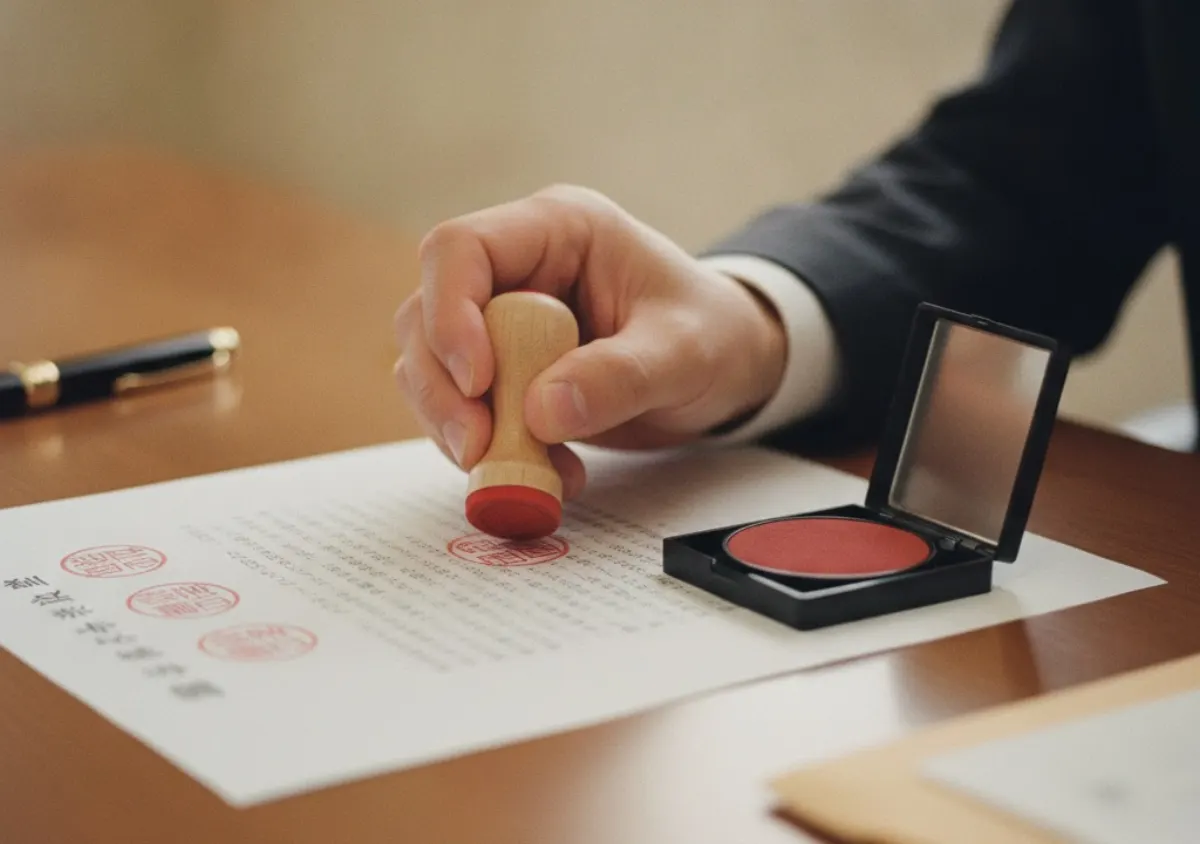
The hanko stamps on the document are the visible record of the approval cycle. Each signatory stamps their inkan (personal seal) in the box next to their name, in sequence, and the document moves to the next signatory once the previous box is stamped.
The hanko itself is a small physical seal carrying the signatory's name in kanji, used in Japan since the eighth century and formalised as a corporate signature substitute through the Meiji and Showa periods. A personal jitsuin is the registered seal used for high-value transactions; a mitomein is the everyday seal used for routine internal approvals including ringi-sho. Most signatories keep their mitomein in a small case in their desk drawer or in a personal hanko holder that travels with them.
The 2020 datsu-hanko policy push, accelerated by remote-work pressure during the pandemic, has digitised much of the routine hanko stamping. Many Japanese companies now use electronic stamping or dedicated workflow tools that replicate the ringi sequence digitally; some have eliminated the physical stamp for internal approvals entirely. The policy changes the medium of the stamp, not the underlying process. The routing remains the same, the upstream nemawashi remains the same, the consensus expectation remains the same. European sellers who hear that a Japanese buyer has gone "paperless" sometimes assume this means ringi has gone away; it has not.
Reading the routing list is one of the most underused diagnostic tools the European seller has. The routing list reveals the spend authority needed for the decision, the departments that have a stake in the outcome, and the relative seniority of the originator. A routing list that ends at kacho or bucho signals a decision that the section is taking on its own authority; a list that ends at jomu, senmu, fuku-shacho, or shacho signals a decision that has reached the executive line. A list with five or six departments signals cross-functional implications that will broaden the nemawashi requirement; a list with two departments signals a cleaner internal alignment.
Sellers who understand the structure of the routing list can also read the warning signs. A signatory whose stamp is conspicuously slow to appear is usually the source of an unresolved nemawashi gap. A document that returns to the originator from a senior signatory is usually a signal that the senior wants additional supporting evidence or a revised proposal element. The seller cannot directly act on these signals, but the originator's account of what is happening becomes much more legible to a seller who knows what to look for.
The hanko tilt convention is sometimes mentioned in intercultural training as a sign that an approver is registering reluctance: a stamp tilted slightly off-vertical is folklore-coded as a lukewarm yes. The convention is genuine in some traditional companies and absent in many modern ones; the seller should not over-read a tilted stamp into a deal-killing concern, but should mention it to the originator as a question rather than as an interpretation.
Five Failure Modes European Sellers Repeat
The five patterns below are the ones that come up most often in European sales reviews of stalled Japanese deals. They are obvious in retrospect. The reason they keep happening is that the European sales motion is built around organisational decision systems where these moves are productive, and the same moves are counter-productive in the ringi context.
The first failure mode is pushing for shortcuts. A European seller, frustrated by the cycle length, asks the buyer for "an exception" or "a fast-track approval" or to "escalate the decision." All three formulations land badly. There is no exception path in ringi; the system is the system. Asking for one signals that the seller has not understood the procedure and has not built the relationship to know not to ask. The remediation is to spend more time on the upstream nemawashi in the next cycle and to size the next deal for realistic ringi timing rather than for European sales-cycle expectations.
The second failure mode is escalating outside the chain. The European country head, frustrated by the cycle slippage, emails the buyer's executive sponsor or asks for a steering call with the buyer's CFO. The intent is to apply senior pressure; the effect is to undermine the originator. The senior signatory now has to either rebuke the European side, which damages the relationship, or push down on the originator's chain, which damages the nemawashi. Either response slows or kills the deal. The remediation is to coach European executives that escalation in Japanese B2B does not work the way it does in European B2B and to reserve senior contact for moments the Japanese side has invited it.
The third failure mode is providing the wrong document trail. The seller provides a polished European-style commercial proposal, in English, denominated in EUR, with European references and SOC 2 evidence. The originator cannot use it directly in the ringi-sho and has to compile a Japanese-language equivalent themselves, which delays the cycle by weeks and signals that the seller does not understand what the originator needs. The remediation is to prepare the Japanese-language summary, the JPY-denominated commercial proposal, the ISMS-aligned security evidence, and the Japan-customer references as a pack, in advance of the formal proposal request, so the originator can lift them directly.
The fourth failure mode is sending the wrong people to meetings. The European side, treating Japan like other markets, sends the same account team that closes deals in Germany or France. The Japanese side, used to seniority symmetry in serious meetings, reads a junior European account team meeting a senior Japanese committee as a signal that the European side does not take the deal seriously. The remediation is to match seniority deliberately on the European side: send the European country head to the executive briefing, send the technical specialist to the architecture review, send the relationship lead to the relationship-building dinner. The mapping does not have to be perfect; it has to be visibly considered.
The fifth failure mode is pricing the deal for European decision speed. The seller forecasts the deal for closure in six weeks because that is the European average; the deal is in fact a twelve-week ringi cycle; the forecast misses; the European management interprets the miss as Japanese underperformance; the European country team gets less budget for Japan; the next deal is even harder to close because the country team is under-resourced. The remediation is to publish a Japan-specific sales cycle baseline that European sales operations and finance use for forecasting, separate from the European average, with realistic distributions for SaaS, services, and capex deals.
Selling Into Ringi: What Helps, What Hurts
The mirror image of the failure modes is a small set of moves that the European seller can make at each ringi stage to help the originator and the cycle.
In the nemawashi stage, before any document moves, the most useful thing the seller does is provide internal-conversation material in Japanese: a one-page proposition summary in Japanese, a comparative table in Japanese, a customer reference list including Japanese references with named contacts, security and compliance evidence in Japanese including ISMS and APPI material. The seller is not trying to influence the nemawashi directly; that is the originator's job. The seller is trying to make the originator's nemawashi job easier by giving them the material they need to have credible internal conversations.
At the transition to formal ringi, the most useful thing the seller does is supply the JPY-denominated, JCT-qualified, milestone-structured commercial proposal as a clean document the originator can attach to the ringi-sho. The proposal should mirror the originator's internal financial format, which in practice means JPY by year, JCT broken out, and total cost of ownership stated explicitly. A clean attachment saves the originator from rebuilding the financials and removes one common reason ringi-sho get returned for revision.
During formal circulation, the most useful thing the seller does is be patient and stay close to the originator without being intrusive. A short check-in once every one to two weeks, in Japanese where possible, is appropriate; weekly emails in English asking for updates are not. If the originator surfaces a concern from a signatory, the seller can usually provide additional material to address the concern; what the seller should not do is approach the signatory directly, ask for a meeting with them, or send them material independently.
At points of cycle slowdown, the most useful thing the seller can do is invite the originator to re-open the nemawashi. The framing matters; an explicit "should we go back to the consultation stage" can land badly because it implicitly criticises the originator's earlier work. The right framing is to ask whether there is additional material the seller can provide that would help with any specific concern that has surfaced. The originator who needs to re-open nemawashi will use the material; the originator who does not will say no.
After successful ringi, the most useful thing the seller does is continue the relationship work. The originator's ringi-sho is now their professional record; the deal's success or failure shapes their internal standing. Sellers who maintain the relationship after closure, who help the originator make the post-decision case to their internal stakeholders, who provide continued evidence of value, build the kind of long-term Japanese B2B relationship that produces follow-on deals and reference business.
Realistic Cycle Lengths
The cycle-length numbers below are working ranges, not guarantees. Specific industries, specific companies, and specific deal types vary, but the ranges are indicative enough to inform European sales forecasting.
A moderate enterprise SaaS deal, mid-six-figure annual contract value, single department, no novel architectural decision, runs four to twelve weeks of ringi cycle on top of whatever sales cycle preceded it. The four-week end of the range corresponds to clean nemawashi, an experienced originator, a routing list that ends at bucho, and complete documentation. The twelve-week end corresponds to gaps in nemawashi, an inexperienced originator, a longer routing list, or incomplete documentation that triggers revision cycles.
A larger services or strategic-consulting deal, low-seven-figure annual contract value, multiple departments, with operational implications across teams, runs eight weeks to six months. The cycle expands because the routing list expands and because cross-departmental nemawashi takes longer.
A capital expenditure or strategically novel decision, regardless of size, runs three to nine months. The novelty lengthens the nemawashi substantially because there is no organisational precedent for the decision and the originator has to construct one through individual consultation.
A government or regulated-industry decision can run six to eighteen months. Regulated procurement carries additional procedural overhead on top of the standard ringi cycle, with formal RFP, vendor evaluation, and audit-trail requirements.
European sellers should publish these baselines explicitly into their sales operations and finance forecasting. The cost of using a single global baseline that overstates Japanese cycle speed is not just forecast inaccuracy; it is a continuous misalignment between the country team's actual work and the parent company's expectations, which compounds over multiple quarters into reduced country-team budget and reduced ability to do the upstream nemawashi work that closes deals.
The Wider Cultural Frame
The ringi system is a coherent expression of how Japanese organisations balance individual responsibility, collective consensus, and authority, not a peculiarity of them. Reading it as a procedural quirk, something that gets in the way of "real" decision-making, misses the point. The slow cycle is the feature, not the bug; the consensus expectation is the design, not the side effect.
European sellers who internalise this can adjust their sales motion to work with the system rather than against it. The motion that works is dense early, patient late, Japanese-document-heavy throughout, and built around the originator rather than the executive sponsor. The motion that fails is light early, aggressive late, English-document-heavy, and built around escalation. The two motions look superficially similar to a European observer; the difference in outcome is large. The same consensus logic applies inside mixed teams; our working with Japanese colleagues training covers that side of the picture.
The wider cultural frame is in Japanese Business Culture: A Working Guide. The upstream nemawashi stage is in Nemawashi: How Japanese Companies Actually Make Decisions. Communication patterns that intersect with ringi are in EU-Asia Communication Mistakes That Tank Marketing Campaigns. The wider entry frame, including how ringi interacts with entry-model decisions, is in the Japan Market Entry Guide and the SME-specific framework in Japan Market Entry for European SMEs. The cultural-marketing layer is in the Cross-Cultural Marketing Guide. For SaaS the operational stack that produces the document trail ringi requires is in EU SaaS in Japan: GDPR/APPI, Stripe and PAY.JP, JCT Qualified Invoices.
The European sales team that takes ringi seriously, that times the cycle correctly, that produces the right document trail, that respects the routing list, and that disciplines its escalation instincts, will close the deals it should be closing. The team that does none of those things will continue to lose Japanese deals for reasons it cannot explain. The system is the system; the question is whether the seller understands it.
Related concepts
Ringi is one of four concepts that decide how a Japanese organisation reaches and communicates a decision:
- Nemawashi: how Japanese decision-making really works, the upstream informal consensus-building that a ringi-sho ratifies
- Horenso: the Japanese reporting cadence, explained, the report, contact, and consult rhythm the originator runs while the document moves
- Honne and tatemae: what Japanese partners really mean, how to read a status update that is accurate and still not candid
- Japanese business terms: a glossary for European executives, the vocabulary index for ringi-sho, hanko, kacho, bucho, and the rest
Sources
- JETRO, Japan External Trade Organization, official guidance on Japanese B2B procurement and decision processes.
- EU-Japan Centre for Industrial Cooperation, the official EU-Japan bilateral support institution with seminars and publications on Japanese organisational practice.
- Hofstede Insights country comparison, the canonical academic frame for the cultural dimensions that produce the ringi pattern.
- Personal Information Protection Commission of Japan, the regulator whose APPI compliance evidence forms part of the document trail required for B2B ringi.
Stay Ahead in Cross-Cultural Marketing
Get monthly insights on international growth strategies, cultural intelligence, and digital marketing trends delivered to your inbox.
We respect your privacy. Unsubscribe at any time.