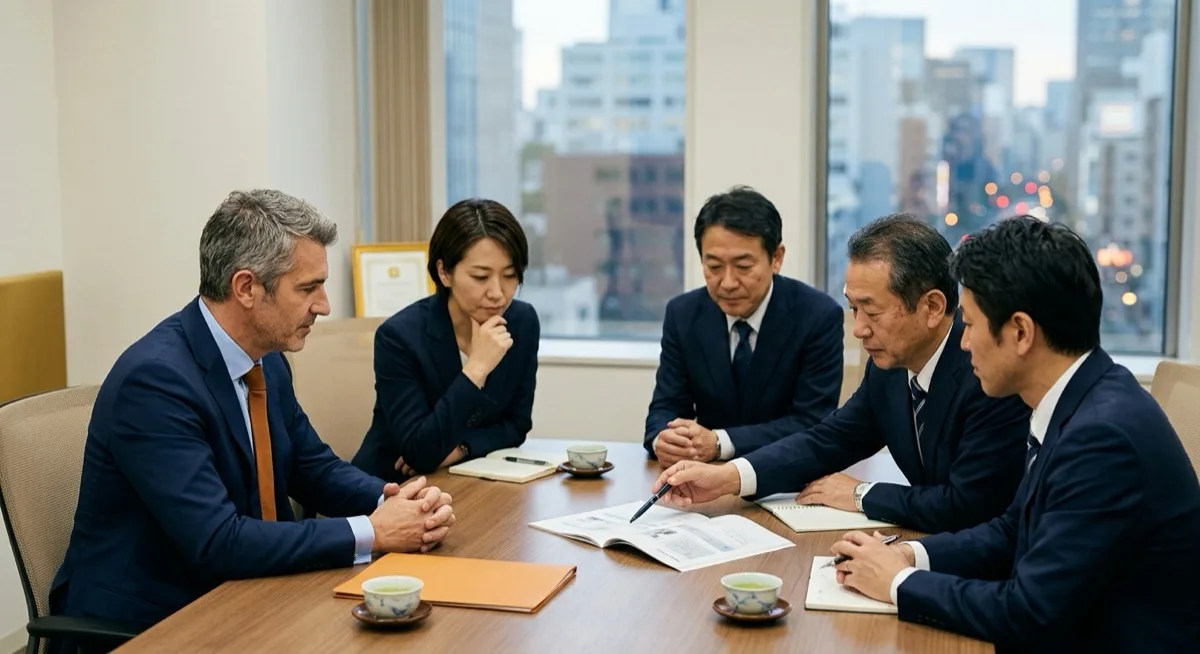
B2B Marketing in Japan: A Guide for European Companies
How B2B marketing in Japan actually works for a European entrant: the consensus buying process, the trust-gated channel stack (Facebook, Eight, LINE, not LinkedIn), content that survives Japanese scrutiny, and a 12-month operating plan. Sourced 2026 numbers throughout.
- The buying process, not the channel mix, is the real difference. Japanese B2B purchases move by internal consensus (nemawashi and ringi), so marketing must equip an internal champion to sell for you, not push a single decision-maker to convert
- The channel stack is not your channel stack. Japan has roughly 5.4 million LinkedIn members against about 16.5 million Facebook ad reach and around 100 million monthly LINE users, so the European LinkedIn-first playbook starts on the smallest network (DataReportal, LY Corporation)
- Trust is gated and sequenced: discovery happens offline and in search, connection happens on Facebook and the Eight business-card app, and LINE marks the inner circle. The move is almost always one step warmer than your European instinct
- Content must be denser, longer, and better evidenced than in Europe: risk-averse buying committees read specifications, case studies, and third-party proof before they will meet you
- Plan on 18 to 24 months. Cycle length is structural, not a sign of failure; the companies that win budget for the long nurture and measure micro-conversions along the way
Most European B2B playbooks fail in Japan for a reason that has nothing to do with translation. They assume a buyer: one person with a budget, a problem, and the authority to say yes. Japanese organisations mostly do not buy that way. Purchases move through group consensus, the professional networks where you would find that buyer are different networks entirely, and the evidence bar your content must clear is set by the most cautious member of a committee you will never fully see.
Getting it right means knowing how the Japanese B2B buying process actually works, what the 2026 platform numbers mean for your channel plan, how to sequence the trust-gated channel stack, and what to publish so a Japanese buying committee can say yes. Each channel section links to a dedicated deep look; this page gives you the operating system that connects them.
One framing note before the detail. Japan is the world's fourth-largest economy1 with around 107 million internet users2, and the EU-Japan Economic Partnership Agreement has removed most tariff and services barriers since 20193. The opportunity is not the question. The question is whether your marketing works the way Japanese organisations buy.
The Buying Process Is the Strategy
Start inside your prospect's office, not inside your marketing stack. Two Japanese-language words describe how a company you are courting will decide.
Nemawashi is the informal groundwork: a project sponsor talks to each stakeholder one to one, before any meeting, until objections are surfaced and softened. Ringi is the formal step that follows: a written proposal (the ringi-sho) circulates for approval stamps across departments. By the time a decision is announced in a meeting, it has usually already been made in the corridors. We cover the structural consequences for pipeline design in B2B lead generation across borders, but three follow directly for marketing:
-
You are not persuading a decision-maker. You are equipping a champion. Somebody inside the account has to walk your case through nemawashi. Your job is to arm that person: a Japanese-language summary they can forward, a specification sheet that answers the technical stakeholder, a security document for IT, a cost justification for finance. Marketing collateral in Japan is internal ammunition, not external persuasion.
-
Every stakeholder is a potential veto. Consensus systems are conservative by design: one unconvinced department head can stall the ringi. This is why Japanese buying committees read more, ask for more proof, and take longer. It is also why "risk reversal" content (references, certifications, guarantees, local support commitments) outperforms aspiration-led content.
-
Cycle length is structural. Enterprise cycles of 9 to 18 months are normal, and our own Japan market entry guide advises planning 18 to 24 months to meaningful revenue, on a realistic budget of EUR 50-150K for setup and localisation plus EUR 100K or more for first-year marketing. A European CFO reading a Japan pipeline through a six-month lens will conclude the market does not work. It does work; it compounds late.
One more structural note: in enterprise segments, much of Japanese procurement runs through system integrators (the large SIers: NTT Data, Fujitsu, NEC, Hitachi), and a channel partner of that kind is often the entity your marketing has to convince first. Where that applies, the committee logic above simply doubles: the SIer has its own ringi.
The expensive mistake this structure invites is treating the long cycle as a funnel problem to optimise away. It is not friction. It is the process. Marketing that works with the cycle rather than against it feeds it: measure micro-conversions (a second meeting, a downloaded specification, a webinar attendee from the target account) and keep showing up for the length of the nemawashi you cannot see.
The Numbers That Reorganise Your Channel Plan
The second structural difference is the platform map. Here are the 2026 numbers, with sources, because most advice on this topic still circulates figures that are years out of date.
| Platform | Japan reach (2026) | Role in Japanese B2B |
|---|---|---|
| ~5.4 million members, about 4% of the population2 | Findability and research, foreign-affiliated firms, recruitment | |
| ~16.5 million ad reach2 | The professional network: trust-gated, real names, post-meeting connections | |
| LINE | ~100 million monthly active users, about 81% of the population, with a 92.5% usage rate across every age group4 | Inner-circle messaging; the signal a relationship has become close |
| X (Twitter) | ~71.2 million ad reach, the platform's second-largest market25 | Listening and intelligence, anonymity culture, not a B2B ad channel |
| Eight (Sansan) | ~3.8 million users; Sansan holds about 82.4% of the corporate card-management market (company data)67 | Digital layer on the business-card exchange; keeps met contacts warm |
| note.com | ~65.7 million monthly active users (company-reported)8 | Where Japanese executives publish candid strategy essays |
| Wantedly | ~40,000 companies, ~4 million professionals (company-reported)9 | Culture-first discovery; the "casual visit" as a sanctioned front door |
A caveat on comparability: DataReportal reports Facebook and X on advertising reach but LinkedIn on total registered members, so the figures describe scale, not a strict same-metric comparison. The strategic reading survives the caveat: the network Europeans default to is the smallest professional surface in the market, and it is not where Japanese business relationships live.
Two more numbers complete the map. Japanese search is mostly Google (roughly 60% share, with Yahoo! Japan, which runs on Google's engine, now in single digits)10, so your discovery layer is Japanese-language SEO rather than a separate search ecosystem; the mechanics live in our guide to SEO in Japan. And smartphone ownership stands at 91.8% of households11, which is why the dense, mobile-first Japanese web looks the way it does.
The Channel Stack, Sequenced by Trust
Japanese professional networks are trust-gated: you connect with people you have met, and each channel marks a level of relationship. The full operator's map is in Japan B2B networking: the channels that actually work; here is the stack in buying order, with the rule that governs it. The right move is almost always one step warmer, one step more personal, than your European instinct.

Discovery: search, events, and the casual visit
Cold discovery in Japan runs through three doors. Japanese-language search is the always-on one. Industry exhibitions and trade events are the highest-yield one: the physical business-card exchange (meishi) remains the moment a B2B relationship formally begins, and for European companies the institutional on-ramps are real, from JETRO's market-entry support to the EU-Japan Centre for Industrial Cooperation's programmes12. And Wantedly's casual visit is the door Europeans miss: a culturally sanctioned way to get inside a Japanese company for a conversation without a warm introduction, built for hiring but usable, carefully, for market learning.
What does not work as a discovery layer: cold LinkedIn outreach and cold email. The first lands on a network your buyer is barely on. The second collides with both etiquette and law, since Japan's anti-spam rules (the Specified Electronic Mail Act) require prior opt-in consent for commercial email13.
Findability: LinkedIn, used for what it is
Keep LinkedIn in the stack, but reassign it. LinkedIn in Japan is small and growing (+14.9% year on year)2: too small to run demand generation on, too important to be absent from, because your internationally minded counterparts will look you up there. Maintain Japanese-language company and executive profiles, and use it outbound as a research tool.
Paid LinkedIn still earns a place for specific jobs. Our own EUR 406 pilot targeting executive assistants rather than the C-suite, written up in LinkedIn advertising for international B2B, reached decision-makers at a fraction of direct-targeting cost, and the regional playbook, including where LinkedIn does and does not work across Asia, is in LinkedIn B2B advertising for Asia-Pacific markets. Target the foreign-affiliated segment and the gatekeepers; do not expect the Japanese domestic mid-market to be there.
Connection: Facebook and the business card's digital layer
After a first meeting, the Japanese follow-up is not a LinkedIn add. It is more often a Facebook friend request within a couple of days, referencing the meeting. Facebook occupies the professional-network role in Japan that LinkedIn holds in Europe: real names, real photos, connections you have actually met. Build a curated presence there and treat it as relationship maintenance, not a broadcast channel.
The second half of the follow-up is Eight, the business-card app from Sansan. Scan every card you receive; the app notifies you when a contact changes jobs, which in a market where relationships attach to people rather than roles is genuine pipeline intelligence. Eight is a maintenance tool for people you have met, not a prospecting database, and using it the second way burns trust.
Nurture: webinars, consented email, and reading the room
The middle of the Japanese funnel is long, so build assets that survive it. Webinars work well once adapted to local norms of format, scheduling, and follow-up; the platform and partner detail is in our webinar marketing in Japan guide. Email nurture works on an opt-in list built from events and downloads, with the consent mechanics above.
Nurture is also inbound intelligence. note.com hosts candid strategy essays from Japanese executives, including, sometimes, the people you are selling to: reading a counterpart's note before a meeting tells you how they think. And X in Japan is the listening post: its anonymity culture surfaces unvarnished industry sentiment you will not hear in a meeting room. Use both to read the room, not to broadcast.
Inner circle: LINE
When a Japanese counterpart proposes exchanging LINE IDs, the relationship has crossed a line worth noticing. LINE in B2B is not a marketing channel in the European sense: it is the inner-circle messaging layer, and being invited into it signals that you have moved from vendor to trusted partner. Have it installed, understand its etiquette, and let the other side initiate.
Content That Survives a Japanese Buying Committee

Channel strategy gets you into the room. Content is what the committee reads after you leave, and Japanese B2B content norms differ from European ones in consistent, documentable ways.
Density beats minimalism. Japanese business web pages carry more information per screen than European ones: full specifications, detailed pricing logic, extensive FAQ. This is not bad design; it serves a reader who is assembling an internal case and needs the answers in writing. Resist the instinct to strip your Japanese pages down to a hero line and a demo button.
Proof beats promise. The content that moves a risk-averse committee is third-party evidence: named customer case studies, certifications (ISMS and security documentation for anything touching data), years-in-market, local support commitments, and references a stakeholder can call. If you are new to Japan and have no Japanese references yet, European enterprise references plus a clearly stated Japan support plan are the honest substitute.
Native-grade Japanese is the commitment signal. The committee circulates documents; an English-only deck stops at the first stakeholder who does not read English comfortably. Localise what the committee will pass around: product pages, specification sheets, case studies, security documents. Machine-translated Japanese is identifiable within a sentence and reads as a measure of how seriously you take the market.
Structure for answer engines. Japanese search has AI Overviews as of 2024, and buying-committee members research in Japanese long before they contact you. Pages built on the question-answer patterns that answer engines cite (definitions up front, sourced statistics, FAQ blocks) earn visibility twice: once with the human researcher, once with the machine summarising for them.
Lead Generation Economics for the European Entrant
Put the structure and the channels together and the economics of international B2B lead generation shift in three ways.
Cost per lead rises; lead quality rises faster. Trust-gated channels produce fewer, warmer contacts than European-style volume demand generation. In our work with European teams, we have seen this confuse reporting more than anything else: a Japanese contact who has met you, connected on Facebook, and attended your webinar is far deeper in the process than a European MQL, because the gating has done your qualification for you.
The unit of progress is the account, not the lead. Consensus buying means a single contact cannot move a deal alone. Measure penetration of the buying committee: how many stakeholders in the target account have touched your content, met your team, attended your event. This is closer to account-based marketing than to funnel marketing, and it is the natural shape of Japanese B2B.
Budget for the tail. The follow-up window after a Japanese event or webinar runs weeks to months, not days. The companies that convert are the ones still nurturing, politely and usefully, in month six, when the nemawashi you cannot see finally surfaces as a request for a proposal.
On compliance, the EU-Japan corridor is unusually friendly: the EU and Japan hold mutual data-protection adequacy decisions, so personal data flows both ways without extra contractual mechanisms for most cases14, and Japan's APPI sits close enough to GDPR that a compliant European operation adapts rather than rebuilds15. The EPA eliminated tariffs on roughly 99% of EU goods exports3; the mechanics, including where to reinvest the savings, are covered in the EU-Japan EPA for marketers.
A 12-Month Operating Plan
A realistic first-year sequence for a European B2B company entering Japan, assuming a defined target segment and native-grade Japanese support in place:
- Months 1 to 3: build the findable layer. Japanese-language site core (product, specifications, security, company), Japanese SEO foundations, LinkedIn profiles localised, Facebook presence established, Eight accounts set up for the team.
- Months 2 to 4: first proof assets. Two case studies localised with committee-ready detail, one specification or comparison document worth forwarding, security documentation in Japanese.
- Months 3 to 6: first physical presence. One industry exhibition or partner event; every card scanned into Eight; Facebook follow-ups within days; consented email list started from real meetings.
- Months 4 to 9: nurture engine. Quarterly webinar cadence in Japanese formats, monthly opt-in email, note.com and X monitoring of target accounts, Wantedly visits where a target company warrants the deeper look.
- Months 6 to 12: account concentration. Pick the 10 to 20 accounts where committee penetration is real, map stakeholders, equip your champions with forwardable Japanese collateral, and measure micro-conversions per account.
- Month 12: honest review. Judge the year on committee penetration, second meetings, and pipeline formed, not revenue closed. Revenue is a year-two metric in this market. I advise setting that expectation with your board in month 1, in writing, because renegotiating it in month 9 is where Japan programmes die.
The Takeaway
B2B marketing in Japan is not European B2B marketing with subtitles. The buying process is consensus-driven, so marketing equips champions instead of converting decision-makers. The channel stack is trust-gated and mostly not LinkedIn, so the platform plan starts from the 2026 numbers, not from habit. The content bar is set by a cautious committee, so density, proof, and native-grade Japanese win. And the clock runs on nemawashi time, so the plan, the budget, and the metrics must be built for 18 to 24 months.
One nuance worth holding, because it changes how you read the consensus process: indirect communication is not a sign of a slow or undemanding culture. The GLOBE study records Japan, with Korea, at high performance ethics and medium-to-high performance orientation despite non-explicit communication norms (Javidan, 2004). The committee is not dawdling. It is applying a standard you have not seen yet.
If your question is the paid layer rather than the organic one, advertising in Japan covers the channel set and the Dentsu spend data behind it, and SEO and search marketing in Japan covers the two-engine search market and the answer layer sitting above it.
Every channel in this guide has a dedicated deep look in the series index below. If you want the thinking applied to your own entry, that is what we do, with the demand side handled through B2B lead generation in Japan and LinkedIn advertising.
References
-
International Monetary Fund, World Economic Outlook database: IMF WEO, Japan nominal GDP ranking, 2026 edition. ↩
-
DataReportal, Digital 2026: Japan: internet-user count, LinkedIn member count and growth, Facebook and X advertising reach. Note that LinkedIn is reported on registered members while Facebook and X are reported on advertising reach, so the figures indicate scale rather than a same-metric comparison. ↩ ↩2 ↩3 ↩4 ↩5
-
European Commission, EU-Japan Economic Partnership Agreement, in force since 1 February 2019. ↩ ↩2
-
LY Corporation, service data: LINE monthly active users in Japan, 2026 company reporting. ↩
-
Statista, X/Twitter users by country: Japan as the platform's second-largest market. ↩
-
Eight by Sansan: user count, company-reported. ↩
-
Sansan, Inc.: corporate business-card-management market share and customer count, company-reported. ↩
-
note inc., investor relations: monthly active users, company-reported. ↩
-
Wantedly, Inc.: company and professional-user counts, company-reported. ↩
-
Search-engine market share, Japan: StatCounter GlobalStats, 2026 readings. StatCounter's Japan figures have moved sharply over recent years; confirm live numbers before quoting them in a plan. ↩
-
Ministry of Internal Affairs and Communications (MIC), Communications Usage Trend Survey, 2025: household smartphone-ownership figure. ↩
-
EU-Japan Centre for Industrial Cooperation: EU-funded market-entry support programmes, events, and webinars for European companies targeting Japan. ↩
-
Act on Regulation of Transmission of Specified Electronic Mail (Japan's opt-in anti-spam law), administered by the Ministry of Internal Affairs and Communications. ↩
-
European Commission, adequacy decisions: the EU-Japan mutual adequacy arrangement, in place since 2019. ↩
-
Personal Information Protection Commission, Japan: APPI legal texts and guidance. ↩
Stay Ahead in Cross-Cultural Marketing
Get monthly insights on international growth strategies, cultural intelligence, and digital marketing trends delivered to your inbox.
We respect your privacy. Unsubscribe at any time.