Cross-Cultural Training for Japan: What Changes Behaviour
The working method behind cross-cultural training for Japan that produces behaviour change, not just awareness. Four features that separate programmes that stick from programmes that fade by month three.
Part of our Cross-Cultural Leadership series. Start with the full guide: Japanese Business Culture: A Working Guide for Europeans
- Most cross-cultural training for Japan teaches awareness; awareness does not change behaviour in the next Japanese meeting. The training that changes behaviour shares four features, structured around the operating logic rather than the etiquette.
- The four features: teach the cultural concepts that govern decisions (nemawashi, ringi, honne-tatemae, HoRenSo), train the line managers alongside the participants, rehearse the actual conversations the team is about to have, and build a 90-day reinforcement loop into the engagement.
- Pre-training discovery is the single most undervalued input. A two-hour conversation with the cohort and their line managers before any session reshapes what gets taught, how it gets taught, and whether the manager is positioned to reinforce it afterwards.
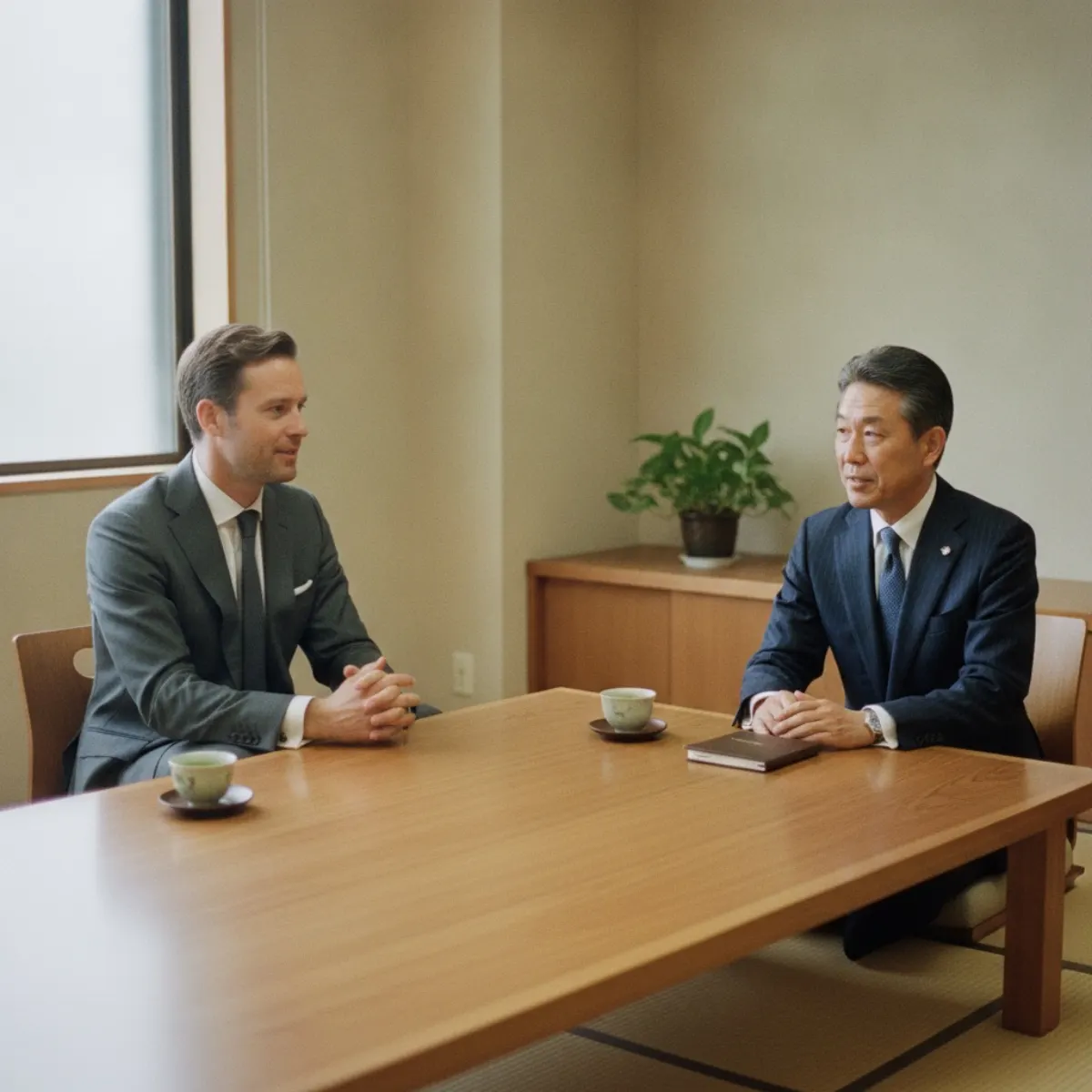
- The seating chart of the training matters. Mixed-team training, European and Japanese participants in the same room, surfaces the actual misreads in real time. Single-side training trains the half of the conversation that is usually not the problem.
- The triggers for commissioning training are predictable: a Japan posting, an M&A integration, a distributor consolidation, a new joint product launch, a board-level escalation of stalled Japan revenue. The cost of running training before the trigger is a fraction of the cost of running it after the deal has gone sideways.
Cross-cultural training for Japan that actually changes behaviour looks different from the training most European companies have bought. The half-day awareness workshop, the etiquette primer, the slide deck on nemawashi: these are entry points. They produce informed managers. They do not produce managers who close differently in their next Japanese meeting.
After eight years running cross-cultural growth marketing between the EU and Japan, in partnership with Takashi Kawatani (Diversity Management Institute, 35+ years, Global HR Excellence Award, 20,000+ alumni), the pattern is clear. The training that changes behaviour shares four features: it teaches the operating logic rather than the etiquette, it trains the line managers alongside the participants, it rehearses the actual conversations the team is about to have, and it builds a reinforcement loop after the room empties.
This is the working method we hand to European leadership teams before they take a Japan posting, sign a Japanese partnership, attempt an M&A integration, or try to recover a stalled distributor relationship. The specifics of the programme adapt to the trigger. The four features do not.
Feature 1: Teach the operating logic, not the etiquette
The visible layer of Japanese business culture, the business cards, the seating order, the gift-giving, the bowing, is the easiest to study and the least useful to learn first. A European who fumbles a meishi exchange but otherwise demonstrates careful preparation, patience, and the right reading of the room will be treated kindly. A European who executes the etiquette flawlessly but pushes for a same-day decision will not.
The training that changes behaviour leads with four cultural concepts that govern how decisions actually get made.
Nemawashi, the informal one-on-one consultation that happens before a formal meeting. Stakeholders are visited individually, objections are surfaced and resolved quietly, the proposal is shaped so the formal meeting is a confirmation, not a debate. Without nemawashi, a European partner is not in the meeting that matters.
Ringi, the formal document that records consensus and circulates up through every level of relevant management. Each person stamps or signs it. By the time it reaches the top, every line of authority has approved it. Ringi is why Japanese decisions are slow on the front end and exceptionally stable once made.
Honne-tatemae, the gap between the real opinion (honne) and the public position (tatemae): a form of social lubrication that allows a group to function without open conflict, more than any kind of deception. A European who reads only the tatemae will leave meetings believing things are agreed when they are not.
HoRenSo (hokoku, renraku, sodan, or report, inform, consult), the reporting cadence between juniors and seniors. Continuous low-volume updates upward, not weekly summaries. The European manager who is used to a Friday status report and silence in between is misreading the Japanese subordinate who sends three short messages a day as anxious or junior. The opposite is true.
These four concepts are the load-bearing logic. A training programme that runs through them in the first two hours, with case material specific to the team's sector and the actual Japanese counterparties they work with, produces participants who can read their next meeting differently the same week. A training programme that starts with business cards and arrives at nemawashi on slide 47 produces participants who can recite definitions.
For the depth treatment of each concept, see our pillar guide on Japanese business culture and the concept pages on nemawashi, ringi, and honne-tatemae.
Feature 2: Train the line managers, not just the participants
The most common failure pattern in cross-cultural training is local. A team returns from a half-day session enthusiastic, slightly intimidated by what they have learned, and ready to behave differently. Their line manager, who did not attend, asks for the same Friday status report they always asked for. Within two weeks the new behaviours have been redirected into the old patterns. The training did not fail. The reinforcement environment did.
The fix is structural, not extensive. A 30-minute briefing with the line manager before training begins, framing what the team will learn and what changes in their behaviour the manager should expect, accept, and reinforce. A 90-minute debrief with the same manager after training closes, walking through the new patterns and rehearsing the manager's role in them. Two hours of additional time, total. The reinforcement effect is roughly an order of magnitude larger than another half-day of participant training would have been.
The category of buyer most likely to skip this step is the Head of HR who treats training as a service delivered to a cohort. The buyer most likely to ask for it without prompting is the Head of Global Mobility who has watched a previous expat assignment unwind for reasons that look interpersonal but were structural.
If you are commissioning cross-cultural training for Japan and the provider does not include a manager-side component by default, ask for one. Most credible providers will add it. The cost is small. The cost of skipping it shows up in month three.
Feature 3: Rehearse the actual conversations, not generic role-play

Generic role-play is the lowest-yield component of most cross-cultural training programmes. A facilitator presents an abstract scenario, two participants improvise the conversation, the room observes, the facilitator debriefs. The scenarios are usually well-designed. They are also usually not the scenarios your team has on its calendar next month.
The training that changes behaviour does pre-training discovery first. Two hours of structured conversation with the participants and their line managers, before any session, surfaces the specific situations the team is currently working through. The Japanese partner who has gone quiet for three weeks. The distributor who keeps asking for more documentation. The board meeting in Tokyo where the European MD has to present a strategy that will not survive nemawashi unless it is reshaped first. The supplier who said kentou-shimasu ("we will consider it") two months ago and has not been heard from since.
These scenarios become the role-play. The Japanese counterparties are named. The actual emails are pulled from sent folders and read aloud. The facilitator (and ideally a Japanese co-facilitator) work the room through how the conversation could have gone differently, what specifically would have changed if nemawashi had been done, what the tatemae in the email was and what the honne probably was. By the time the session closes, the team has rehearsed three or four conversations they are actually about to have. The transfer rate from training room to live engagement is roughly five times higher than for generic scenarios.
Pre-training discovery is the single most undervalued input in this market. It is also the easiest for a vendor to skip, because it costs them two hours of senior time before the session begins. If your provider's intake form is a one-page brief, the discovery is not happening. Ask for the discovery interviews to be scheduled.
Feature 4: Build a reinforcement loop, not a smile sheet
Most cross-cultural training programmes end with a satisfaction survey collected as participants leave the room. The score is high, partly because participants are reflexively polite, partly because they have just been informed and feel informed. The survey is logged. The programme is recorded as a success. Three months later, the team's behaviour has drifted back to pre-training defaults.
Behaviour change has a half-life. The reinforcement loop is what extends it.
The mechanics are not complicated. At day 30, a 45-minute virtual check-in with the cohort, structured around three questions: which of the new patterns have you applied, where did you apply them, what happened. At day 60, the same check-in, with the line manager invited to attend the second half. At day 90, a written reflection from each participant against four observable behaviours defined at the start of the programme, scored one to five with a one-line example for each. The reflection takes 20 minutes to write. The cohort gets a one-page summary of the aggregate scores. The line managers get the breakdown for their direct reports.
This is the architecture that Forum Corporation Japan's 2026 corporate training research calls hard evidence of impact. It is also the architecture that most Japan-specific training providers do not currently deliver. The 2026 demand for measurable outcomes is outrunning the supply. The buyer who insists on 30/60/90-day follow-up gets it from a smaller set of providers than the buyer who does not insist.
When the timing actually matters
The triggers for commissioning cross-cultural training for Japan are predictable. Five repeat across most of the engagements we have seen.
A senior expatriate posting to Tokyo. The most obvious trigger. Pre-departure training, two to four weeks before the move, with a follow-up at 90 days post-arrival, prevents the most common first-year retention failures.
An M&A integration involving a Japanese counterparty. The cultural integration work runs in parallel with the financial and operational integration. Skipping it produces a deal that closes on paper and underperforms in execution. Programmes in this category are typically multi-month, with separate cohorts for the integration leadership, the operational teams, and the board.
Consolidation or renegotiation of distributor relationships. Japanese distributors are long-cycle counterparties. Renegotiating without understanding the nemawashi the distributor has already done internally produces a renegotiation that fails before the European side knows it has failed. A targeted programme for the renegotiation team, with rehearsal of the specific conversations, runs four to six weeks.
The launch of a new joint product with a Japanese partner. The friction in joint launches is rarely product. It is process, sequencing, decision rights, and reporting cadence. A two-session programme that aligns the European product team with the Japanese partner team on these four dimensions, ideally with both teams in the same room, prevents the launch from stalling in the first ninety days.
A board-level escalation of stalled Japan revenue. This is the most expensive trigger because it is reactive. The training is being commissioned because the previous behaviour did not work. The engagement is larger, the scope is unclear, and the political stakes are higher. Annual refreshers for established Japan teams catch this drift before it produces the escalation.
The cost of running training before a trigger is a small fraction of the cost of running it after. The pattern repeats across our discovery calls. Companies that book training proactively, often around year-end for the following year, spend less and get more.
What gets in the way
Three patterns recur in the post-mortems of training programmes that did not change behaviour. They are usually compatible, often combined, and rarely the fault of the trainer.
Buying for awareness, then expecting application. The mismatch between the format purchased and the outcome required. A half-day workshop produces awareness. Behaviour change in the next Japanese meeting requires pre-work, scenario practice, manager engagement, and post-training reinforcement. The framing of the purchase as "we need to do some Japan training" rather than "we need this specific team to handle this specific engagement differently" is the source of the mismatch.
Buying for the team but not for the line managers. Covered in feature 2 above. The reinforcement environment dilutes the training within weeks.
Buying once and never again. Cross-cultural fluency degrades like language fluency. A team trained in 2024 has lost meaningful capability by 2026 unless reinforced. Annual refreshers, executive coaching for senior leaders, integration into new-hire onboarding: this is how the better-resourced teams maintain it. Most teams do not. The cost shows up two years later, in the next Japan engagement that goes sideways.
Every programme in our training catalogue is built on these four features; the flagship Japan course below shows them end to end.
How we run it
Where Silkdrive fits, transparently. We deliver cross-cultural training for Japan in partnership with Takashi Kawatani, who anchors the Japan-side facilitation. The standard intake includes pre-training discovery interviews with the cohort and their line managers, a customised curriculum built around the team's live engagements, mixed-team delivery where the situation warrants it, manager briefings before and after the sessions, and a 30/60/90-day reinforcement loop.
We are a strong fit if your team is Dutch, German, Belgian, or Nordic, if you want dual-direction training (EU to Japan and Japan to EU as standard, not as bolt-on), if you want the Kawatani trainer profile specifically, and if you want measurable 90-day outcomes you can report to leadership. The full programme structure, indicative pricing, and FAQ are on our cross-cultural training for Japan landing page.
We are not the right choice if you need on-site delivery inside Japan only (Inventure or Japan Intercultural Consulting are stronger), a certified 30-hour protocol course (ICPA is the standard), or a US-multinational delivery footprint at scale (Japan Intercultural Consulting). The honest positioning across the credible providers in this market is in our providers compared guide, which scores Silkdrive against five established competitors on seven criteria.
If you want to evaluate an engagement, the next step is a discovery call. We will tell you, before quoting, whether the format you have in mind matches the outcome you need.
Further reading
- Japanese Business Culture: A Working Guide for European Companies, the framework anchor for the cluster.
- Cross-Cultural Training for Japan: Providers Compared (2026), the seven-criterion provider scorecard.
- Nemawashi: Japanese Decision-Making, the concept page.
- Ringi: The Japanese Approval Process European Sales Teams Keep Misreading, the procedural counterpart.
- Honne and Tatemae: Reading What Japanese Partners Actually Mean, the interpretation primer.
- How Much Does Cross-Cultural Training Cost?, the pricing breakdown.
Stay Ahead in Cross-Cultural Marketing
Get monthly insights on international growth strategies, cultural intelligence, and digital marketing trends delivered to your inbox.
We respect your privacy. Unsubscribe at any time.