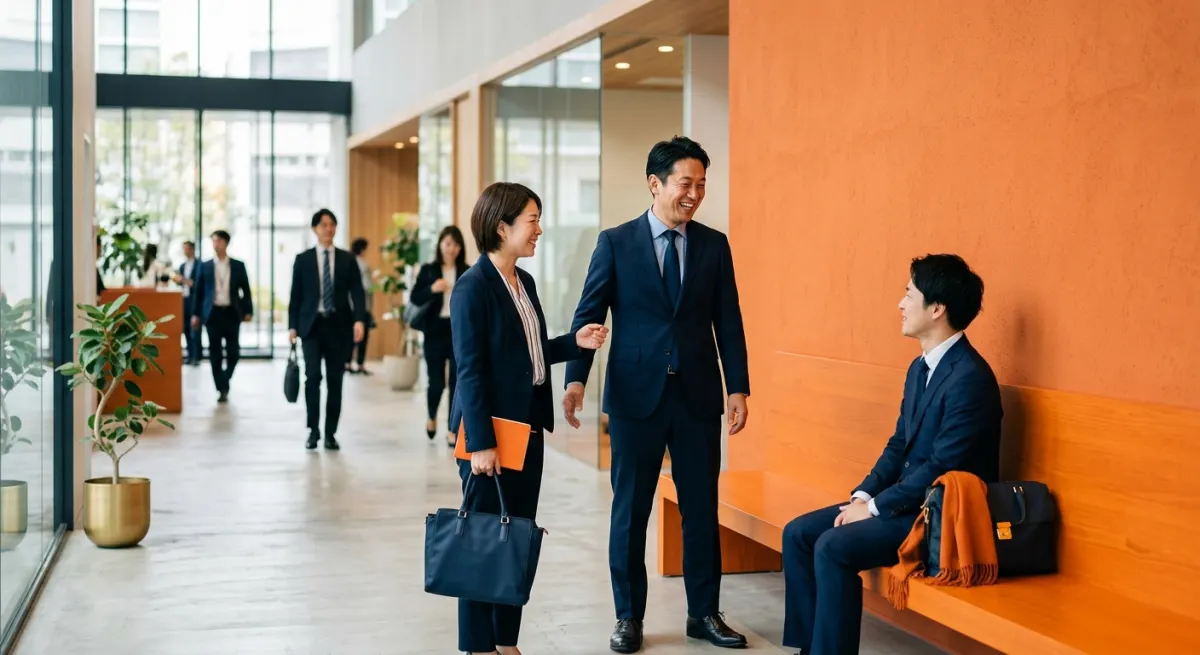
Japanese Business Terms: A Glossary for European Executives
A scannable reference to the Japanese business vocabulary a European operator actually needs: nemawashi, ringi, honne and tatemae, meishi, keiretsu, kaizen, monozukuri, omotenashi, hanko, hou-ren-sou and more, grouped by theme with what each term means for a European doing business in Japan.
Part of our Cross-Cultural Leadership series. Start with the full guide: Japanese Business Culture: A Working Guide for Europeans
- This is a working reference to the Japanese business vocabulary a European operator meets in practice, grouped into five themes: decision-making, relationships and communication, etiquette, organisation and hierarchy, and quality and operations
- Each entry gives the term in romaji and, where the kanji is standard and reliable, in Japanese, plus a short definition, why it matters to a European doing business in Japan, and a one-line note on how to use it
- Most of these terms describe a system. Nemawashi, ringi and ringisho describe how a decision actually gets made; honne and tatemae describe how candour is rationed; omotenashi describes the service bar your firm is measured against
- The vocabulary is strongest in established large firms and traditional supplier relationships, and weaker or differently expressed in startups, tech, foreign-owned subsidiaries and among younger employees; surface practices such as seals and company drinking have changed fast, while the underlying preferences have not
- Where a term has a deeper Silkdrive guide, the entry links to it, so this page works as the index to the rest of our Japan material
- Some operational and shop-floor terms are widely used in Japanese industry but are not yet anchored to a source in our verified claims database; those definitions are marked accordingly so you can treat them as working definitions rather than cited fact
Most glossaries of Japanese business terms are word lists. You look up a term, get a one-line gloss, and move on. That is fine for a crossword and useless for an operator, because the terms that matter are the visible surface of a system, and the system is what trips up European executives.
This glossary is built for the operator. It covers the Japanese business vocabulary a European actually meets in practice, grouped into five themes so you can see how the terms connect: decision-making, relationships and communication, etiquette, organisation and hierarchy, and quality and operations. Each entry gives the term in romaji, the kanji where the written form is standard and reliable, a short definition, a note on why it matters to a European doing business in Japan, and a one-line note on how to use it.
It is also the index to the rest of our Japan material. Several terms here have a full Silkdrive article, and the entry links straight to it, so you can scan the glossary for orientation and then go deep where you need to. After more than a decade of cross-cultural growth work between Europe and East Asia, and through work delivered as an EU-Japan Centre for Industrial Cooperation expert, the same vocabulary keeps deciding outcomes. Learn it as a system, not a list.
One note on the kanji. In English-language business you never need to write or read it; the romaji is standard. We include kanji only where the written form is settled and useful as a memory aid, and we give the romaji alone where the standard form is ambiguous or we could not confirm it. An ambiguous character is omitted, not guessed.
Which Japan are we describing?
Every term below is real and in current use, but the settings where they carry the most weight are not the whole country. This vocabulary is strongest in established large firms, long-tenure manufacturers, traditional supplier relationships, and older hierarchical organisations, which is also where most of the sources cited here did their fieldwork. It is weaker, or expressed differently, in startups, much of the tech sector, foreign-owned subsidiaries, and among younger employees.
Two kinds of change move at different speeds, and it is worth separating them. Surface practices shift fast: seal-based approval has been giving way to electronic workflow, and company drinking has measurably declined since 2019. Underlying preferences shift slowly: relationship-based trust before transactions, indirectness that protects harmony and face, and consensus built before the meeting rather than inside it are all still doing the same work they did twenty years ago.
Read the glossary with that filter on. Facing a sixty-year-old bucho at a listed manufacturer, expect the full system. Facing a thirty-two-year-old product lead at a Tokyo software company, expect the deep preferences with much less of the ritual.
How to use this glossary
Use the index below to jump to a theme or a term. Each theme opens with the terms most worth knowing. If you read only one section, read decision-making: it explains the single behaviour Europeans misread most often, the meeting where nothing seems to get decided.
Decision-making
How a decision actually gets made: nemawashi, ringi, ringisho, hanko, hou-ren-sou, makaseru, chosei.
Relationships and communication
How candour is rationed and rapport is built: honne, tatemae, aizuchi, chinmoku, giri, ninjo, uchi, soto, amae, wa, kuuki, omoiyari, kikubari, aisatsu, nominication.
Etiquette
The visible protocol: meishi, aisatsu, the san suffix, gift-giving (omiyage, oseibo), omotenashi.
Organisation and hierarchy
Who outranks whom and how groups are structured: bucho, kacho, senpai and kohai, keiretsu, tanshin-funin.
Quality and operations
How work gets done well: kaizen, monozukuri, 5S, hansei, ganbaru, mottainai, saihatsu boshi.
Decision-making
This is the cluster that explains the behaviour European executives misread most often: the meeting that feels attentive but decides nothing. It decides nothing because the deciding happens elsewhere.
Nemawashi (根回し)
The informal, one-on-one consultation that happens before a formal decision. You present an idea to each relevant stakeholder, listen, adjust, and move on, so that by the time the formal meeting happens everyone has already been brought along.1
Why it matters. This is the concept that explains the most about Japanese decision-making. A European who skips it and tries to negotiate in the meeting finds a room that is polite, attentive, and impossible to move, because no one will commit to something their colleagues have not been consulted on.
How to use it. Arrive early, request individual conversations with stakeholders before the group meeting, and do not push for an in-room yes. Full method in our guide to how Japanese companies actually make decisions through nemawashi.
Ringi (稟議) and ringisho (稟議書)
Ringi is the formal, document-based approval process that follows nemawashi. The proposal is written up as a ringisho, a formal request document that circulates through the organisation, with each stakeholder marking approval as it moves from junior to senior.1
Why it matters. If a Japanese partner asks for a formal written proposal, that is the start of the ringi paperwork, not the start of the decision. The decision was being built informally through nemawashi well before the document appeared.
How to use it. Treat the request for a formal proposal as a sign the groundwork is working, not as the negotiation opening. See our article on the ringi approval process.
Hanko (判子) and inkan (印鑑)
A personal seal used in place of a signature to approve documents, including the ringisho. The seal is pressed in red ink. Managers who approve stamp the document in the prescribed place, and a manager who does not approve shows it by passing the document on unstamped.23
Why it matters. It is the mechanism by which consensus becomes a record, and the silent no is part of it: nothing has to be said out loud for a proposal to stall. A ringisho that has collected every seal but the most senior one is, in effect, already approved.
How to use it. You will not personally stamp anything, but recognise that seal collection is the visible progress bar of an approval, and that a missing seal means a stakeholder is not yet aligned. One-page reference, including why Japanese law makes the seal rather than the signature the provable mark: hanko, and why Japan signs with a seal.
A caveat on currency. Physical seals have been giving way to electronic approval workflows, particularly since the 2020 administrative push to strip seal requirements out of Japanese procedure and the remote-work shift that followed. Treat the seal as the visible form rather than the substance: where the stamps have gone digital, the circulation order, the collection of approvals and the unstamped no all still work exactly as described.
Makaseru (任せる)
To delegate or entrust a task or decision fully to someone, handing them latitude to act.
Why it matters. A European may read makaseru as a clean handover of authority, then be surprised when the delegate still consults widely before acting. Entrusting a task does not suspend the consensus norms around it.
How to use it. When you entrust work to a Japanese counterpart, confirm what they are authorised to decide alone versus what still needs broader sign-off, rather than assuming full autonomy.
Chosei (調整)
Coordination or adjustment: the ongoing work of aligning interests, schedules, and positions among parties so that things fit together smoothly.
Why it matters. Much of what looks like delay in a Japanese organisation is chosei in progress: the active labour of fitting a proposal to everyone's constraints before it surfaces.
How to use it. When you hear that something is being coordinated, treat it as active work with a real timeline, not as a stall, and ask what specifically still needs to be aligned.
Hou-ren-sou (報告・連絡・相談)
A contraction of houkoku (report), renraku (contact or inform), and soudan (consult): the expected rhythm of keeping colleagues informed early and often, sharing sideways as well as upward, and consulting before acting.
Why it matters. Many Japanese teams treat frequent status-sharing as a basic professional duty. A European who works in the European default of going quiet between milestones and surfacing only the finished result can read as unreliable.
How to use it. Over-communicate status by European standards: short, frequent updates land as conscientious. Silence between milestones reads as a problem, not as quiet progress.
Relationships and communication
This cluster governs how candour is rationed and how rapport gets built. The central pair, honne and tatemae, is the one a European must internalise to read a Japanese counterpart accurately.
Honne (本音) and tatemae (建前)
Honne is a person's true feeling or real opinion. Tatemae is the public-facing position that is appropriate to express in a given setting. The Japanese distinguish the two deliberately as a way of keeping the group functioning.3
Why it matters. This is the pair that costs European teams the most when it is misread. Polite, non-committal language in a meeting is often tatemae, not agreement, and European optimism turns "we will study this" into a forecast that never lands.
How to use it. Do not treat tatemae as a yes. Expect honne to surface later and informally, which is one reason the business dinner matters. Full treatment in our guide to honne and tatemae in Japanese communication.
Wa (和)
Harmony: the preservation of smooth, friction-free group relations, treated as a high social priority.45
Why it matters. Wa is the reason for much indirectness. Open disagreement that a Dutch or German executive treats as healthy debate can register as a threat to harmony, and therefore as rudeness.
How to use it. Raise disagreement privately and gently rather than in the room. Preserving wa is how candour is delivered without anyone losing face.
Face: kao wo tateru (顔を立てる) and mentsu (面子)
Face is a person's social standing and dignity in the eyes of the group. Causing someone to lose face, or losing your own, damages the relationship.45
A note on the vocabulary, because English-language sources often get this wrong. There is no single Japanese noun that maps onto "face" the way the English word is used in cross-cultural writing. What Japanese actually uses is the verb phrase kao wo tateru, literally to stand someone's face up, meaning to let them keep their standing; its opposite kao ga tsubureru, for a face that has been crushed; and the noun mentsu, borrowed from Chinese, in expressions such as mentsu wo tsubusu, to destroy someone's face. If you use a term, use one of those rather than kao on its own.
Why it matters. Many etiquette and communication norms exist to protect face on both sides. Correcting a counterpart publicly, or forcing a flat no, makes someone lose face and is rarely forgiven quietly.
How to use it. Give people a graceful exit. Frame disagreement as a shared problem to study rather than as an error to expose.
Kuuki (空気)
Literally "air" or "atmosphere": the unspoken mood of a situation that participants are expected to read. The phrase kuuki wo yomu, to read the air, describes sensing what is appropriate without it being said.
Why it matters. A great deal of meaning in a Japanese meeting is carried by the atmosphere rather than the words. A European who tracks only the literal content misses half the conversation.
How to use it. Watch reactions, pauses, and who defers to whom as carefully as you listen to the words, and check your read with a trusted local contact afterward.
Omoiyari (思いやり) and kikubari (気配り)
Omoiyari is empathy or considerate concern for others; kikubari is the attentive, anticipatory care of noticing and meeting others' needs before they are voiced.
Why it matters. These are the relational engine behind omotenashi and much else. Demonstrating that you have noticed and anticipated a counterpart's needs builds trust faster than any pitch.
How to use it. Anticipate the small things: send the promised document early, remember a preference mentioned once, and never make a partner chase you. Attentiveness is read as character, not just service.
Aisatsu (挨拶)
Greetings and the ritual courtesies of opening and closing an interaction: the bow or handshake, the set phrases, the acknowledgement of the other person.
Why it matters. Aisatsu sets the tone and signals respect before any substance. Skipping or rushing it reads as carelessness about the relationship.
How to use it. Greet the most senior person first and reciprocate the gesture you are offered, usually a handshake with a slight nod. Detail in our Japanese business etiquette guide for European executives.
Aizuchi (相槌)
The short listener sounds and nods produced while the other person is still speaking: hai hai, sou sou, ee, with steady head movement. They signal attention and an invitation to continue, not agreement.67
Why it matters. Reading continuous nodding as agreement is the single most misread signal for Europeans, and it is how a room that felt persuaded turns out to have agreed to nothing.
How to use it. Give more acknowledgement than feels natural on a call, and watch for it stopping rather than for it happening. One-page reference: aizuchi, and why a Japanese listener keeps nodding.
Chinmoku (沈黙)
Silence, treated as carrying meaning rather than as a gap. In a meeting it is often digestion time; it also appears among refusal signals, and which one applies depends on the situation.8
Why it matters. The European reflex is to fill it, which ends the thinking the pause was for. The costlier version is outside the meeting: nobody chasing you is not evidence that a matter closed.
How to use it. Do not press individuals for opinions; give the group a short break to confer. One-page reference: chinmoku, and how silence works in a Japanese meeting.
Giri (義理) and ninjo (人情)
Giri is a debt of gratitude discharged by returning favours, held by everyone and tracked carefully. Ninjo is human feeling, what a person would do from warmth rather than obligation.89
Why it matters. English collapses both into goodwill, so a European cannot tell whether a counterpart is being warm or settling an account, and the two carry different expectations.
How to use it. Notice the ledger, do not try to run it. One-page reference: giri, the Japanese ledger of obligation.
Uchi (内) and soto (外)
Inside and outside. The pair marks who counts as part of the group in a given situation, and the assignment moves with the situation rather than attaching to people: two departments are soto to each other until their company negotiates with another, at which point all of them are uchi.10
Why it matters. This is the pair that decides which register you get, and honne and tatemae sit inside it. Whether you are on the inside of the line matters more than whether your counterpart likes you.
How to use it. Work out which side of the boundary the current situation puts you on before you read anything into a short answer. One-page reference: uchi and soto, the Japanese in-group boundary.
Amae (甘え)
Glossed in English as dependency: the expectation of being looked after within a relationship. The gloss belongs to the authors who use it in cross-cultural work rather than to a settled translation, and the concept's standing in the scholarship is contested.11
Why it matters. Its documented business use is narrow: Japanese advertising is described as building a relationship with the consumer through an indirect approach rather than arguing a product case.
How to use it. Use it to read creative, not to read a person. One-page reference: amae, and its limits.
Nominication (飲みニケーション)
A portmanteau of nomu (to drink) and "communication": the relationship-building and frank conversation that happens over drinks after work, often where honne becomes accessible.
Why it matters. The after-hours drink is a setting where evaluation and candid conversation happen beyond the tatemae of the formal room. It is also the single practice in this glossary that has changed most, and a European briefed on 2010s advice will overestimate it.
How much it has changed. In 2024 only 59.6% of Japanese companies held a year-end or New Year party, almost twenty percentage points below 2019, and in a Persol Research Institute survey reported in 2025 close to 80% of respondents regarded criticism for not attending a drinking party, or for not pouring drinks, as harassment.12 The practice survives; the obligation attached to it does not.
How to use it. Treat an invitation as a genuine opportunity and accept where you can, but do not read a declined invitation as a snub, and never imply that attendance is expected of anyone on your own side. If you go: pour for others before yourself, wait for the senior person's first toast, and stay attentive.
Etiquette

The visible protocol. These are the terms behind the most-written-about rituals, but the rituals matter because of what they signal about preparation and respect.
Meishi (名刺)
A business card. In Japan the meishi exchange is a structured ritual at the start of a meeting, not an afterthought, and the card is an identity document for the conversation.
Why it matters. The exchange is how everyone establishes names, titles, and rank for the rest of the meeting. Mishandling the card, by glancing and pocketing it, signals you did not take the person seriously.
How to use it. Present and receive with both hands, Japanese side facing the recipient, most senior first; lay received cards on the table to mirror the seating. One-page reference: meishi, the Japanese business card exchange. Full mechanics in the etiquette guide.
The san suffix (さん)
An honorific added to a name, roughly equivalent to a respectful Mr or Ms but used far more widely, including with first names and in many professional contexts.
Why it matters. Using a counterpart's family name plus san is the safe, respectful default. Jumping to first names or dropping the honorific, a Dutch or American reflex, can read as over-familiar.
How to use it. Address counterparts as [family name]-san until invited to do otherwise. Never add san to your own name.
Omiyage (お土産) and oseibo (お歳暮)
Omiyage is a souvenir brought back from a trip and shared with colleagues or hosts; oseibo is the customary winter gift exchanged to thank those one is indebted to, with a summer counterpart, ochugen.
The distinction worth getting right: the gift you carry when you go and visit someone is temiyage (手土産), not omiyage. English business writing routinely uses omiyage for both, which is understood but slightly off. If you bring a regional specialty to a first meeting in Tokyo, that is temiyage; if you bring one back to your Japanese colleagues after a trip, that is omiyage.
Why it matters. Gift-giving is established relationship work, not a bribe, and the European reflex to spend more to show respect misfires. Thoughtfulness and correctness outrank cost, and reciprocity runs deep.
How to use it. Bring a quality regional specialty from home, present it modestly with both hands, avoid sets of four and funeral-white wrapping, and keep the value modest enough not to create an awkward obligation.
Omotenashi (おもてなし)
Anticipatory, selfless hospitality: service that meets a need before the guest expresses it and expects nothing visible in return.138
Why it matters. Omotenashi is the ambient standard, and it sets the bar your firm is measured against. On the commercial payoff, treat the numbers as reported rather than settled: an EU-Japan Centre report on digital marketing for Japan cites survey figures of 50.8% of satisfied customers sharing that satisfaction by word of mouth against 4.1% of dissatisfied ones, and does not name the underlying survey. The direction is well attested even where the precision is not, and the service-expectation comparison behind it comes from a study of clothing retail in Japan and Sweden rather than from B2B.
How to use it. Treat responsiveness and anticipation as core deliverables, not courtesies extended when you have spare capacity. Reply within hours, send the promised material early, and never make a partner chase you. One-page reference: omotenashi as a service standard.
Organisation and hierarchy
Who outranks whom, and how groups are structured. Hierarchy in Japan is structural rather than decorative, so these terms carry operational weight.
Bucho (部長) and kacho (課長)
Common management titles: bucho is a department or division general manager, kacho is a section or unit manager who typically reports to a bucho.
Why it matters. Titles map directly to rank, and rank determines who you address, who decides, and the seating order. Misreading a kacho for the decision-maker, or vice versa, wastes your nemawashi effort on the wrong person.
How to use it. Confirm each counterpart's title at the meishi exchange and direct the substance of your case to the right level, while still consulting the others.
Senpai (先輩) and kohai (後輩)
Senpai is a senior or more experienced colleague; kohai is the junior. The relationship carries mutual obligation: the senpai mentors and looks out for the kohai, who in turn shows deference and support.
Why it matters. It is one of the structures behind Japan's vertical orientation. Seniority earned through years in the organisation often outranks formal title in informal influence.
How to use it. Respect length of tenure and age, not just job grade, when you read who carries weight in a room.
Hierarchy and respect by age, status, and rank
In Japanese business culture, the respect a person enjoys depends primarily on age, status, and rank, and the individual has traditionally derived identity from group affiliations such as family, school, and company.935
Why it matters. Hierarchy is structural, not symbolic. The order in which you greet, seat, and address people is the protocol that keeps the system coherent, and you are met first as a representative of your organisation.
How to use it. Match your delegation's seniority to the Japanese side, respect the rank order strictly, and do not press a junior counterpart for a commitment they cannot make.
Keiretsu (系列)
A network of companies linked by cross-shareholdings and long-term trading relationships, often clustered around a major bank or a large manufacturer and its suppliers.
Why it matters. The classic keiretsu has loosened since the 1990s, but the underlying preference for durable, trust-based supplier relationships over lowest-bid procurement persists. Breaking into an established supply relationship is slow and relationship-led.
How to use it. Do not expect price alone to displace an incumbent supplier inside a group. Plan for a long, relationship-first entry, and look for the gaps an incumbent cannot serve. One-page reference: keiretsu and how Japanese business groups work.
Tanshin-funin (単身赴任)
A work assignment, often a transfer or posting, taken up by an employee who relocates alone while their family stays behind, common in Japanese corporate life.
Why it matters. It signals how far loyalty to the employer can extend into personal life, and it is part of the context behind long tenures and deep company identification.
How to use it. When a Japanese counterpart relocates for a posting, recognise the personal cost involved; it is a mark of commitment to the organisation, not merely a career move.
Quality and operations
How work gets done well. These shop-floor and mindset terms shape the quality bar a Japanese partner expects, and several have entered global management vocabulary.
Kaizen (改善)
Continuous, incremental improvement: many small changes to a process, made continuously and often by the people doing the work, rather than occasional large overhauls.
Why it matters. Kaizen is one of Japan's best-known exports to global management, and it sets an expectation that process is never finished. A partner may expect visible, ongoing refinement, not a one-time fix.
Do not over-mystify it. In everyday Japanese, kaizen is simply the ordinary word for "improvement" and carries no special charge; a Japanese colleague uses it about a spreadsheet. The philosophical weight the term carries in English is largely a Western management reception of Toyota production practice. Using it reverently in a Tokyo meeting sounds odd. Using it plainly does not.
How to use it. Show that you improve your own processes continuously and welcome small corrections; treating quality as an endpoint rather than a habit reads as complacency.
Monozukuri (ものづくり)
The craft and mindset of making things well: a pride in manufacturing and the pursuit of quality in the act of production itself.
Why it matters. Monozukuri explains why kaizen is taken so seriously. It is closer to a value than a method, and it raises the bar a Japanese manufacturing partner expects from a supplier.
How to use it. Demonstrate attention to how something is made, not just to the finished result; respect for the craft of production builds credibility with manufacturing counterparts.
5S: seiri, seiton, seiso, seiketsu, shitsuke (5S)
A workplace-organisation method built on five steps: seiri (sort), seiton (set in order), seiso (shine or clean), seiketsu (standardise), and shitsuke (sustain).
Why it matters. 5S is a visible signal of operational discipline and supports much Japanese shop-floor practice. A workplace that visibly runs on 5S expects partners to share that standard of order.
How to use it. If you visit or host a site, recognise that order and cleanliness are read as proxies for quality and reliability, not just housekeeping.
Hansei (反省)
Honest self-reflection: a structured look back at what went wrong and what could be improved, even after an apparent success, without defensiveness.
Why it matters. Hansei is why a Japanese team may dwell on shortcomings after a result a European would call a win. This reflection is the engine of improvement, closely tied to kaizen.
How to use it. Join the reflection rather than rushing to celebrate. Acknowledging what could have gone better signals maturity and shared commitment to quality.
Ganbaru (頑張る)
To persevere, to do one's best, to push through with effort and endurance. The encouragement ganbatte means roughly "do your best" or "hang in there".
Why it matters. Visible effort and persistence are valued in their own right, sometimes independently of the immediate result. A European who emphasises only outcomes may undervalue demonstrated commitment.
How to use it. Recognise effort and endurance, not just deliverables, when you work with or manage a Japanese team.
Mottainai (もったいない)
A sense of regret at waste: the feeling that something useful is being thrown away or not used to its full value.
Why it matters. Mottainai underlies a cultural aversion to waste that shows up in resourcefulness, careful use of materials, and frugality, sometimes at odds with European assumptions about scale and disposability.
How to use it. Frame efficiency and waste-reduction as shared values; they resonate, and visible wastefulness can read as carelessness.
Saihatsu boshi (再発防止)
Recurrence prevention: the disciplined practice of identifying the root cause of a problem so that the same problem does not happen again, rather than just fixing the immediate symptom.
Why it matters. When something goes wrong, a Japanese partner often expects a credible root-cause analysis and a prevention plan, not just an apology and a quick patch. A symptom-level fix can read as not taking the problem seriously.
How to use it. After an error, lead with the root cause and the measures that will stop it recurring; this is the response a Japanese counterpart is looking for.
How the terms connect
Read individually, these are vocabulary. Read together, they are one system. Hierarchy and group identity set the structure; wa, face, honne and tatemae govern how candour moves inside that structure; nemawashi, ringi and hou-ren-sou are how a decision is built and recorded; omotenashi, kaizen and monozukuri set the quality and service bar; and the etiquette terms are the visible surface that signals whether you understand the rest.
- 1
Structure
Hierarchy by age, status, and rank, plus group-anchored identity, set who decides and who you address.
- 2
Candour control
Wa, face, and the honne/tatemae split ration how directly anything difficult gets said.
- 3
Decision build
Nemawashi builds consensus informally; ringi and the ringisho record it; hanko seals mark approval.
- 4
Execution rhythm
Hou-ren-sou keeps the team aligned; chosei coordinates; kaizen and saihatsu boshi keep quality improving.
- 5
Relationship bar
Omotenashi, omoiyari, and the etiquette terms set the standard your firm is measured and remembered by.
A European who learns the words but not the connections will still misread the meeting. A European who sees the system can use this glossary as a map, not a dictionary.
Where to go deeper
This glossary is the index. For the systems behind the terms, the Silkdrive deep-dives are the next step:
- Nemawashi: how Japanese companies actually make decisions, the informal consensus engine
- The ringi approval process, the formal documentation that follows nemawashi
- Honne and tatemae in Japanese communication, how candour is rationed
- Japanese business etiquette for European executives, the full protocol system behind meishi, gifts, dining, and omotenashi
- Japanese business culture, the underlying cultural framework: hierarchy, wa, and group identity
- Japanese work culture, how these norms play out day to day inside a Japanese workplace
- The complete guide to Japan market entry for European companies, where this vocabulary sits inside a real expansion
For team-level preparation, our cross-cultural communication training and Japan negotiation training turn this vocabulary into rehearsed practice, and our Japan expert network connects you with specialists who have run these dynamics in real deals.
The bottom line
The Japanese business terms that matter to a European operator are the visible surface of a coherent system. Learn the decision-making cluster first, because it explains the meeting that decides nothing. Learn honne and tatemae next, because they explain why polite is not the same as yes. The rest of this glossary fills in the relationships, etiquette, structure, and quality vocabulary around that core. Use it as a map, link through to the deep-dives where you need them, and treat the terms as a system rather than a list.
This glossary is written by Patric Sawada, founder of Silkdrive and an EU-Japan Centre for Industrial Cooperation expert, drawing on more than a decade of cross-cultural growth work between Europe and East Asia. The cultural claims are anchored to peer-reviewed and institutional sources where available. Several operational and shop-floor terms in widespread use in Japanese industry are given as working definitions and flagged in the source notes, because they are not yet anchored to a citable source in our verified claims database; treat those as practical guidance rather than cited fact.
References
-
Sagi, S. (2015). "Ringi System": The Decision Making Process in Japanese Management Systems: An Overview. International Journal of Management and Humanities, Vol. 1, Issue 7. On nemawashi and the ringi approval process. ↩ ↩2
-
Haghirian, P. (ed.) (2016). The Routledge Handbook of Japanese Business and Management. Routledge. On the mechanics of stamping a ringi document, including disapproval by passing it on unstamped. ↩
-
JETRO / Gundling, E. (1999). Communicating with Japanese in Business. JETRO. On honne and tatemae, and group-anchored identity. ↩ ↩2 ↩3
-
Ciubancan, M. (2015). Principles of communication in Japanese: indirectness and hedging. Romanian Economic and Business Review. On wa, face, and indirectness. ↩ ↩2
-
Adachi, Y. (2010). Business Negotiations between the Americans and the Japanese. Global Business Languages. On Japan as a vertical society and the social priority of harmony. ↩ ↩2 ↩3
-
Maynard, S. (1986). Comparative study of back channel in Japanese and American casual conversation. Twelve pairs; the counts are an exemplar corpus, not a national sample. ↩
-
Angela Kessel, EU-Japan Centre for Industrial Cooperation, webinars 93 and 124. On aizuchi as attention rather than agreement, on Japanese refusal signals, and on giving a group a break rather than pressing individuals. ↩
-
EU-Japan Centre for Industrial Cooperation (https://www.eu-japan.eu/). Building a Robust Digital Marketing Strategy for Japan. On word-of-mouth behaviour among satisfied Japanese customers (50.8% versus 4.1%). ↩ ↩2 ↩3
-
Katz, L. (2008). Negotiating International Business: Japan. On respect deriving from age, status, and rank. ↩ ↩2
-
Cattelain, E. (2014). Uchi-Soto. Key Concepts in Intercultural Dialogue, No. 43, Center for Intercultural Dialogue. A two-page open-access reference sheet citing Bachnik & Quinn (1994) and Makino (2002); those underlying works were not read. ↩
-
de Mooij, M. (2011), and Moriuchi, E., in Haghirian, P. (ed.) (2016), citing De Mooij and Hofstede (2011). On Japanese advertising building a relationship with the consumer, a dependence named as amae. ↩
-
Nippon.com Japan Topics (2025). Nominication: Japan's Changing Culture of Company Drinking, reporting Tokyo Shoko Research and Persol Research Institute survey data. On the decline of company drinking parties and shifting attitudes to attendance. ↩
-
The Customer is God: Japanese Service Culture in Clothing Stores (2007). Stockholm School of Economics master thesis. On Japanese customer service expectations versus a European (Swedish) baseline. ↩
Stay Ahead in Cross-Cultural Marketing
Get monthly insights on international growth strategies, cultural intelligence, and digital marketing trends delivered to your inbox.
We respect your privacy. Unsubscribe at any time.