Japanese Etiquette for European Executives: The Country-by-Country Delta
What changes for European executives specifically in Japan: how far Dutch, German, and French baselines each have to move on greetings, directness, hierarchy, decision pace, gifts, and dining, with a country-by-country delta table.
Part of our Cross-Cultural Leadership series. Start with the full guide: Japanese Business Culture: A Working Guide for Europeans
- Japanese business etiquette is one connected protocol system, not a checklist; greetings, meishi, gifts, dining, omotenashi, and customer service all run on the same logic of preparation, hierarchy, and reciprocal obligation
- The single most useful working method is to read every protocol as a signal of how seriously you take the relationship, then calibrate your home-country defaults against it rather than memorising rules
- Dutch, German, and French executives each start from a different cultural baseline, so the same Japanese protocol requires a different size of adjustment for each; this guide gives a country-by-country delta table
- The Hofstede masculinity gap between Japan (95) and the Netherlands (14) is one of the widest of any EU-Japan bilateral pair, which is why Dutch directness needs the most deliberate translation
- Omotenashi (anticipatory hospitality) and the Japanese standard of customer service set the bar your European company is measured against from the first meeting onward
For a European executive, the protocol is the easy half. The hard half is how far you personally have to move to reach it, and that distance depends on the country you are travelling from. The Hofstede masculinity gap sets the scale: 81 points between Japan (95) and the Netherlands (14), against 66 for Germany and 43 for France (Hofstede Insights).
That is what makes this guide different from a general protocol reference. The rules themselves, greetings, meishi, seating, gifts, dining, correspondence, are set out in our pillar guide to Japanese business etiquette. This page assumes you have those and asks the question that follows: what specifically changes for a Dutch director, a German Mittelstand owner, or a French luxury-brand manager, each walking into the same Tokyo meeting room carrying different defaults and each needing to move a different distance to land in the same place.
Three things are different for Europeans in particular. Most published etiquette advice is US-coded, so the deltas it implies are the wrong ones for a European baseline. The European starting points are unusually far apart from each other, so a single "European" adjustment does not exist. And the widest measured gap of the three, the 81 points between the Dutch and Japanese masculinity scores, belongs to the largest European investor in Japan, so the executives who most need the translation are among the most likely to be making the trip (see our Japan-Netherlands corridor analysis).
The working method is calibration rather than memorisation. Greetings, the meishi exchange, gift-giving, dining, omotenashi, and the Japanese standard of customer service all run on the same underlying logic: that visible preparation, correct reading of hierarchy, and reciprocal obligation are how seriousness gets signalled. Once you see the logic, you stop reciting individual rules and start adjusting your own home-country defaults against a coherent standard. The country-by-country delta table below is where that adjustment gets specific.
This is the reference we hand to European leadership teams before they take a Japan posting, host a Japanese delegation in Amsterdam or Frankfurt, or fly to Tokyo to open a partnership. After more than a decade of cross-cultural growth work between Europe and East Asia, and through work delivered as an EU-Japan Centre for Industrial Cooperation expert, the same patterns repeat. The protocols matter. The attitude they reveal matters more.
Why etiquette in Japan is an information system, not decoration
In most European business cultures, etiquette is social lubrication. It makes interactions smoother but rarely decides outcomes. A Dutch executive who skips small talk and opens with the price is direct, perhaps abrupt, but the proposal is still judged on its merits.
Japan works differently. Etiquette is closer to an information-gathering system. When a Japanese executive watches you enter the room, greet the team, exchange cards, choose a seat, and handle the first twenty minutes, they are reading signals about your preparation and your grasp of how the relationship should work.
This is not arbitrary formality. It traces to a small set of cultural foundations that the etiquette makes visible:
- Hierarchy is structural. In Japanese business culture, the respect a person enjoys depends primarily on age, status, and rank (Katz, Negotiating International Business: Japan, 2008).1 The order in which you greet people, exchange cards, and seat them is the protocol by which the system stays coherent, not optional courtesy.
- Harmony (wa) and face govern communication. Japanese indirectness rests on two cultural principles: wa (harmony) and face (Ciubancan, Principles of communication in Japanese indirectness, 2015).2 The point of much etiquette is to let the group function without open friction or anyone losing face.
- Identity is group-anchored. The individual has traditionally derived identity from group affiliations such as family, school, and company (JETRO, Communicating with Japanese in Business, 1999).3 You are met first as a representative of your organisation, which is why delegation seniority and your company's standing carry so much weight.
Get this frame right and the individual protocols stop being trivia. They become legible. A minor fumble with card handling or bow depth is forgiven instantly when it comes from a visibly prepared visitor. What is not forgiven is the carelessness that signals you did not think the relationship was worth the work.
There is a second, quieter reason the frame matters for Europeans. Japanese communication runs on a much wider gap between what is said and what is meant than most European business cultures tolerate. Indirectness is critical for Japanese people in order to maintain harmony and save face (Adachi, Cultural Differences in Business Communication, 2010),4 and the preference for indirect, roundabout communication rather than direct statements is the default rather than the exception (Ciubancan, 2015).2 One study found Japanese has sixteen distinct ways to express refusal without ever using the word no (Kadoi, 2015).5 Etiquette is the surface where this indirectness becomes readable: the correct protocol is itself a form of communication, so performing it well is part of how you make yourself understood without forcing anyone into an uncomfortable directness.
Minor etiquette mistakes from a prepared visitor are forgiven instantly. The attitude behind careless mistakes is not.
Greetings and the opening of a meeting
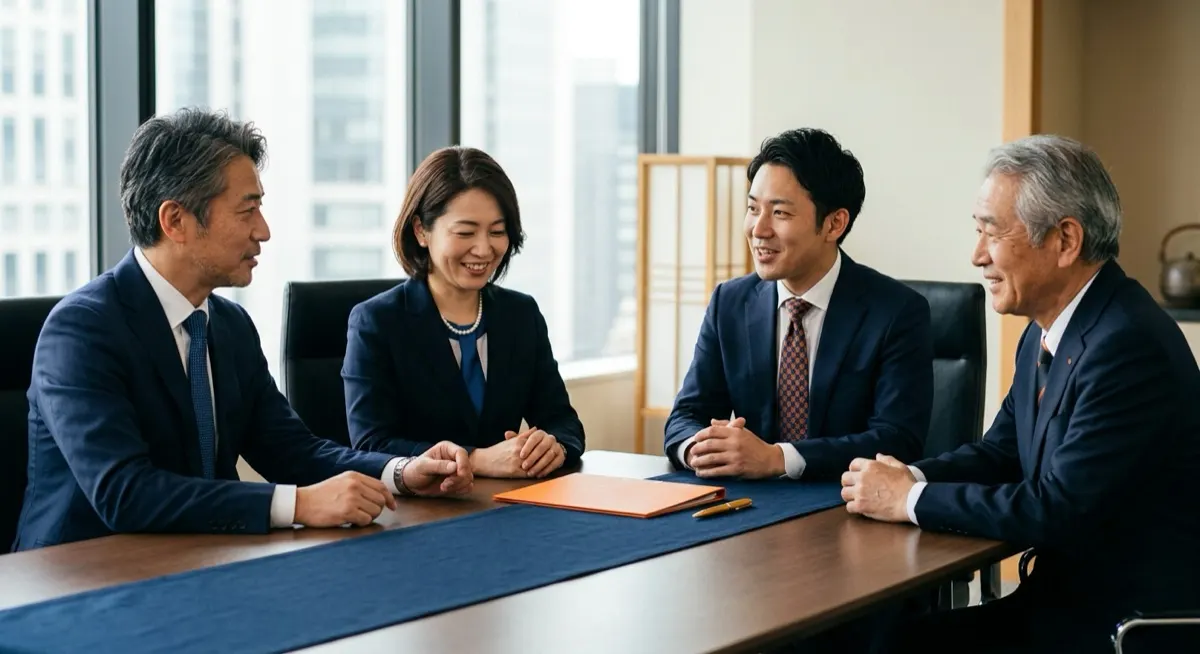
European first meetings usually open fast: handshakes, names, and a quick move to the agenda. Japanese first meetings have a slower rhythm, and the opening twenty minutes are doing real work even when they feel ceremonial.
Bow or handshake
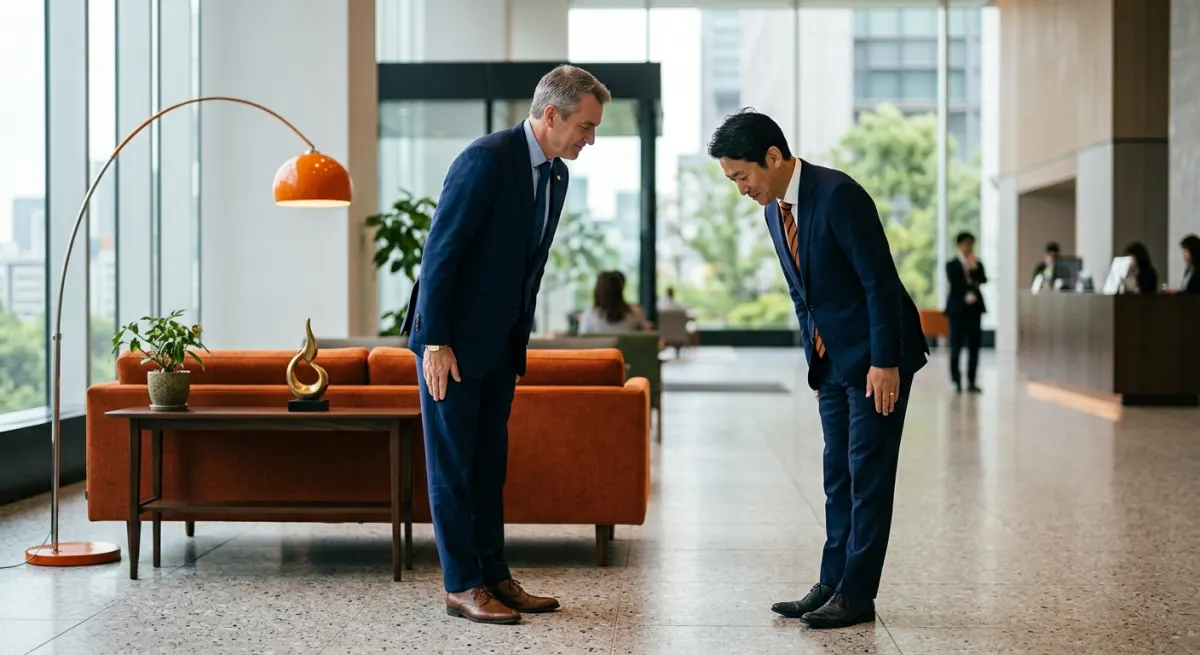
You rarely need to perform a formal bow. Japanese professionals who deal with Europeans will often offer a handshake, sometimes with a slight bow attached. Your job is to reciprocate naturally: a modest nod or slight bow of the head when you greet, thank, or take your leave. Do not attempt deep formal bows you are unsure of. A sincere, modest acknowledgement reads better than an awkward imitation, and over-bowing draws attention for the wrong reasons.
What matters more than the gesture is the order. Greet the most senior person on the Japanese side first. If you do not know who that is, this is exactly what the next step resolves.
The opening sequence
A typical Japanese first meeting runs roughly like this:
- 1
Arrival and tea
You are escorted in and offered tea or coffee. Accept it; declining is mildly awkward for hosts who prepared for you.
- 2
Entrance
Stand when the Japanese delegation enters. The most senior person often enters last. Do not start handing out cards yet.
- 3
Meishi exchange
Cards are exchanged one at a time, most senior first on each side. This is how everyone learns names, titles, and rank.
- 4
Seating
Everyone sits by hierarchy. The most senior guest takes the seat furthest from the door (kamiza).
- 5
Jikoshoukai
Brief self-introductions: company, role, and why you are here. Keep it concise but do not skip it.
- 6
Substance
Only now does the real discussion begin, and even then the first meeting rarely produces a decision.
If you are used to German, Dutch, or Scandinavian meetings where the deck appears within three minutes of sitting down, recalibrate. In Japan, those first twenty minutes are the meeting establishing whether there is enough alignment to justify a second one.
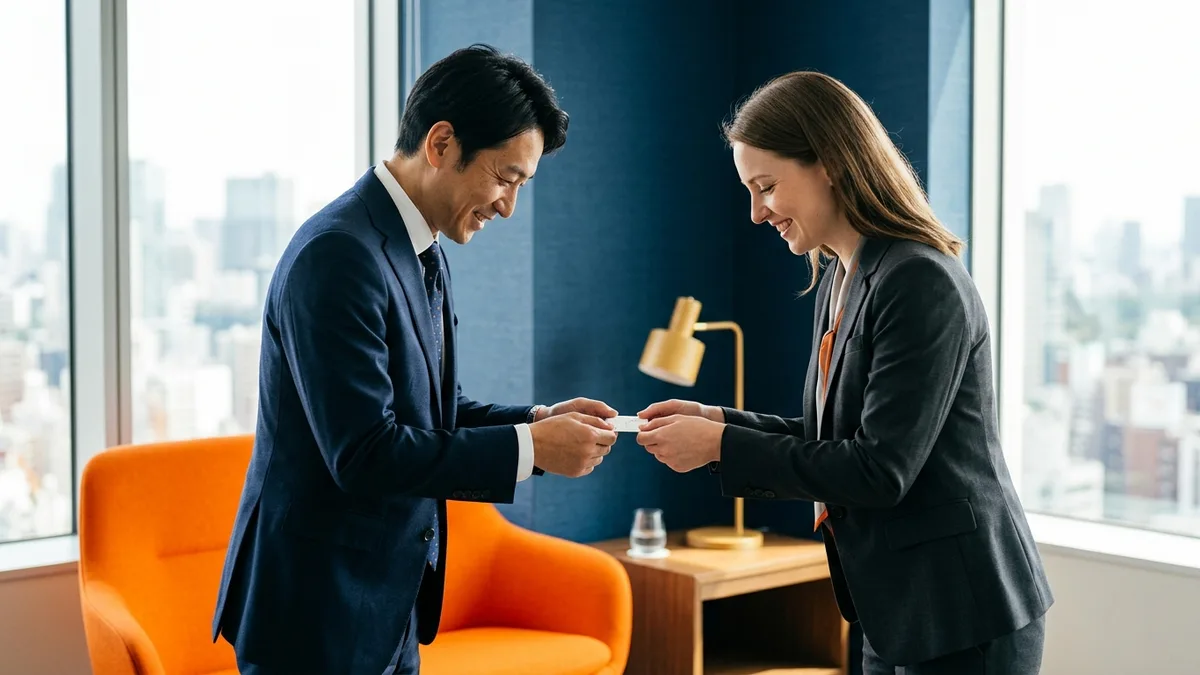
Meishi: the business card exchange
The meishi exchange is the single most written-about element of Japanese business etiquette, and most coverage fixates on the mechanics. The mechanics matter, but the function matters more.
What the exchange actually does
In a Japanese business context, the business card is an identity document for the meeting. When your counterpart reads your card, they are establishing your exact title, your department, and where you sit in your company's hierarchy, all of which determine how they will address and position you for the rest of the conversation.
The mechanics that count
- Carry plenty. Around fifty cards for a two-day Tokyo trip is not excessive. Running out mid-meeting is a real and avoidable failure.
- Dual-sided. English on one side, Japanese on the other.
- Both hands, Japanese side up. Present with both hands, the Japanese text facing the recipient so they can read it immediately.
- Seniority order. Begin with the most senior person on the host side and work down.
- Receive with care. Take the offered card with both hands, read it, and acknowledge the person's title. Do not glance and pocket it.
- Lay them out. Place received cards on the table in front of you, arranged to mirror the seating across from you, so you can match faces to names and ranks through the meeting.
- Never deface. Do not write on a card in front of the giver, fold it, or shove it into a back pocket. The card stands in for the person.
None of this is hard. It simply requires that you treat the exchange as the structural event it is rather than a formality to rush through.
Hierarchy and seating
Seating encodes hierarchy, and the rule is consistent enough to memorise once and apply everywhere. The kamiza (the upper seat, the position of honour) sits furthest from the door. The shimoza (the lower seat) sits closest to the door and is where the most junior person, or the host managing logistics, sits.
The most senior visitor takes the kamiza; the most senior host sits across from them; junior members fill in toward the entrance. The same logic governs meeting rooms, restaurants, taxis, and even lifts: status is positioned furthest from the door. When in doubt, hesitate at the threshold and let your host gesture you to a seat. Allowing yourself to be placed is safer than guessing wrong.
Because hierarchy is structural rather than symbolic, two practical consequences follow for Europeans. First, match your delegation to the seniority of the Japanese side; sending three junior representatives to meet their director and two managers signals you do not consider the relationship important enough to commit decision-makers. Second, do not press a junior counterpart for a commitment they cannot make. Asking them to agree in the room is asking them to violate the protocol that keeps their organisation coherent.
Gift-giving without the missteps
Gift-giving (an established part of relationship-building, not bribery) is one of the few etiquette areas where a well-meant European instinct goes wrong, because the European reflex is to spend more to show respect. In Japan, thoughtfulness and correctness outrank cost.
What to bring. A quality regional specialty from your home country travels best: Dutch stroopwafels, Belgian or French chocolates, German confectionery, a small piece of Scandinavian design. Something around EUR 15 to 40, properly packaged, signals more care than a generic EUR 100 item.
How to present. Offer the gift with both hands, usually near the end of the meeting, and present it modestly rather than playing it up. Bring enough for the team, not only the most senior person.
What to avoid.
Sets of four
The number four (shi) sounds like the word for death. Avoid four of anything; sets of three or five are safe.
White or funeral wrapping
White is associated with mourning. Let a shop wrap it, or choose soft, warm tones.
Overly expensive gifts
A lavish gift creates an uncomfortable obligation to reciprocate at equal value.
Gifts that need explaining
If you have to justify why it is good, it is the wrong gift. Choose something self-evidently considered.
Reciprocity runs deep here. A gift received creates a quiet obligation, which is precisely why a modest, well-chosen item is the considerate choice: it expresses respect without burdening the recipient.
Business dining and the nomikai
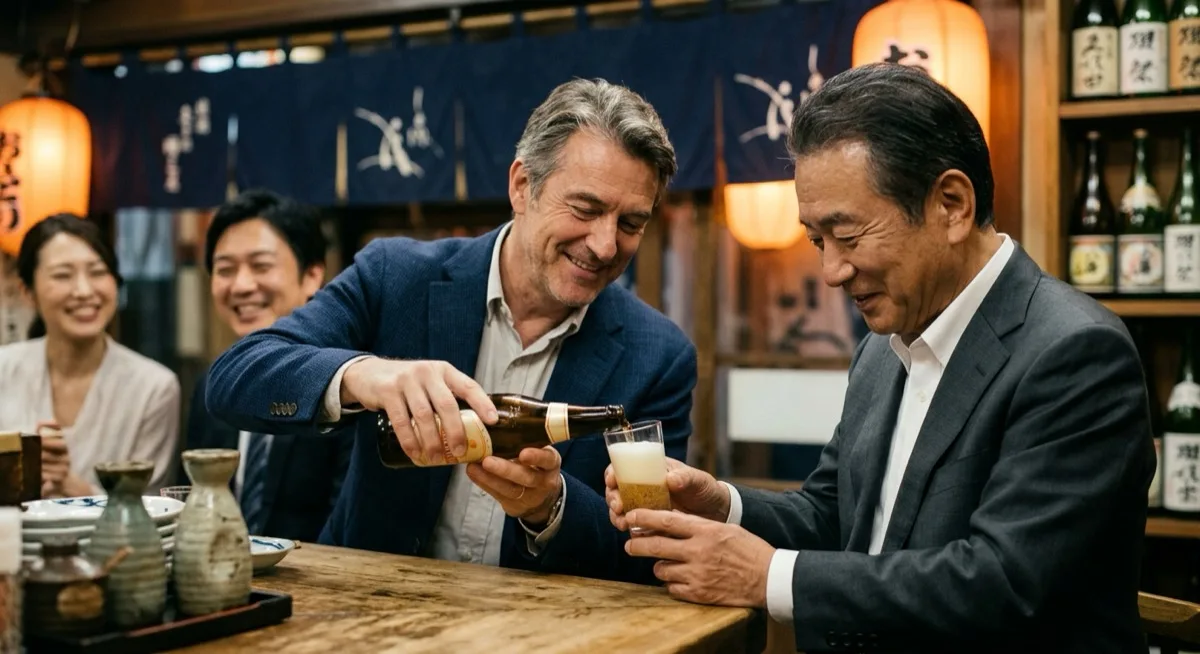
European executives routinely underestimate the business dinner. In Japan, dining (often a nomikai, a drinking gathering) is a continuation of business by other means. Conversations that the formal meeting room could not hold happen at the table, and honne (the real opinion) becomes more accessible than the tatemae (the public-facing position) presented in formal settings. The distinction is not deception; the Japanese distinguish their true feeling (honne) from what is appropriate to say in public (tatemae) as a way of keeping the group functioning (JETRO, Communicating with Japanese in Business, 1999).3
The working protocols at the table:
- Pour for others first. Fill your neighbours' glasses before your own, and let them fill yours. Keeping an eye on others' glasses is part of the courtesy.
- Wait for the toast. Do not drink until the senior person initiates the first kanpai.
- Follow the host's lead on ordering. Let the host set the pace and the dishes; signal enthusiasm rather than steering.
- Seating still follows hierarchy. The most senior guest sits furthest from the door, exactly as in the meeting room.
- The inviting party pays. Do not fight over the bill; if you are the host, settle it discreetly.
Treat the dinner as where evaluation happens, not as time off. The European who switches into pure social mode and stops paying attention misses the part of the relationship that the formal meeting was never going to give them.
Omotenashi and the Japanese standard of customer service
Omotenashi is anticipatory, selfless hospitality: service that meets a need before the guest expresses it and expects nothing visible in return. It is the ambient standard, and for a European company it sets the bar you will be measured against.
The evidence on Japanese service expectations is striking. In a comparison of clothing-store customers, Japanese customers held higher expectations of the store and its staff than Swedish customers, placed higher demands on staff initiative and knowledge (viewing staff as fashion coordinators rather than order-takers), and experienced service that was more detailed, socially driven, and frequent, producing a total experience rather than a transaction (The Customer is God: Japanese Service Culture in Clothing Stores, 2007).6 The same baseline carries into B2B relationships.
Two implications for European firms:
- Your responsiveness is judged against a high bar. The attentive follow-through that impresses a European client is closer to the expected minimum in Japan. Slow replies, vague timelines, and "good enough" delivery read as a lack of commitment.
- Service is a trust-building channel, not a cost centre. Consistent, detailed, proactive account management is one of the most reliable ways an outside company earns durable standing in Japan. It is also one of the few areas where a smaller European firm can out-compete a larger, slower rival.
There is a concrete commercial payoff to getting this right, because Japanese satisfaction translates into word of mouth at a rate Europeans tend to underestimate. Among satisfied Japanese customers, more than half (50.8%) shared their satisfaction through word of mouth, against only 4.1% of dissatisfied ones who spoke up (EU-Japan Centre, Engaging with Japanese Consumers: why storytelling wins in digital and social media).7 In a market where the individual derives identity from group affiliations, a recommendation inside a trusted network carries disproportionate weight. The practical lesson for a European account team is that the omotenashi standard is the input to a referral engine that compounds quietly over years.
What omotenashi looks like in practice for a European supplier is unglamorous and specific: replying within hours rather than days, anticipating the next question before it is asked, sending the promised material early rather than on time, remembering the small preferences a counterpart mentioned once, and never making a Japanese partner chase you for an update. None of this requires a larger team. It requires treating attentiveness as a core deliverable rather than a courtesy you extend when you have spare capacity.
In Japan, exceptional service is the baseline expectation, not the differentiator. Match it, and you have only met the standard.
The EU-country protocol delta table
Here is what no US-default guide gives you: the same Japanese protocol requires a different size of adjustment depending on your starting culture. A Dutch executive and a French executive are not making the same move when they "adapt to Japan," because they begin at different points.
The deltas below are grounded in Hofstede dimension scores. The single most operationally important number is the masculinity-femininity gap. Japan scores 95, the highest in Hofstede's dataset; the Netherlands scores 14, near the opposite extreme, a spread of 81 points that is among the widest of any EU-Japan bilateral pair (scores from Hofstede Insights, theculturefactor.com; dimension framework per Hofstede, Dimensionalizing Cultures: The Hofstede Model in Context, 2011).8 Germany sits at 66 and France at 43, so each EU country travels a different distance.
Dimension scores checked against Hofstede Insights as of August 2026.
| Protocol element | Dutch (NL) delta | German (DE) delta | French (FR) delta |
|---|---|---|---|
| Greeting style | Large: drop flat-hierarchy informality; greet most senior first, no first-name jump | Small: keep formality; add a slight head-bow, retain the handshake | Medium: drop the cheek-kiss (la bise); use a measured handshake and nod |
| Directness in the room | Largest: Dutch frankness reads as rudeness; cushion every disagreement | Large: soften Klartext plain-speaking; never state a flat no | Medium: keep warmth, but stop treating debate as a sign of engagement |
| Hierarchy and seniority | Large: flat-org instincts misfire; respect the rank order strictly | Small: hierarchy already respected; match it to seniority of delegation | Small to medium: status-aware already; mind the seating order precisely |
| Decision pace | Large: resist pushing for an in-meeting yes; expect nemawashi delay | Medium: precision is shared, but consensus timing is slower than DE | Medium: relationship pace suits you; do not mistake courtesy for a deal |
| Gift-giving | Medium: NL under-gifts; bring a considered regional item | Medium: quality instinct helps; avoid over-engineering the choice | Small: gifting instinct strong; keep it modest, avoid sets of four |
| Business dining | Large: treat the dinner as work, not optional social time | Medium: shift from efficiency mode to relationship mode | Small: dining-as-relationship is native; observe pour-and-toast order |
A few notes on how to read this:
- Dutch executives carry the largest aggregate delta, driven by the masculinity and power-distance gaps. Dutch directness and flat hierarchy are genuine strengths at home and genuine liabilities in a first Japanese meeting. The fix is to translate. State the same content with deliberate cushioning and let the rank order guide who you address.
- German executives start closest on preparation, precision, and respect for hierarchy, which is why German firms often do well in Japan. The trap is Klartext, the cultural pride in plain speaking. In Japan, a flat "this will not work" lands as aggression. Substitute "this may be difficult; could we study it further" and you keep the meaning while preserving harmony.
- French executives bring relationship-building and formality that map well onto Japan, plus a comfort with hierarchy. The adjustments are specific: drop the cheek-kiss, and recognise that the French intellectual style of treating disagreement as engagement reads in Japan as confrontation rather than rapport.
This is also where Hofstede's framework needs care rather than reverence. Erin Meyer notes that hierarchy and decision style are independent axes, which is why Japan is a notable exception: strongly hierarchical yet one of the most consensual decision-making cultures in the world (Meyer, The Culture Map, 2014).9 A European who assumes "hierarchical" means "the boss decides quickly" will misread the entire pace of a Japanese deal. For the operational consequence, see our guide to how Japanese companies actually make decisions through nemawashi and the formal ringi approval process.
The mistakes that signal carelessness
Across food, technology, professional services, and manufacturing, European companies repeat a small set of avoidable errors. None is about bow depth. Each one signals that the relationship was under-prepared.
- 1
Pushing for an in-meeting decision
Asking 'can we close this today?' puts a counterpart in an impossible spot; Japanese decisions are made through consensus before the meeting, not in it.
- 2
Mismatched delegation seniority
Sending juniors to meet seniors permanently caps the seniority of every future meeting and signals low priority.
- 3
Reading tatemae as agreement
Polite non-committal language is not yes. European optimism turns 'we will study this' into a forecast that never materialises.
- 4
Treating service as good enough
Slow, vague follow-through reads as low commitment against the omotenashi baseline. Responsiveness is a trust signal.
- 5
Applying a US-default playbook
Most Japan etiquette content is US-coded. European baselines differ; the delta is what matters, not a generic checklist.
- 6
Skipping preparation entirely
Walking in without researching attendees, hierarchy, or the company telegraphs that you did not think it was worth the effort.
The through-line is consistent. Japanese counterparts forgive unfamiliarity readily and carelessness reluctantly. Preparation is the cheapest insurance you can buy before a Japan engagement, and it is almost entirely within your control.
How to prepare a European team
Reading a guide is necessary but not sufficient, because the protocols only stick when a team has practised them against its own cultural defaults. The working method we use with European teams has three parts:
- Baseline first. Identify the team's home-country defaults and where they diverge most from Japan. A Dutch team and a German team need different drills even for the same meeting.
- Protocol rehearsal. Run the meishi exchange, the seating logic, the gift presentation, and the dinner sequence as practice, not theory. The first real meeting should not be the first time anyone has done it.
- Decision-pace calibration. Reset internal expectations so that the team does not treat nemawashi delay as a stalled deal and does not pressure counterparts for premature commitments.
This is the substance of Silkdrive's cross-cultural training for European teams and our broader intercultural training programmes. For teams entering the market rather than visiting, the etiquette work sits inside a wider engagement; see our Japan market entry guide for European companies and, for Dutch firms specifically, the Japan-Netherlands business corridor analysis. The deeper cultural foundations behind every protocol in this guide are covered in our working guide to Japanese business culture.
The bottom line
Japanese business etiquette is one connected protocol system that signals preparation, reads hierarchy, and honours reciprocal obligation. Greetings, meishi, gifts, dining, omotenashi, and customer service all run on that same logic. Once you see the logic, you stop chasing rules and start calibrating, and the calibration depends on where you start: Dutch, German, and French executives each travel a different distance to reach the same place.
Get the attitude right and small mistakes are forgiven. Get the preparation right and the protocols take care of themselves. That is the difference between a European company that earns a second meeting in Tokyo and one that does not.
This guide is written by Patric Sawada, founder of Silkdrive and an EU-Japan Centre for Industrial Cooperation expert, drawing on more than a decade of cross-cultural growth work between Europe and East Asia. The cultural claims are anchored to peer-reviewed and institutional sources rather than travel-guide folklore.
References
-
Katz, L. (2008). Negotiating International Business: Japan. On respect deriving from age, status, and rank. ↩
-
Ciubancan, M. (2015). Principles of communication in Japanese: indirectness and hedging. On wa, face, and indirectness as the communication default. ↩ ↩2
-
JETRO (1999). Communicating with Japanese in Business (Gundling). On group-anchored identity and the honne / tatemae distinction. ↩ ↩2
-
Adachi, N. (2010). Cultural Differences in Business Communication. On indirectness as critical to maintaining harmony and saving face. ↩
-
Kadoi (2015), citing Ueda. On the sixteen ways Japanese expresses refusal without the word no. ↩
-
The Customer is God: Japanese Service Culture in Clothing Stores (2007). On Japanese customer expectations versus a European (Swedish) baseline. ↩
-
EU-Japan Centre for Industrial Cooperation (https://www.eu-japan.eu/). Engaging with Japanese Consumers: why storytelling wins in digital and social media. On word-of-mouth behaviour among satisfied Japanese customers. ↩
-
Hofstede, G. (2011). Dimensionalizing Cultures: The Hofstede Model in Context. Online Readings in Psychology and Culture. Dimension scores referenced from Hofstede Insights (https://www.theculturefactor.com/country-comparison-tool). ↩
-
Meyer, E. (2014). The Culture Map: Breaking Through the Invisible Boundaries of Global Business. PublicAffairs. On the independence of hierarchy and decision style, and Japan as the hierarchical-yet-consensual exception. ↩
Stay Ahead in Cross-Cultural Marketing
Get monthly insights on international growth strategies, cultural intelligence, and digital marketing trends delivered to your inbox.
We respect your privacy. Unsubscribe at any time.