
Doing Business in Japan from France: A Corridor Guide
A France-to-Japan corridor guide: where French relationship-led, hierarchical, debate-driven business culture meets Japanese expectations, why luxury, cosmetics, and F&B are a genuine FR-JP strength, and how to assess entry readiness.
Part of our EU-Japan Market Entry series. Start with the full guide: Japan Market Entry Guide for European Companies [2026]
- French business culture is closer to Japan than Anglo-American culture on relationship-building and hierarchy, which is a real head start, but the closeness creates false confidence
- Where France diverges most: open intellectual debate, the prized contradictory argument, and a comfort with confrontation that reads as aggression in a Japanese meeting
- Luxury, cosmetics, fashion, and fine food and wine are a structural FR-JP strength: East Asia is the largest market in the world for Western luxury and prestige brands (Wong and Ahuvia, 1998)
- The sector advantage does not transfer to the working relationship: a strong brand still stalls in a Japanese consensus process if the French team pushes for a fast decision
- Entry readiness is a question of delegation seniority, timeline tolerance, and local distribution, not of how good your product is
Most guidance on doing business in Japan is written from a US perspective. For a French company that is doubly unhelpful, because France is not an Anglo-American business culture and Japan is not an Anglo-American market. The default playbook misreads both ends of the relationship.
France actually starts from a more useful position than most Western countries. French business culture is relationship-led and hierarchical, and so is Japan's. A French executive who already understands that trust precedes transactions, and that rank in the room matters, has a genuine head start over a counterpart trained to open with the deal terms.
But that head start is partial, and the partial overlap is exactly what creates trouble. French business culture also prizes open intellectual debate, the well-constructed contradictory argument, and a directness in discussion that, in Paris, signals respect and engagement. In a Japanese meeting, that same directness reads as confrontation. The places where France and Japan align are not the places where French teams usually stumble.
This guide covers the French starting point honestly, where French operators specifically come unstuck, the one sector lane where the France-Japan fit is genuinely strong, and a practical way to assess whether your company is ready to enter.
France's relationship-led, hierarchical instincts are a real head start in Japan. The trouble is the part of French culture that prizes the winning argument.
The French Starting Point: Closer Than You Think, and Further
Before looking at the gaps, it is worth being precise about where French and Japanese business cultures actually align, because the overlap is real and it is an advantage when used deliberately.
Relationship before transaction
French business runs on relationships. Deals move through people who trust each other, introductions carry weight, and the long lunch is part of the work. A French executive rarely expects to walk into a first meeting and leave with a signed agreement.
Japan operates the same way, only more so. Building the relationship before doing business is the process itself in Japan. Initial meetings that produce no tangible outcome are investments. For a French operator, this rhythm is familiar in a way it is not for a culture that measures every meeting by what was closed.
Respect for hierarchy
French organisations are hierarchical. Titles matter, the cadre system encodes status, and decisions tend to concentrate at the top. A French executive instinctively understands that who is in the room signals how serious the relationship is, and that you address the senior person with appropriate deference.
This maps cleanly onto Japan, where respect depends primarily on age, status, and rank.
Both France and Japan also sit high on Hofstede's power-distance dimension, the degree to which less powerful members of an organisation accept that power is distributed unequally.
So the French instinct to read the room for seniority, and to behave accordingly, transfers well. A French team is less likely than a Dutch or American one to commit the basic error of treating a junior counterpart as a decision-maker.
Where the overlap stops
Here is the trap. Because the relationship rhythm and the hierarchy feel familiar, French operators often assume the rest will be familiar too. Much of it is unfamiliar. The single sharpest divergence between France and Japan is on individualism.
France is a high-individualism culture: the individual argument, the individual's intellectual contribution, and individual achievement are central to how business is conducted. Japan is collectivist, defined by the connectedness of people to each other and a self that is understood through relationships.
That one gap, individual versus group, is the root of most France-Japan friction. The French reflex to make the personal case, directly and persuasively, meets a Japanese system that decides collectively and communicates indirectly. The relationship and the hierarchy feel like home; the way decisions actually get made does not.
Where French Operators Specifically Stumble
Every Western culture has its own characteristic mistakes in Japan. The Dutch struggle with directness and tempo. The Germans struggle with process rigidity meeting Japanese ambiguity. The French stumbles are specific, and they trace back to the things French business culture most values.
The prized argument
In French business and intellectual life, the ability to construct and defend an argument is a mark of competence. Contradiction reads as engagement. A meeting where everyone agrees is a meeting where nobody was thinking. The French executive who can dismantle a weak proposal and rebuild a better one is respected for it.
In a Japanese meeting, this is close to the worst possible behaviour. Direct contradiction of a counterpart, especially in front of others, causes the kind of loss of face that can quietly end a relationship. The Japanese system relies on indirect communication: "that would be difficult" usually means no, and "we will consider it" often means this is going nowhere. The French operator, trained to value the explicit and the argued, hears these as openings to be debated rather than answers to be read.
The French strength, intellectual confrontation as a tool of respect, becomes the French liability.
Eloquence over consensus
French business culture rewards the person who wins the room. The strongest presenter, the most articulate advocate, the one who carries the argument, tends to carry the decision too. French teams sometimes send their best debater to Japan rather than their most senior decision-maker, because in France the debater is how you win.
Japanese organisations do not decide in the room. They decide through nemawashi, the quiet groundwork of building agreement across many people before anything is formalised, followed by ringi, the circulation of a written proposal for layered approval. The person across the table from you almost certainly cannot say yes in the meeting, no matter how persuasive you are. Eloquence does not move a consensus system; it can even unsettle it, because a too-polished, too-forceful pitch signals someone who does not understand how the decision will actually be made.
For the mechanics of this, our guides to nemawashi, how Japanese companies actually make decisions and the ringi approval process cover the full sequence. The short version for French teams: the room is not where you win.
Mistaking brand prestige for bargaining power
This one is specific to France's strongest sectors. A French luxury, fashion, or fine-food brand often arrives in Japan with genuine prestige, and prestige is real currency in this market. The mistake is treating that prestige as bargaining power over the process. A strong brand opens doors and earns attentive first meetings. It does not let you compress a Japanese decision timeline or skip the relationship-building. The brand gets you into the room faster; it does not change how the room decides.
The seniority and tempo mismatch
French planning horizons, while longer than Anglo-American quarterly cycles, still tend to expect momentum. A French company that has invested in travel, presentations, and a strong brand expects movement in return. When the Japanese side responds with more meetings, more relationship-building, and no decision, French impatience can surface as pressure, and pressure damages the relationship before it matures.
The fix is structural, not attitudinal: commit a senior person to the relationship over 12 to 24 months, and resource the entry on a timeline that matches Japanese consensus-building rather than French expectations of pace.
Contrast Table: France vs Japan
The table below summarises the working differences that matter most for French teams. The first three rows are where France and Japan are closer than the Anglo-American default; the rest are where they diverge.
| Dimension | French default | Japanese expectation | Practical consequence |
|---|---|---|---|
| Relationship vs transaction | Relationship-led; trust before terms | Relationship is the process itself | French rhythm transfers well; lean into it |
| Hierarchy | Hierarchical; rank and cadre matter | Respect by age, status, and rank | French seniority-reading is an asset |
| Power distance (Hofstede) | High | High | Familiar territory; both expect hierarchy |
| Individualism (Hofstede) | High; the individual argument is central | Collectivist; the group and relationship come first | Root cause of most friction |
| Debate and contradiction | A mark of engagement and respect | Direct contradiction causes loss of face | French strength becomes a liability |
| Who decides | The strongest advocate in the room | The group, via nemawashi and ringi | Eloquence does not move a consensus system |
| Communication | Explicit, argued, direct | Indirect, high-context, implication-led | "Difficult" means no; read, do not debate |
| Decision tempo | Expects momentum after investment | Slow, collective, relationship-paced | Pressure damages the relationship |
| Brand prestige | A strong card to play | Opens doors, does not move the process | Brand gets you in; process decides |
The Sector Where France Genuinely Wins: Luxury, Cosmetics, and Fine Food
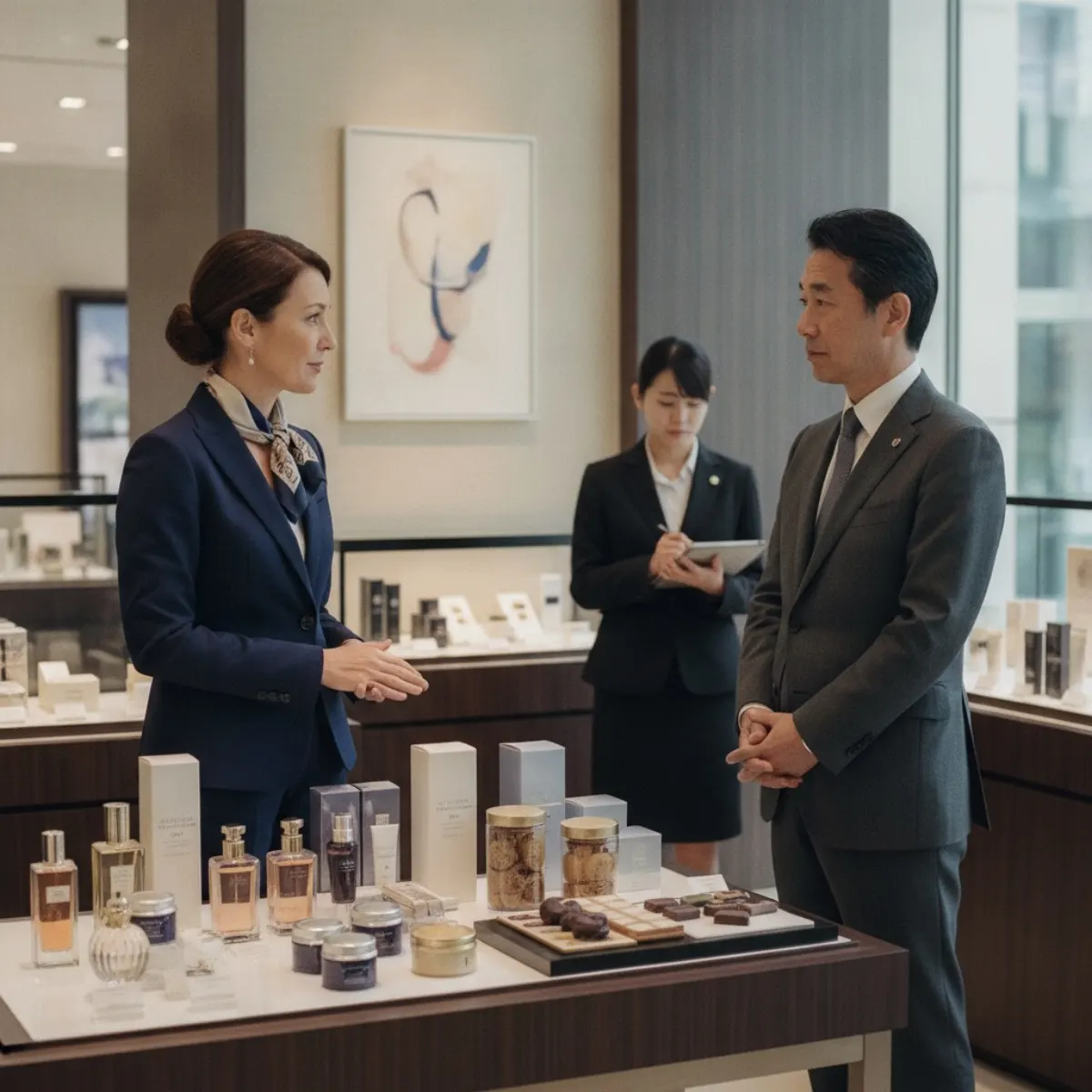
Most country-to-Japan guidance treats every sector the same. For France that would waste the single biggest structural advantage in the corridor. Luxury, cosmetics, fashion, and fine food and wine are where the France-Japan fit is not just good but exceptional, and it is worth understanding why, because the reason is cultural, not just commercial.
Why the demand is structural
East Asia is the largest market in the world for Western luxury and prestige brands.
That is not a passing trend. It connects to how luxury consumption works in Confucian-influenced cultures. The way people buy and use luxury differs systematically between Confucian and Western cultures.
The mechanism is the relationship between the self and social role. In these cultures the self divides into a private inner self and a public self based on social roles, and that division is the basis for face-driven rather than purely taste-driven luxury consumption.
In plainer terms: a French heritage brand signals recognised, legible status to others, and in a market where the public self carries this much weight, recognised status is exactly what the category rewards. A brand whose prestige is universally understood is worth more in Japan than a brand that requires explanation. France happens to own a disproportionate share of exactly those universally recognised names, in leather goods, fashion, fragrance, cosmetics, champagne, and fine wine.
Why the supply side is already built
The demand would mean little without the operating history, and France has it. French houses have decades of presence in Japan: established retail partnerships, department-store relationships, distribution routes, and brand familiarity built over generations of Japanese consumers. A new French entrant in these categories joins a lane where the infrastructure and the consumer recognition already exist. That lowers the entry barrier in a way that is not available to most sectors or most countries.
The EU-Japan Economic Partnership Agreement reinforces this. In force since 1 February 2019, it eliminated tariffs on around 99% of EU exports to Japan, with the most relevant French gains in wine and spirits, cheese and dairy, processed foods, and cosmetics.
The catch the brand cannot solve
Here is where the sector advantage and the cultural reality meet. A strong brand changes the demand side: it earns attention, opens doors, and shortens the path to a serious first meeting. It does not change the supply side of the relationship: how the Japanese partner, distributor, or retailer actually decides.
A French luxury brand still has to run the consensus process with its Japanese distributor. It still has to build the relationship across the trading company or retail group, still has to wait through nemawashi, still has to read indirect signals rather than debate them. The prestige that makes the category a structural win does nothing to compress the decision tempo. French teams that internalise this, brand for the door, process for the deal, outperform those that assume a great name does the work.
For the food and beverage and wine side specifically, the EU-Japan trade picture is worth reading in full in our EU-Japan EPA marketer's guide.
Entry Readiness: A French Company's Checklist
Whether your company is in luxury, cosmetics, pharma, aerospace, or industrial goods, readiness for Japan comes down to operating model, not product quality. A brilliant product on the wrong operating model stalls; a good product on the right one succeeds. The questions below are the ones that actually predict outcomes.
1. Can you commit senior delegation over 12 to 24 months?
Not a sales lead for a quarter, a senior decision-maker for the duration of the relationship. Match the seniority of the Japanese side in every meeting. French companies sometimes default to sending their most persuasive person rather than their most senior; in Japan, rank in the room is read as a measure of how seriously you take the relationship. If you cannot commit a senior person consistently, the relationship will not form.
2. Can your planning tolerate a long relationship-led sales cycle?
Japanese decisions move on a timeline measured in many months of relationship-building before revenue. If your internal reporting punishes a country manager for a quarter with no closed deals, your own incentives will push your team to apply the pressure that damages the relationship. Readiness here is as much about your internal planning as about Japan.
3. Do you have a local distribution or partnership route?
Most Japanese categories are gated by trading companies and established retail relationships. In luxury and fine food this can be an advantage, because the routes already exist for French houses. In other sectors it is a gap to close before entry, not after. Either way, a direct-to-market assumption is usually wrong for Japan.
4. Have you separated brand strength from process strength?
If your entry plan leans on brand prestige or product superiority to carry the deal, it is leaning on the wrong lever. The brand opens the door; the consensus process decides. A plan that does not account for nemawashi and indirect communication is not ready, however strong the product.
5. Has your team been prepared for the specific France-Japan gaps?
Generic "working across cultures" training does not address the French-specific stumbles: the prized argument, eloquence over consensus, and brand-as-advantage. Cross-cultural training that targets the France-Japan delta, and executive coaching for the senior person carrying the relationship, are risk mitigation, not a nice-to-have.
If you answer no to any of the first three questions, the gap is in operating model and is fixable before you commit budget. If you answer no to the last two, the gap is in preparation, and it is the cheapest gap to close.
What This Means for Your Company
A French company has a better starting hand for Japan than the Anglo-American default suggests. The relationship-led instinct and the respect for hierarchy are genuine assets, and in luxury, cosmetics, fashion, and fine food, France holds a structural advantage that almost no other country can match: the largest luxury market in the world, a category that rewards exactly the recognised prestige French houses own, and decades of built distribution.
The risk is the false confidence that follows from the things that feel familiar. The relationship and the hierarchy transfer; the individualism, the prized argument, the eloquence, and the assumption that a great brand or a great case carries the decision do not. Japan decides collectively, slowly, and indirectly, and no amount of French brilliance in the room changes that.
The companies that win in this corridor are the ones that play the French strengths deliberately, brand and relationship to open the door, and then run the Japanese process patiently, with senior delegation, a realistic timeline, and a team prepared for the specific gaps. That combination is rare, and it is exactly where the opportunity sits.
For the broader corridor picture and how this compares with the Netherlands-Japan relationship, see our Netherlands-Japan business corridor guide. For the cultural systems French teams most often misread, start with Japanese business culture and Japanese business etiquette.
Frequently Asked Questions
Is doing business in Japan easier for French companies than for British or American ones?
In some respects, yes. French business culture is relationship-led and hierarchical, two traits it shares with Japan, so French operators often find the relationship-building rhythm and respect for seniority more intuitive than Anglo-American executives do. But the closeness is partial and creates false confidence. France also prizes open intellectual debate, the contradictory argument, and a directness in discussion that reads as confrontation in a Japanese meeting. The areas where France and Japan align are not the areas where French teams usually stumble.
Why are French luxury and cosmetics brands so strong in Japan?
Two reasons converge. First, demand: East Asia is the largest market in the world for Western luxury and prestige brands, and luxury consumption in Confucian-influenced cultures is strongly tied to social role and the public self rather than private taste alone (Wong and Ahuvia, 1998). A French heritage brand signals exactly the kind of recognised status that this market rewards. Second, supply: France has decades of operating history in Japan across fashion, leather goods, cosmetics, and fine food and wine, so the distribution relationships, retail partnerships, and brand familiarity already exist. The category fit is genuine, not a marketing claim.
What is the biggest mistake French companies make in Japan?
Treating a strong brand or a strong argument as a substitute for the consensus process. French business culture rewards the person who wins the debate and the brand that commands prestige. Japanese organisations make decisions through nemawashi, quiet groundwork built across many people before anything is decided in a meeting. A French team that arrives, presents brilliantly, debates confidently, and pushes for a decision in the room is optimising for the wrong system. The brand opens the door; the process decides the outcome, and the process is slow and collective.
How different are France and Japan on Hofstede's cultural dimensions?
Both France and Japan score high on power distance and high on uncertainty avoidance, which is part of why the relationship and the respect for hierarchy can feel familiar to French operators. The sharpest divergence is on individualism: France is a high-individualism culture where the individual argument and individual achievement are central, while Japan is collectivist, where the group and the relationship come first (framework: Hofstede). That single gap explains much of the friction: the French instinct to make the personal case directly meets a Japanese system that decides collectively and indirectly.
Does the EU-Japan EPA help French exporters?
Yes. The EU-Japan Economic Partnership Agreement, in force since 1 February 2019, eliminated tariffs on around 99% of EU exports to Japan and improved access for European service providers (source: European Commission). For France the most relevant gains are in wine and spirits, cheese and dairy, processed foods, and cosmetics, all categories where France has both strong supply and strong existing demand in Japan. The EPA removes the tariff barrier; it does not remove the cultural and distribution barriers, which is where most of the real work sits.
What sectors beyond luxury matter in the France-Japan corridor?
France runs structurally important Japan trade well beyond luxury: aerospace, pharmaceuticals, defence, energy, and food and beverage all have established French-Japanese activity. Luxury, cosmetics, fashion, and fine food and wine are the lane where the cultural and commercial fit is strongest and most visible, which is why this guide leads with it, but a French company in pharma, industrial goods, or services faces the same underlying cultural questions: delegation seniority, decision tempo, and indirect communication.
How senior should the delegation be for a first meeting in Japan?
Match the seniority of the Japanese side. If they send a director and two managers, sending three junior staff signals that you do not consider the relationship important enough to commit decision-makers. This matters more for French companies than they often expect, because French organisations sometimes send the strongest debater rather than the most senior person. In Japan, rank in the room is read as a measure of how seriously you take the relationship. Confirm attendees in advance and ask a local contact for guidance on title equivalence.
How do I know if my French company is ready to enter Japan?
Readiness is less about product quality than about three operational questions. Can you commit a senior decision-maker to the relationship over 12 to 24 months, not just a sales lead for a quarter? Can your internal planning tolerate a sales cycle measured in many months of relationship-building before revenue? And do you have, or can you build, a local distribution or partnership route, since most Japanese categories are gated by trading companies and established retail relationships? If the answer to any of these is no, the gap is in operating model, not in market opportunity. A structured cultural and entry assessment is the fastest way to find out.
Related Resources
- The Netherlands-Japan Business Corridor, the parallel EU-Japan corridor and how the bilateral relationship is structured
- Nemawashi: How Japanese Companies Actually Make Decisions, why eloquence does not move a Japanese consensus process
- Ringi: How Japanese Companies Approve Proposals, the formal approval flow that follows nemawashi
- Japanese Business Culture, hierarchy, wa, and the systems French teams most often misread
- Japanese Business Etiquette, the working protocols, from meishi to seating, that signal preparation
- The EU-Japan EPA: A Marketer's Guide, what the 2019 trade agreement changed for European exporters, including French wine, dairy, and cosmetics
- The Complete Guide to Japan Market Entry for European Companies, the EU-Japan entry framework
- Cross-Cultural Training and Japan Executive Coaching, preparation for the France-specific gaps
Stay Ahead in Cross-Cultural Marketing
Get monthly insights on international growth strategies, cultural intelligence, and digital marketing trends delivered to your inbox.
We respect your privacy. Unsubscribe at any time.