After Hours in Japan: Settai, Nomikai, and Real Decisions
Settai (接待) is host-paid business entertainment; nomikai and nominication are after-work drinking as relationship-building. How honne surfaces after hours, the table protocol European teams get wrong, and why the old picture is dated.
Part of our Cross-Cultural Leadership series. Start with the full guide: Japanese Business Culture: A Working Guide for Europeans
- Settai (接待) is formal, host-paid business entertainment; nomikai (飲み会) is the looser after-work drinking gathering, and nominication (飲みニケーション) is the coined term for the relationship-building it does
- The after-hours table is where honne (the real opinion) becomes reachable, because the tatemae performed in the meeting room relaxes; treat the evening as the meeting, not as time off
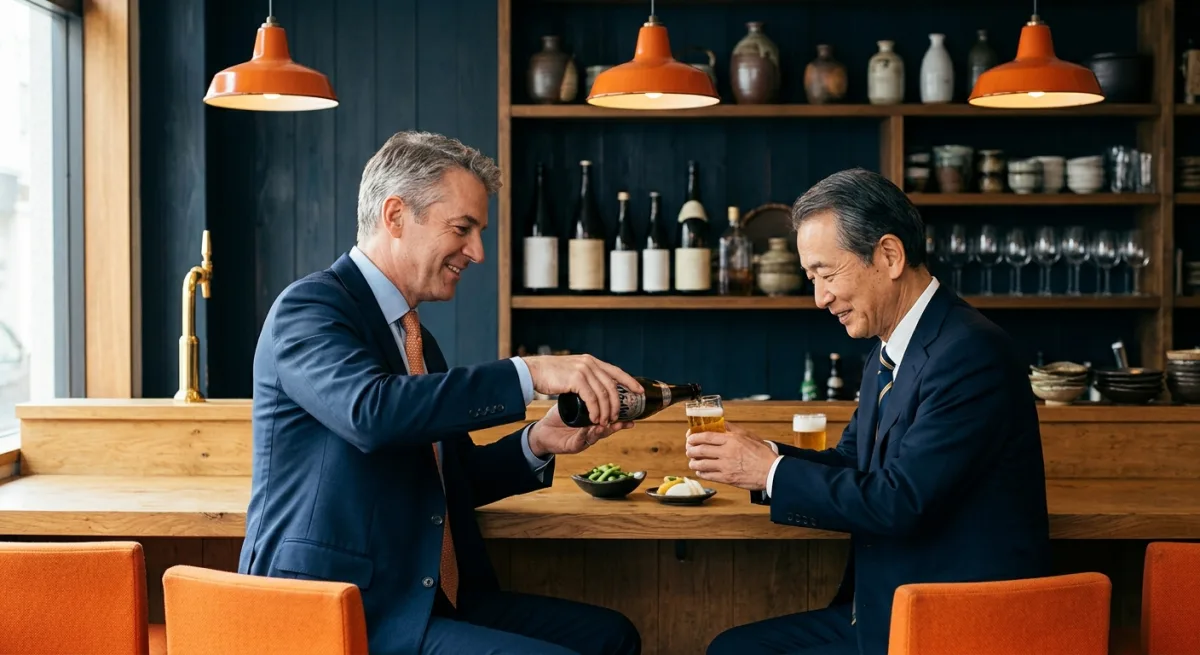
- The working protocol: wait for the first kanpai, pour for others before yourself, take a pour with both hands, sit by rank (kamiza is furthest from the door), and let the inviting side pay
- The old picture is dated. Company drinking is declining fast, a 2024 survey put year-end-party rates near 29%, down from about 52% in 2019, forcing drinks is now condemned as aruhara (alcohol harassment), and the all-male, all-drinking assumption no longer holds
- Never coerce a non-drinker and never be coerced. Joining the first toast then switching to a soft drink, or proposing a proper lunch the next day, costs you nothing
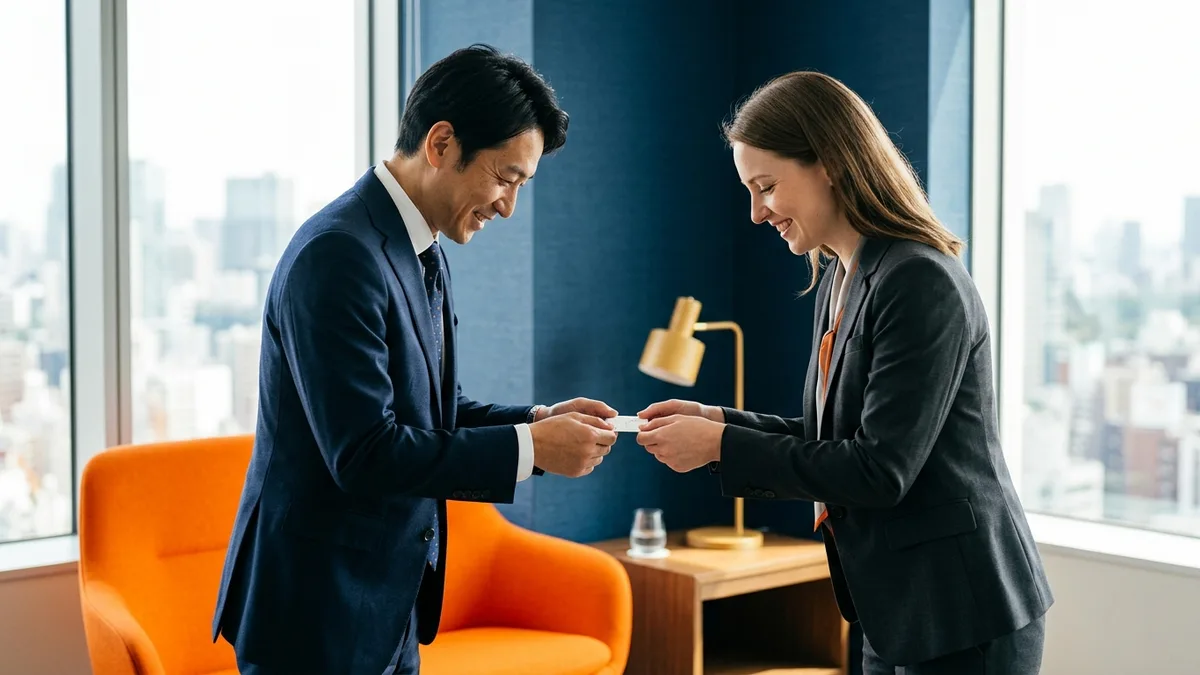
European executives prepare hard for the Japanese meeting, the meishi exchange, the seating, the proposal, and then treat the dinner afterwards as the reward for getting through it. That is backwards. In Japan a great deal of the real work happens after the office lights go down, and the company that reads the evening as decompression misses the part of the relationship the formal meeting was never going to give it.
This is a companion piece to our guide on Japanese business etiquette for European executives and our explainer on honne and tatemae. Here we go deep on one thing those guides only touch: the after-hours channel, what happens at settai and nomikai, why honne surfaces there, the protocol that carries you through the evening, and the modern caveats that make most older advice on this subject actively misleading.
Why the evening is where the real conversation happens
Japanese communication runs on two layers. There is honne (本音), the real opinion, and tatemae (建前), the position it is appropriate to say in public. The gap between them is not dishonesty; it is social infrastructure that keeps the group functioning without constant friction (JETRO, Communicating with Japanese in Business, 1999).1 In a formal meeting, with juniors present and the group watching, tatemae is the default. The genuine reservation, the real state of the internal discussion, the thing your counterpart actually thinks about your price, tends not to appear.
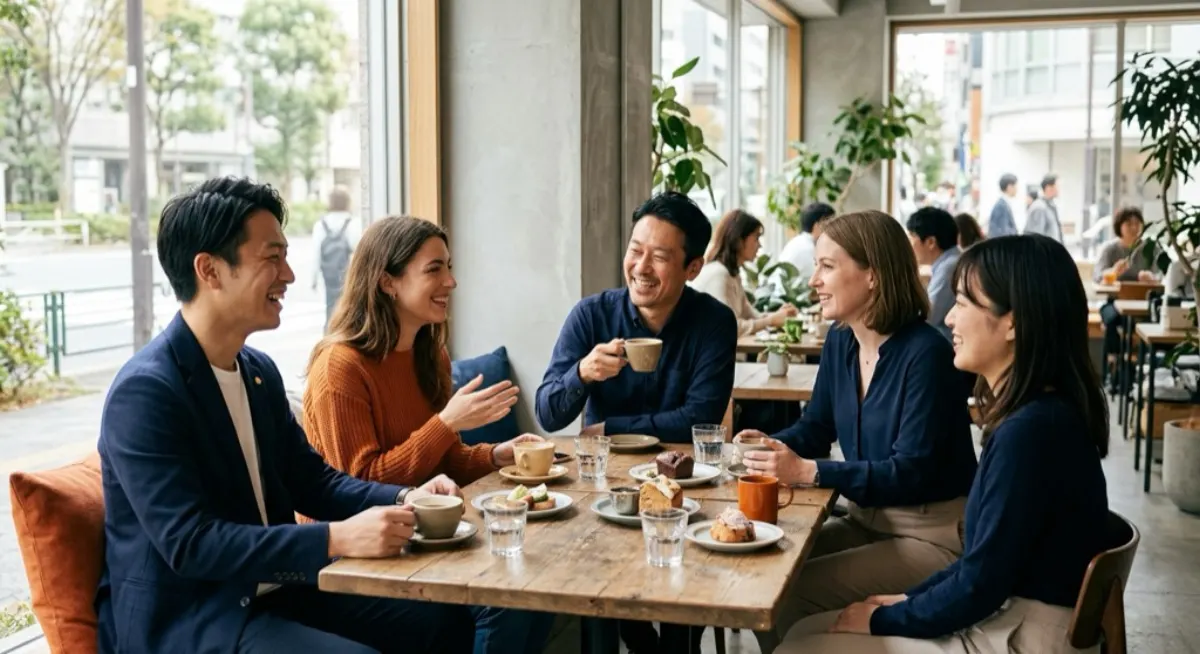
It appears after hours. Away from the meeting room, over the second drink, the performance relaxes and honne becomes reachable. Things get said at the table that would never be said across a conference table. This is the whole point of the evening, not a side effect of it, and it is why treating the dinner as social time is a category error. The dinner is where the evaluation happens.
The European who treats the meeting as the truth and the dinner as the reward has it exactly backwards. The dinner is where you learn what your counterpart actually thinks.
One consequence matters more than any etiquette point: do not work the room. The evening is for the relationship, not for reopening the negotiation. If you spend it pushing commercial points, you signal that you saw the invitation as a tactic, and you close the very channel you were invited into. Do not raise business unless your counterpart raises it first. If real information surfaces, and it often does, receive it quietly. Do not pounce on it.
Settai and nomikai: two names for the after-hours channel
The channel has two names worth knowing.
Settai (接待) is formal business entertainment: the evening a company lays on for a client or partner. Dinner, drinks, sometimes a second venue after, and the hosting side pays, without discussion. The characters carry the sense of connecting and hosting, and the purpose is to build closeness outside the transactional frame. Historically settai could be lavish, the expensive restaurant, the hostess bar afterwards, but that end has narrowed. Compliance culture, tighter expense scrutiny, and the pandemic have all pushed settai toward the restrained and the genuine (Nippon.com, Settai: Coronavirus Clusters Put Spotlight on Japan's Nightlife; MailMate, Japan business glossary).2 For a European SME, this is good news: you are not expected to compete on extravagance, and a well-judged, sincere dinner does the work.
Nomikai (飲み会) is the looser after-work drinking gathering, with less ceremony and often a wider or more mixed group. The relationship work it does even has a coined name, nominication (飲みニケーション), the Japanese nomu, to drink, fused with "communication" (Nippon.com, Nominication: Japan's Changing Culture of Company Drinking).3 Whether it is a formal settai or an informal nomikai, the underlying function is the same: the drinking loosens the constraints that hierarchy and formality place on everyday interaction, and that is where trust is built.
The table protocol: kanpai, pouring, seating, who pays
The protocol is small and learnable, and getting it roughly right signals that you took the relationship seriously enough to prepare.
Wait for the kanpai
Do not drink until the senior person leads the first toast, the kanpai (乾杯). Raise your glass with the group; do not start on your own.
Pour for others first
Fill your neighbours' glasses before your own, keep an eye on who is running low, and take a pour with both hands. This courtesy, o-shaku (お酌), is watched more than you would think.
Sit by rank
The seat of honour, kamiza (上座), is furthest from the door; the junior seat, shimoza (下座), is nearest it. Let the host place you rather than choosing your own seat.
Let the host lead and pay
Follow the host on ordering and pace. The inviting side pays as a matter of course; a light offer to contribute is polite, but do not insist or perform it.
Two of these repay a closer look. On pouring: the habit of filling others' glasses and letting them fill yours is a small, continuous act of attention that stands in for a lot of unspoken relationship maintenance. Keeping your counterpart's glass topped up, and letting them keep yours, is part of the conversation. On seating: the kamiza rule is the same logic as the meeting room, and it has a feudal root, the seat furthest from the entrance was the safest from a sudden attack, so it became the seat of highest status (Nippon.com, Place of Honor: Seating Etiquette in Japan).4 You will usually be guided to a senior seat as the foreign guest; accept the guidance rather than modestly refusing it, which only creates an awkward negotiation.
Karaoke, the second party, and the izakaya
If the evening goes well it may not end at the restaurant. A nijikai (二次会), a second party at a bar or a private karaoke room, is common, and the same rules apply: it is relationship time, the hierarchy loosens but does not vanish. Karaoke in particular is a genuine part of Japanese corporate culture, not a novelty; the private room lowers the social pressure and the point is shared participation, not performance (GLOBIS Europe, on karaoke and corporate culture).5 You do not need to sing well. You need to take a turn, cheer the others, and not hog the microphone. Declining every song while everyone else participates reads as holding yourself apart, which is the one thing the evening is designed to dissolve.
The izakaya, the Japanese pub, is the ordinary setting for all of this: shared plates, a steady flow of drinks, and an atmosphere where the formality of the office deliberately softens. None of it requires you to drink heavily. It requires you to be present and to let the register change.
The modern caveats European teams get wrong
Most guidance on Japanese drinking culture is dated, and running the old script confidently is worse than not knowing it. Three corrections matter.
- 1
It is declining, and it is not mandatory
After-work drinking has receded for years, and the pandemic accelerated it. A 2024 survey of more than four thousand firms found the share holding a year-end party down to roughly 29%, from about 52% in 2019, and a majority of workers across ages now call obligatory drinking unnecessary. Treat the evening as one option for relationship-building, not a rule.
- 2
Never coerce, and never be coerced
Forcing alcohol has a name, aruhara (アルハラ, alcohol harassment), and it is now widely condemned. A non-drinker joins the first toast and switches to tea or a soft drink with no loss of face. Pushing drinks on a Japanese counterpart, or letting yourself be pushed, is a mistake in both directions.
- 3
The all-male assumption is gone
Older etiquette guides implicitly assume an all-male, all-drinking cast. That no longer holds. Women sit in senior seats, and running the evening as if they do not will mark you faster than any fumbled toast.
The traditional logic held that opting out of the drinking evening quietly cost you, that you were seen as not a team player. That logic is weakening as the practice itself recedes and as harassment awareness rises.6 The safe modern stance is neither to treat nomikai as compulsory nor to dismiss it: accept invitations when you can, be genuinely present, and offer an alternative when drinking does not fit, without apology.
Gifts in the relationship, briefly
Two gift habits attach to the after-hours relationship and are worth getting right. When you are received, bring a small gift; Japanese custom reads arriving empty-handed as rude, and a modest, well-wrapped regional item, a temiyage (手土産), does quiet work (Moriuchi, in Haghirian ed., Business in Japan, 2016).7 Keep it modest and beautifully wrapped, because in Japan the wrapping carries more weight than the price, and avoid sets of four or nine (both unlucky homophones) and white flowers (a funeral colour).
Beyond that sits the formal seasonal gift economy, ochugen (お中元) in July and oseibo (お歳暮) in December, Japan's two traditional gift seasons for maintaining relationships (Moriuchi, in Haghirian ed., 2016).7 That layer belongs to established relationships. A first-deal European SME manufacturing a seasonal gift calendar in year one reads as odd rather than cultured, so file it under advanced material. For the full gift and dining protocol in one place, see our Japanese business etiquette guide.
The bottom line
The after-hours channel is not a Japanese quirk to be endured. It is where the relationship you came for actually gets built, and where the honne you cannot reach in the meeting room becomes reachable. Show up, follow a small protocol, do not work the room, and follow up warmly the next morning before anyone chases you. Read the modern caveats too: the practice is fading, coercion is out, and the assumptions in the old guides no longer describe the room you will be in.
Get this right and you gain something a competitor working daylight hours only will never have: the conversation that happens when the meeting is over. For how the after-hours channel fits the wider relationship arc, see our working guide to Japanese business culture and our Japan market entry guide for European companies. For teams new to the market, this evening protocol is part of what we rehearse in cross-cultural training for European teams.
This guide is written by Patric Sawada, founder of Silkdrive and an EU-Japan Centre for Industrial Cooperation expert, drawing on more than a decade of cross-cultural growth work between Europe and East Asia. It is scoped to culture and relationship-building, not tax, legal, or regulatory advice; the note on settai expenses is cultural context, not guidance. The cultural claims are anchored to institutional and academic sources rather than travel-guide folklore.
References
-
JETRO (1999). Communicating with Japanese in Business (Gundling). On group-anchored identity and the honne / tatemae distinction. ↩
-
Nippon.com. Settai: Coronavirus Clusters Put Spotlight on Japan's Nightlife. On settai and the pandemic's effect on business entertainment. ↩
-
Nippon.com. Nominication: Japan's Changing Culture of Company Drinking. On nominication, the etiquette of the toast and pouring, and the decline of obligatory company drinking. ↩
-
Nippon.com. Place of Honor: Seating Etiquette in Japan. On kamiza and shimoza seating and its origin. ↩
-
GLOBIS (Europe). On the role of karaoke in Japanese corporate relationship-building. ↩
-
On aruhara (alcohol harassment): Japanese-language dictionary and workplace-harassment references, and Japan-focused explainers (Savvy Tokyo, Japan Today). ↩
-
Moriuchi, E., in Haghirian, P. (ed.) (2016). Business in Japan. On gift-giving as prescribed behaviour and the ochugen and oseibo gift seasons. ↩ ↩2
Stay Ahead in Cross-Cultural Marketing
Get monthly insights on international growth strategies, cultural intelligence, and digital marketing trends delivered to your inbox.
We respect your privacy. Unsubscribe at any time.