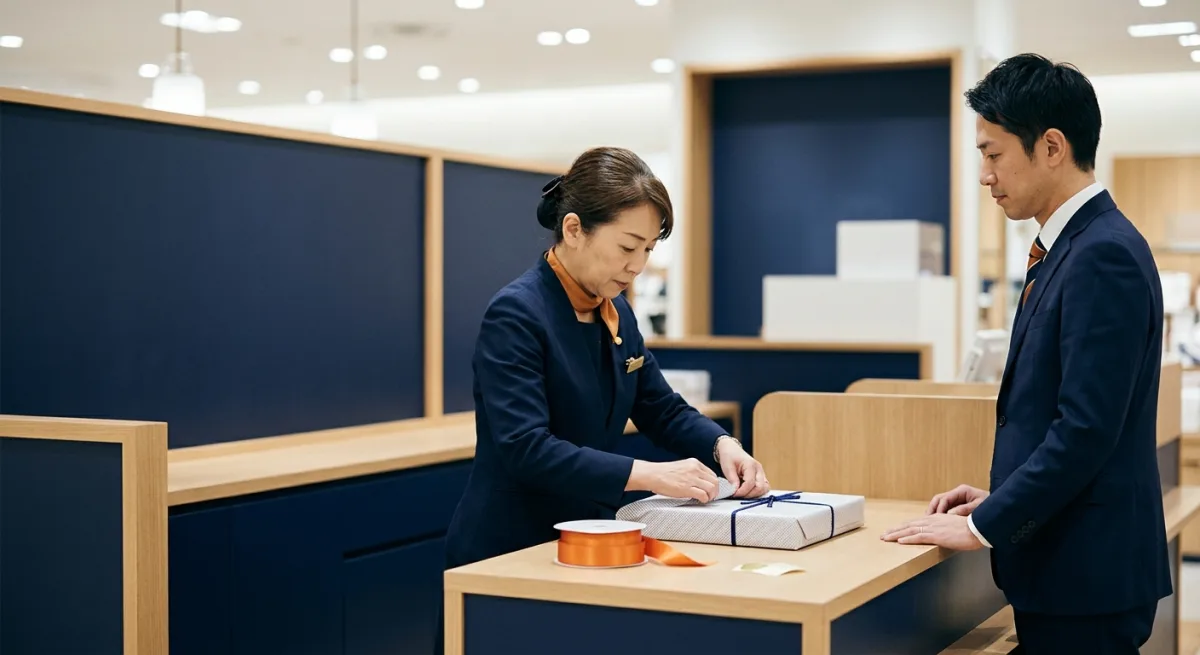
Meishi: The Japanese Business Card Exchange, Explained
Meishi is the Japanese word for a business card, and the exchange is a structured ritual that opens a meeting rather than an administrative step at the end of it. A short reference: what the card stands for, the handling rules and where they come from, and what a European should actually do.
Part of our Cross-Cultural Leadership series. Start with the full guide: Japanese Business Culture: A Working Guide for Europeans
- Meishi is the Japanese word for a business card. The exchange, meishi koukan, happens at the start of a meeting and establishes names, titles and relative rank for everything that follows
- The handling rules are not arbitrary. Japanese employees are taught to treat their own card as standing for the person, and every rule follows from that premise
- The card goes in a card holder, never into a wallet or a trouser pocket. Two Japanese municipal staff manuals rule out the back trouser pocket by name
- Writing on a received card is bounded by timing rather than forbidden outright: not in front of the person who gave it, and expressly allowed afterwards as a memory aid
- The senior people exchange first, and the title printed on the card is read to work out relative status
- Digital exchange through Sansan's Eight app is now part of the same practice, and it keeps working after the meeting by flagging when a contact changes jobs
Meishi is the Japanese word for a business card. The exchange, meishi koukan, takes place at the start of a first meeting rather than at the end of it, and it is the moment when names, job titles and relative seniority are established for everything that follows. Treating it as an administrative step is the most common European mistake, and it is visible from across the room.
What the card stands for
The rules only make sense once you know what they follow from. Japanese employees are taught to regard their own card as standing for the person. Writing for the EU-Japan Centre for Industrial Cooperation, a Japanese intercultural consultant states that Japanese people are taught to treat their own business cards "like their other self", and derives the handling prohibitions from that premise rather than listing them as rules to memorise.
The same mechanism appears in Japanese-language material written for Japanese staff. A Japanese municipal government states in its own staff conduct manual that the business card is the customer's "face", that each card carries that person's feelings, and that it is therefore to be handled so as not to give discourtesy.
The EU-Japan Centre states the same thing on its public business-culture page: cards are considered an extension of the individual and must be treated with respect, which is why you are expected to accept a card with both hands and take time to study it.
The handling rules, and how firm each one is
Use a card holder. A received card does not go into a wallet or a clothing pocket. Two Japanese municipal governments independently rule out the trouser pocket, one of them naming the back trouser pocket specifically and illustrating it as the wrong option, and one ruling out a commuter-pass holder alongside it. The card case is the correct destination; an inside breast pocket, a jacket pocket or a bag pocket are given as acceptable alternatives when no case is available.
Do not write on the card in front of the giver. This one is bounded by timing rather than absolute, and the bounded version is more useful than the blanket rule most guides print. Two EU-Japan Centre sources forbid writing on a card in front of the person who gave it, and both explicitly permit annotating it afterwards, away from the giver, as a memory aid. Note the name and the context once you are out of the room.
Senior people exchange first. When Japanese exchange cards, the higher-level people exchange first, and the title on a received card is checked to establish relative status. That documentation dates from the late 1990s, so treat it as a convention with long standing rather than as a fresh observation, but it is the reason the exchange is worth doing slowly: both sides are reading.
Mishandling is read as a message. An EU-Japan Centre report on Japanese business culture states that Western business people often write on cards or put them in their pockets instead of storing them in a card case, and that this communicates that the Japanese cards are unimportant and not valued. The report carries no method or sample, so this is what the author states rather than a measured effect. It is still the reading you should expect.
The digital half
The paper ritual has a digital counterpart, and ignoring it now costs you more than mishandling a card. Eight, the business-card app from Sansan, notifies you when a contact you are connected to changes their card because of a career move.
That is the part European operators tend to miss. In a market where a relationship survives an individual's job change, an address book that tells you when your contact moves to a new division is doing relationship maintenance, not contact management. The wider Japanese B2B networking stack is covered in our guide to business cards, Eight and Sansan in Japan.
What a European should actually do
Carry more cards than you think you need, in a case, and hand them out with the Japanese side facing the recipient. Present and receive with both hands. Read the card you are given, out loud if the name is hard, and check the title before you decide who you are talking to. Lay received cards on the table in front of you for the duration of the meeting rather than filing them away mid-conversation. Annotate them afterwards.
Then stop. The exchange opens the relationship and does not carry it. A well-run meishi koukan followed by a slow, vague follow-up is worth less than a slightly awkward one followed by the material you promised, sent the next morning. The ritual is a courtesy that buys you the standing to be useful; the usefulness is still your job.
Where the ritual matters less
In a Tokyo startup, a foreign-owned subsidiary, or any meeting held over video, the full exchange is not available and insisting on it reads as stiffness rather than respect. The sources behind these rules describe established firms and first meetings, and that is where the advice is strongest. Away from that setting, this is etiquette, and etiquette alone wins nothing.
Related concepts
The exchange is the opening move of a longer sequence:
- Japanese business etiquette for European executives, the full meeting protocol the exchange sits inside
- Nemawashi: how Japanese decision-making really works, what happens between the meetings the cards get exchanged at
- Uchi and soto: the Japanese in-group boundary, why the same person addresses you differently once the two companies are on the same side of a line
- Japanese business terms: a glossary for European executives, the wider vocabulary
The cultural layer underneath all of them is in our working guide to Japanese business culture.
Where this comes from
The mechanism and the handling rules come from EU-Japan Centre for Industrial Cooperation material, including a Japanese intercultural consultant's own account and the Centre's public business-culture page, cross-checked against two Japanese municipal staff conduct manuals written for Japanese employees. The exchange-order convention comes from JETRO-published material dating to 1999, treated here as long-standing convention rather than current measurement. The Eight notification behaviour is Sansan's own published description of the product.
Stay Ahead in Cross-Cultural Marketing
Get monthly insights on international growth strategies, cultural intelligence, and digital marketing trends delivered to your inbox.
We respect your privacy. Unsubscribe at any time.