Japanese Business Gift Giving: Occasions, Protocol and What to Avoid
When a gift is expected in Japan, what to bring, how to present it, wrapping, the two formal seasons, reciprocity, and the compliance limits visitors miss.
Part of our Cross-Cultural Leadership series. Start with the full guide: Japanese Business Culture: A Working Guide for Europeans
- Gift-giving in Japan is prescribed behaviour rather than a nicety. Custom prohibits arriving at an affiliate's home empty-handed, and the absence of a gift is often seen as rude (Routledge Handbook of Japanese Business and Management, 2016)
- Gift choice differs depending on the season and the purpose, unlike the more casual practice European and US visitors are used to (same source)
- Specificity beats expense. Japanese gift-buying favours high-priced products and known brands to show social status, which is exactly why a visitor should not compete on price: it creates an obligation to reciprocate at equal value
- Ochugen and Oseibo are the two traditional formal seasons, a mid-year one and a year-end one, and their purpose is to broaden and maintain relationships. Ask your counterpart for the timing rather than trusting a date range you read online
- The compliance limit is real: Japan's National Public Service Ethics Act (1999) restricts gifts from interested parties to national public servants, and many companies operate internal limits. Ask early, do not guess a number
Bring something regional, modest and properly wrapped. Japanese custom prohibits arriving at a friend's or affiliate's home empty-handed, and bringing a gift is prescribed behaviour that failing to observe is often seen as rude (Routledge Handbook of Japanese Business and Management, 2016).1 The business version of that norm is softer, but the expectation behind it is the same one.
Most guidance on this subject fails in one of two directions. It either treats gift-giving as a quaint local flourish, which underrates it, or it publishes an intricate calendar of dates and value thresholds it cannot source, which is worse. The rules that are actually documented are few and useful. The parts that are not documented are where the folklore lives, and this piece says so where it applies.
When a gift is expected
Gift choice in Japan differs depending on the season and the purpose of the gift, unlike the more casual practice familiar to US and European visitors (Routledge Handbook, 2016).1 That single sentence carries the whole system: the occasion determines the gift, so the first question is never "what should I bring" but "what is this for".
The occasions a European company will actually meet:
- A first meeting or first visit to their office. Widespread practice, and our recommendation. Something regional, shareable, modest.
- A milestone. Contract signature, the end of a pilot, the opening of a local office.
- Returning from a trip. Omiyage is a souvenir brought back from somewhere and shared with the team. Temiyage is the gift you carry when visiting someone. The distinction matters because they are bought differently: omiyage is a box for the office, temiyage is one thing for one host.
- Hosting them in Europe. If a Japanese delegation visits you, they will almost certainly arrive with something. Have something ready.
- The two formal seasons, if the relationship is running. See below.
What to bring
Specificity beats expense, and there is a mechanism behind that rather than just modesty. In gift-giving, Japanese tend to favour high-priced products and known brands, both to show social status and because their sense of feeling good is tied to interpersonal situations (Routledge Handbook, 2016).1 Read that as a warning rather than an instruction. If you enter a price competition with a counterpart whose culture treats gift value as a social statement, you will either lose it or win it uncomfortably, and an expensive gift from a new supplier creates an obligation to reciprocate at equal value that your counterpart did not ask for.
The working brief:
- Regional. Something identifiably from where you are. Dutch stroopwafels, Belgian or French chocolates, German confectionery, a small piece of Scandinavian design.
- Modest. Roughly EUR 15 to 40 for a first meeting.
- Shareable. Individually wrapped items for a team beat one item for one person.
- Bought at home. Buy before you fly. A gift bought in Tokyo defeats the point, and your counterpart will know the shop.
- Consumable is safest. Food and drink create no storage problem and no display obligation.
If you find yourself needing to buy in Japan, the food floor in a department store basement, the depa chika, is the epitome of a sales floor for luxury ingredients, ready-to-eat foods, sweets and gifts (Routledge Handbook, 2016).2 It is where a Japanese colleague would go, and the counter staff will wrap for you.
Giving and receiving
The mechanics take thirty seconds and are worth getting right, because they sit inside the same rank sequence as the business cards and the seating. The higher-level people exchange cards first and the title on the card is checked on the spot to establish relative status (JETRO, 1999);3 each seat in the room is assigned by rank and experience (Routledge Handbook, 2016).1 The gift lands into that order.
Giving. Present at the end of the meeting rather than the start, so it does not look transactional. Take the item out of the shop bag and hand over the wrapped gift with both hands, keeping the bag. Say one line about what it is and where it is from. Do not oversell it. Do not apologise for it, which is a European reflex that reads as odd.
To whom. If you brought something for the team, give it to the most senior person present and say it is for everyone. If you brought individual items, hand them out in rank order.
Receiving. Both hands, and thank the giver properly. Do not expect the gift to be opened while you are there, and do not press for it to be opened. Practice varies more than the folklore admits, so follow your host rather than a rule.
The team version is our Japan business etiquette training, delivered with Takashi Kawatani of the Diversity Management Institute, whose thirty-plus years on the Japanese side of these meetings is where the industry-specific detail comes from.
Wrapping
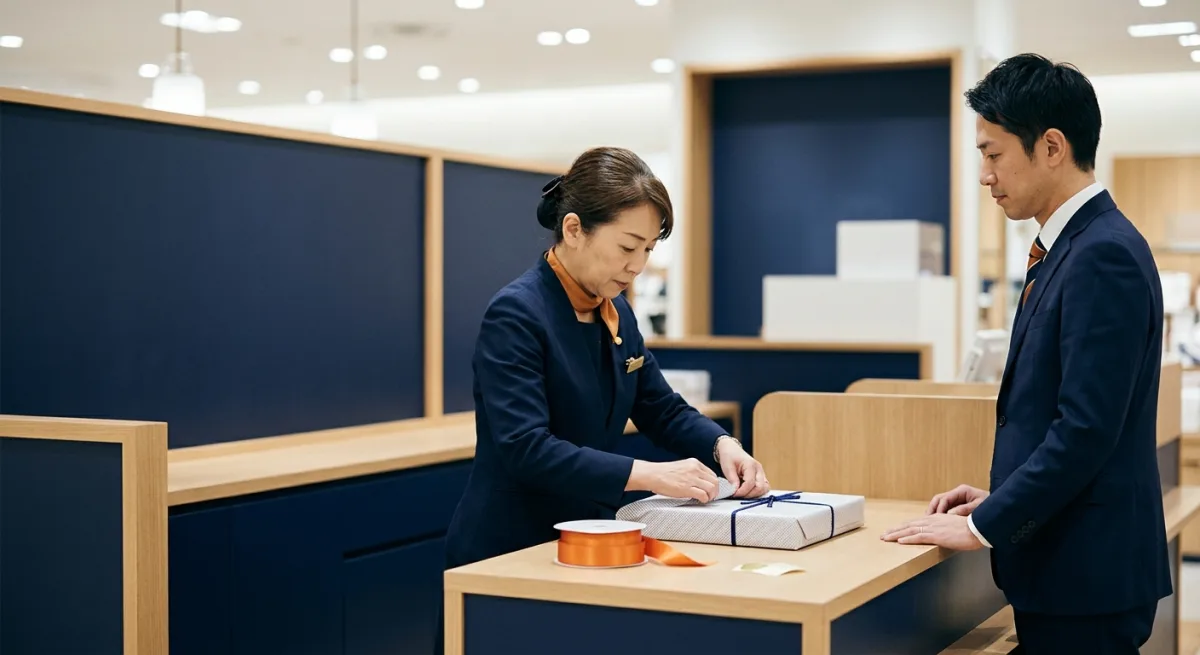
Wrapping is not decoration in Japan, it is part of the gift, and it is the single easiest thing for a visitor to get right: have it wrapped at the point of purchase. Any decent shop in Europe will do it, and any Japanese department store will do it beautifully and for free.
Two practical rules. Keep the wrapping restrained rather than loud, because the paper is doing the same understated work the rest of the exchange does. And hand over the wrapped item, not the carrier bag, which is transport rather than presentation.
You will read that business gifts should be wrapped in a furoshiki cloth. Furoshiki is real and it is lovely, but there is no basis for treating it as an expectation on a foreign visitor's business gift, and buying one to use incorrectly is a worse outcome than clean paper from the shop.
Ochugen and Oseibo, without the fake calendar
Ochugen and Oseibo are Japan's two traditional formal gift-giving seasons, and their purpose is to broaden and maintain relationships with people such as co-workers and teachers (Routledge Handbook, 2016).1 One falls around the middle of the year and one at the year's end, which is what the names say.
We do not publish a date range for either, and you should be sceptical of guidance that does. The windows are reported differently by different sources, they vary by region and by company, and a wrong date is worse than no date because it arrives as a confident instruction. If you have a running relationship with a Japanese partner, ask them whether their office observes the seasons and when they send. It is an easy question, it flatters the relationship, and the answer is authoritative for the one company you actually care about.
What is worth internalising is the function rather than the schedule. These are maintenance gifts. They exist to keep a network warm, which means they signal that a relationship is ongoing rather than transactional. If a Japanese partner sends you one, that is information about how they see the relationship, and the correct response is to reciprocate in kind rather than to escalate.
Reciprocity, and the giri-choko exception
The reciprocity expectation is the reason to keep the value modest, and it is also why the most famous Japanese workplace gift custom is a good thing for a European reader to know about.
Giri-choko, obligation chocolate, is the Valentine's Day chocolate Japanese women have given to male colleagues. The custom is not ancient: Japan's women-give-chocolate-to-men Valentine's practice was firmly cemented by the mid-1960s through confectioners' marketing campaigns, not by prior tradition.4 White Day falls exactly one calendar month later, on 14 March, and is when men are expected to reciprocate.4 And the custom is in retreat: self-purchase (jibun-choko) is rising while obligation chocolate is falling by the wayside among many women consumers.4
That is the useful lesson in miniature. A Japanese business gift custom can be recent, marketing-created, and currently fading, all at once. Treat the norms in this article as live practice to check rather than as fixed tradition, and ask your counterpart when it matters.
Compliance, honestly
There is one hard legal line and one soft organisational one.
The hard line. Japan's National Public Service Ethics Act (1999) and its accompanying ethics code restrict gifts and hospitality from interested parties to national public servants. If your counterpart is a ministry, an agency or a public body, the correct move is to bring nothing and to say plainly that you understand the rules. That sentence does more for your credibility than any gift would.
The soft line. Many Japanese companies operate internal limits on the value of gifts and hospitality staff may accept, and so does your own company, and so does the anti-bribery law you are subject to at home. We deliberately do not publish a figure, because the figure varies by company and a number quoted in an article becomes the number people use. Ask your primary contact early whether their firm has a policy. Compliance questions asked in advance read as professionalism. The same question asked while holding out a box does not.
What to avoid
- Sets of four. The number four (shi) is a homophone of the word for death. Nine (ku) is avoided for its homophone with suffering.
- Anything that needs explaining. If the gift requires a paragraph on why it is special, it is the wrong gift.
- Anything expensive. It creates an obligation your counterpart has to discharge.
- Loud own-branding. A gift covered in your logo is marketing collateral, and it is received as such.
- Anything personal. On a first visit, keep it neutral: food, drink, or a small regional object.
- A gift instead of preparation. No gift compensates for sending the wrong seniority, pushing for a decision in the room, or failing to follow up. Those are covered in the etiquette pillar.
Where the rule breaks
The default here is modest and regional. Two cases invert it.
If your counterpart is a public body, the whole recommendation is void: bring nothing, per the ethics rules above.
And if the relationship is already running and the Japanese side has sent a substantial Ochugen or Oseibo gift, answering it with a bag of stroopwafels is a downgrade rather than a charming gesture. Japanese gift-giving favours known brands and higher price precisely because the value carries social meaning, so a reciprocal gift should be read against what you received. The modest-and-regional rule is a first-meeting rule, and it stops being the right one once the relationship has a history.
Where to go next
- Japanese business etiquette: the manners and protocol that matter, the pillar this article is a spoke of
- Japanese business culture: a working guide for Europeans, the cultural layer underneath
- Japanese business attire: the dress code, decoded, the other thing to settle before you fly
- Women in Japanese business, the protocol and the workforce facts
- Settai, nomikai and Japanese business after hours, where the relationship the gift maintains actually gets built
- Eight and Sansan: keeping Japanese contacts warm after the meishi exchange, the follow-up side
- Japan business etiquette training, the rehearsed version for teams
Sources
- Gift-giving as prescribed behaviour, and season and purpose. Haghirian, P. (ed.) (2016), The Routledge Handbook of Japanese Business and Management, ch. 19: on custom prohibiting arrival at a friend's or affiliate's home empty-handed and the absence of a gift being seen as rude (p. 258); on gift choice differing by season and purpose (p. 257); on Ochugen and Oseibo as the two traditional formal seasons whose purpose is to broaden and maintain relationships (p. 257); and on Japanese gift-buying favouring high-priced products and known brands to show social status (p. 262).
- Where to buy in Japan. Usui, in Haghirian (ed.) (2016), ch. 23, p. 305, on the department-store basement food floor (depa chika) as the epitome of a sales floor for luxury ingredients, ready-to-eat foods, sweets and gifts.
- The rank sequence the gift lands into. JETRO (1999), Communicating with Japanese in Business (Gundling), on the order of the business-card exchange and the checking of titles; Routledge Handbook (2016), ch. 29, on meeting seats assigned by rank and experience.
- Valentine's Day and White Day. Nippon.com: on the women-give-chocolate custom being cemented by the mid-1960s through confectioners' marketing; on White Day falling exactly one calendar month after Valentine's Day, on 14 March, when men reciprocate; and on self-purchase (jibun-choko) rising while obligation chocolate (giri-choko) falls by the wayside among many women consumers.
- Public-sector gifts. National Public Service Ethics Act (Japan, 1999) and the National Public Service Ethics Code, restricting gifts and hospitality from interested parties to national public servants. No thresholds or exemptions are asserted here.
Deliberately not sourced, and therefore not stated: exact Ochugen and Oseibo date ranges, a half-value reciprocity rule, a universal do-not-open-it-in-front-of-you rule, and any numeric corporate gift cap. The claim inventory, including those rejected rows, is at content/blog/research/japanese-business-gift-giving-claims.md.
References
-
Haghirian, P. (ed.) (2016). The Routledge Handbook of Japanese Business and Management, ch. 19 and ch. 29. On gift-giving as prescribed behaviour (p. 258), on gift choice varying by season and purpose (p. 257), on Ochugen and Oseibo as the two traditional formal gift-giving seasons (p. 257), on Japanese gift-buying favouring high-priced products and known brands (p. 262), and on meeting seats assigned by rank and experience (ch. 29). ↩ ↩2 ↩3 ↩4 ↩5
-
Usui, K., in Haghirian, P. (ed.) (2016), ch. 23, p. 305. On the depa chika department-store food basement as the epitome of a sales floor for luxury ingredients, ready-to-eat foods, sweets and gifts. ↩
-
JETRO (1999). Communicating with Japanese in Business (Gundling). On the business-card exchange order and the checking of titles to establish relative status. ↩
-
Nippon.com. On the Japanese Valentine's custom being firmly cemented by the mid-1960s through confectioners' marketing campaigns; on White Day, exactly one calendar month later on 14 March, when men are expected to reciprocate; and on self-purchase (jibun-choko) rising while obligation chocolate (giri-choko) falls by the wayside among many women consumers. ↩ ↩2 ↩3
Stay Ahead in Cross-Cultural Marketing
Get monthly insights on international growth strategies, cultural intelligence, and digital marketing trends delivered to your inbox.
We respect your privacy. Unsubscribe at any time.