Japanese Business Attire: The Dress Code, Decoded
What to wear to a business meeting in Japan: the suit default, colour and formality signals, the summer Cool Biz shift, women's attire, and visitor mistakes.
Part of our Cross-Cultural Leadership series. Start with the full guide: Japanese Business Culture: A Working Guide for Europeans
- Dress in Japan carries rank information, not personality information. Rank is signalled non-verbally, and uniform-style dress is one of the main carriers of that signal (Norbury and Bownas, Business in Japan)
- The default for a first meeting is a dark suit, a plain shirt, quiet accessories and closed shoes. It is the lowest-variance choice, not a display of taste
- Cool Biz is the one sanctioned relaxation. The Ministry of the Environment launched it in 2005, asking offices to set summer cooling at 28 degrees Celsius and allowing staff to work without a jacket and tie
- The window is no longer uniform across firms, so ask your host what the office is wearing rather than guessing. Asking is normal and costs nothing
- Dressing down does not buy informality with a Japanese counterpart; it removes a signal they were reading. The European instinct to signal approachability through clothing does different work in Tokyo
Wear a dark suit, a plain shirt and quiet accessories to a first meeting in Japan. Rank in the Japanese business world is signalled non-verbally, and uniform-style dress is one of the main carriers of that signal (Norbury and Bownas, Business in Japan).1 Dressing down does not earn informality. It removes a signal your counterpart was reading.
That is the whole argument, and everything below is detail. But the argument is worth holding onto, because the European instinct runs the other way. In Amsterdam, Berlin or Milan, taking the tie off is a friendliness move. In a Tokyo meeting room it is a rank move, and it will be read as one.
Why clothing carries more information in Tokyo
Vertical interpersonal relationships dominate in Japan, and people hold different ranks based on gender, age, rank and occupation (Routledge Handbook of Japanese Business and Management, 2016).2 Respect in Japanese business culture depends primarily on age, status and rank (Katz, 2008).3 Those rankings have to be established quickly, by people who have just met, and the two fastest carriers are the business card and the clothes.
There is an old but clean piece of evidence for the mechanism. Japanese raters decode body postures primarily by status and power, whereas American raters decode the same postures primarily by interpersonal responsiveness, such as like or dislike (Matsumoto and Kudoh, 1987).4 That is a 1987 study about posture, not a current survey of offices, and it should be read as one. But it names the asymmetry precisely: the same physical presentation is being read for position on one side of the table and for personality on the other.
The corollary is a warning about overcorrecting. Expansive postures that conflict with East Asian norms of modesty, humility and restraint do not produce the same power-related effects for people from East Asian cultures (Park et al., 2013).5 Dressing and standing to project authority, in the way a European sales director might, does not translate cleanly. Composure does.
The default kit for a first meeting
- Suit. Navy or charcoal, conventional cut, two-button. Avoid head-to-toe black with a white shirt and a dark tie, which reads as funeral formalwear.
- Shirt. White or pale blue, plain, long sleeves.
- Tie. Subdued. A quiet pattern is fine, a novelty is not.
- Shoes. Dark, closed, polished, and easy to slip off. You may be asked to remove them, at a traditional restaurant or occasionally at a site visit, so socks matter more than usual.
- Coat. Take it off before you enter the building or the meeting room, not after you sit down.
- Accessories. Small watch, minimal jewellery, no strong fragrance. A conservative bag that stands up on its own rather than a soft rucksack.
One vocabulary note that explains a lot of what you will see on the street in spring. The near-uniform dark suit worn by Japanese students during shukatsu job hunting is called a rikuruto suutsu, a recruit suit. It is the visual bottom of the formality ladder in a corporate context, which is a second reason a senior visitor avoids plain black.
Cards and clothes work as a pair. The higher-level people on each side exchange cards first, and the title on a received card is checked on the spot to establish relative status (JETRO, 1999).6 The full meishi sequence and the seating logic that follows it sit in our etiquette pillar; dress is the part of that system you have to get right before you arrive.
The team version of that is our Japan business etiquette training, run with Takashi Kawatani of the Diversity Management Institute, who has spent more than thirty years on the Japanese side of these rooms and can tell you what a given industry in a given city actually wears.
Cool Biz: the one sanctioned relaxation
Japan has a formal mechanism for dressing down in summer, and it comes from the government rather than from fashion. Cool Biz was launched by the Ministry of the Environment in 2005 as an energy-saving measure. It asks offices to set summer cooling at 28 degrees Celsius and allows staff to work without a jacket and tie. Warm Biz, introduced the same year, is the winter counterpart: heat less, dress warmer.
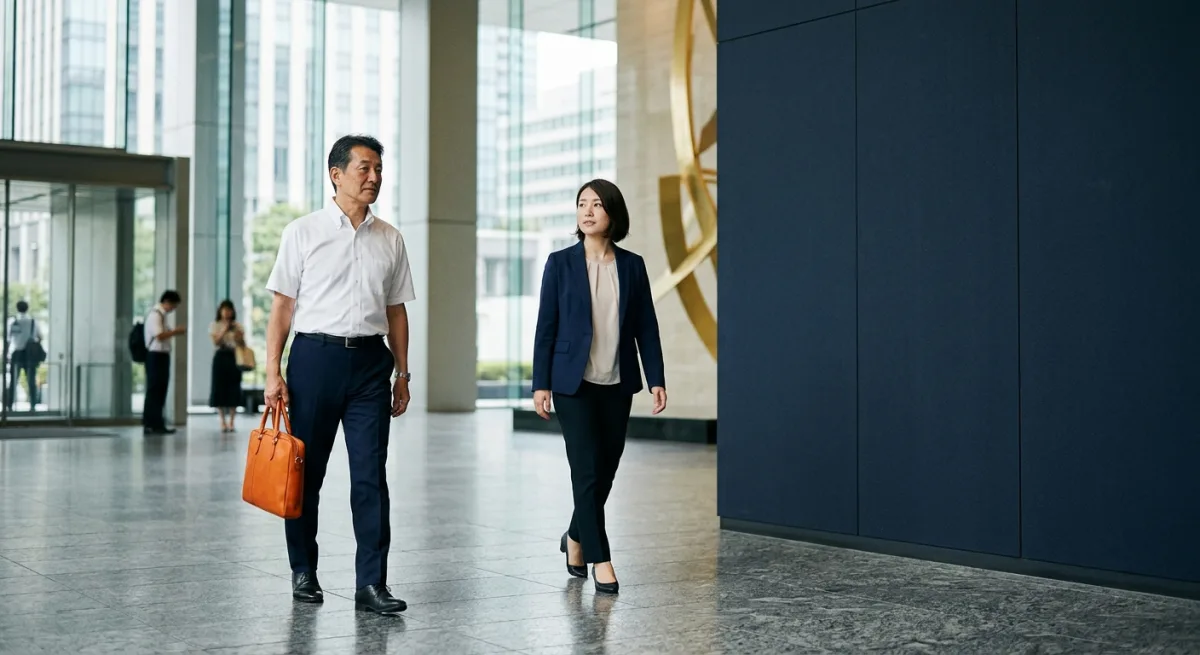
What Cool Biz looks like in practice is an open-collar dress shirt, often short-sleeved, with suit trousers and no tie. It is not smart-casual. Chinos, polo shirts and trainers are not Cool Biz.
The part that trips up visitors is the calendar. The window is no longer applied uniformly across firms, and a bank, a manufacturer and a Tokyo start-up will treat the same August week differently. Do not infer it from a photograph on the company website. Ask your host directly what the office is wearing that month, which is an ordinary question and reads as preparation rather than as fussing.
The safe operating rule when you cannot ask: travel with the jacket, wear it into the building, and follow the room. Taking a jacket off because your host has is easy. Producing one you did not bring is not.
Women's attire
The register is the same as the men's, and the practical answer is short: a dark suit with trousers or a skirt, a plain blouse, closed shoes, small jewellery, minimal fragrance. Trouser suits are unremarkable in Japanese offices.
Heels are not a requirement. They have not been an uncontested one since 2019, when the KuToo campaign, founded by Yumi Ishikawa, took workplace rules requiring women to wear high heels to Japan's Ministry of Health, Labour and Welfare in a petition. The name is a pun on kutsu, shoe, and kutsuu, pain. The campaign did not abolish anything by itself, but it moved the question from private grievance to public policy debate, and a foreign visitor in flat shoes is not making a statement.
Two practical notes that matter more than the clothing. You may need to take your shoes off, so choose accordingly. And if you are the senior person present, your dress should read at the top of your delegation's formality range rather than the middle, because it is one of the inputs the room uses to work out who is in charge. The rest of that calculation, including the meishi order and the seating, is in our guide to women in Japanese business.
By setting
| Setting | Register |
|---|---|
| First meeting at head office | Dark suit, tie, plain shirt. The formal end, always |
| Ongoing meetings, same client | Follow the register your host has set, including Cool Biz in summer |
| Factory, plant or site visit | A step down: jacket without a tie is common, plus whatever safety kit the site requires |
| Client dinner after a meeting | The formality you arrived in; jackets often come off once everyone is seated |
| Trade fair or expo stand | Suit, no tie is acceptable if the stand team is dressed that way |
| Video call from Europe | Jacket and shirt. The camera flattens everything else |
That table is Silkdrive's own operating guidance, not a finding about Japan. The principle behind it is the one thing to remember if you remember nothing else: formality never drops below what the setting demands, and a European visiting Japan dresses up rather than down.
Where the rule breaks
The default advice here is to sit at the formal end and let your host's register tell you when to relax. There is a real case where that is the wrong call: a European visitor arriving in a full dark suit and tie at a Japanese start-up, a creative agency, or a manufacturing floor in August, where the host side is in Cool Biz shirtsleeves. The overdress reads as distance rather than respect, and it makes the host self-conscious in their own office.
The fix is the thing this piece keeps recommending: ask before you pack. Where asking is not available, the formal end remains the lower-variance error, because arriving overdressed is a small awkwardness and arriving underdressed at a first meeting is a rank signal you did not intend to send.
Where to go next
- Japanese business etiquette: the manners and protocol that matter, the full arrival and meeting sequence
- Japanese business culture: a working guide for Europeans, the cultural layer underneath the protocol
- Women in Japanese business, the protocol and the workforce facts, kept apart
- Japanese business gift giving, the other thing you have to get right before you arrive
- Japanese etiquette for European executives, the country-by-country delta for Dutch, German, French and UK baselines
- Japan business etiquette training, the rehearsed version for teams
Sources
- Dress as a rank signal. Norbury, P. and Bownas, G. (eds.), Business in Japan, on rank being indicated non-verbally through uniform-style dress and the frequent exchange of visiting cards.
- Why rank has to be established fast. Haghirian, P. (ed.) (2016), The Routledge Handbook of Japanese Business and Management, ch. 29, on vertical relationships and ranks held by gender, age, rank and occupation. Katz, L. (2008), Negotiating International Business: Japan, on respect depending primarily on age, status and rank.
- How presentation is decoded. Matsumoto, D. and Kudoh, T. (1987), on Japanese raters decoding body postures primarily by status and power while American raters decode them primarily by interpersonal responsiveness. Park, L. et al. (2013), on expansive postures conflicting with East Asian norms of modesty, humility and restraint and therefore not producing the same power-related effects.
- Cards. JETRO (1999), Communicating with Japanese in Business (Gundling), on the order of the business-card exchange and the checking of titles.
- Cool Biz and Warm Biz. Ministry of the Environment (Japan), Cool Biz, launched summer 2005: offices set summer cooling at 28 degrees Celsius and staff may work without a jacket and tie; Warm Biz, the winter counterpart, introduced the same year. Note that the campaign is run by the Ministry of the Environment, not METI, and that no fixed national date range is asserted here.
- Heels. The KuToo campaign, founded by Yumi Ishikawa in 2019, and its petition to Japan's Ministry of Health, Labour and Welfare on workplace rules requiring women to wear high heels.
The claim inventory behind this article, including the colour and prevalence statistics that were rejected, is at content/blog/research/japanese-business-dress-code-claims.md.
References
-
Norbury, P. and Bownas, G. (eds.). Business in Japan. On rank being indicated non-verbally through uniform-style dress and the frequent exchange of visiting cards. ↩
-
Haghirian, P. (ed.) (2016). The Routledge Handbook of Japanese Business and Management, ch. 29. On vertical interpersonal relationships and ranks based on gender, age, rank and occupation. ↩
-
Katz, L. (2008). Negotiating International Business: Japan. On respect depending primarily on age, status and rank. ↩
-
Matsumoto, D. and Kudoh, T. (1987). On Japanese raters decoding body postures primarily by status and power, and American raters primarily by interpersonal responsiveness such as like or dislike. ↩
-
Park, L. et al. (2013). On expansive postures conflicting with East Asian norms of modesty, humility and restraint, and therefore not producing the same power-related effects for people from those cultures. ↩
-
JETRO (1999). Communicating with Japanese in Business (Gundling). On the business-card exchange order and the checking of titles to establish relative status. ↩
Stay Ahead in Cross-Cultural Marketing
Get monthly insights on international growth strategies, cultural intelligence, and digital marketing trends delivered to your inbox.
We respect your privacy. Unsubscribe at any time.