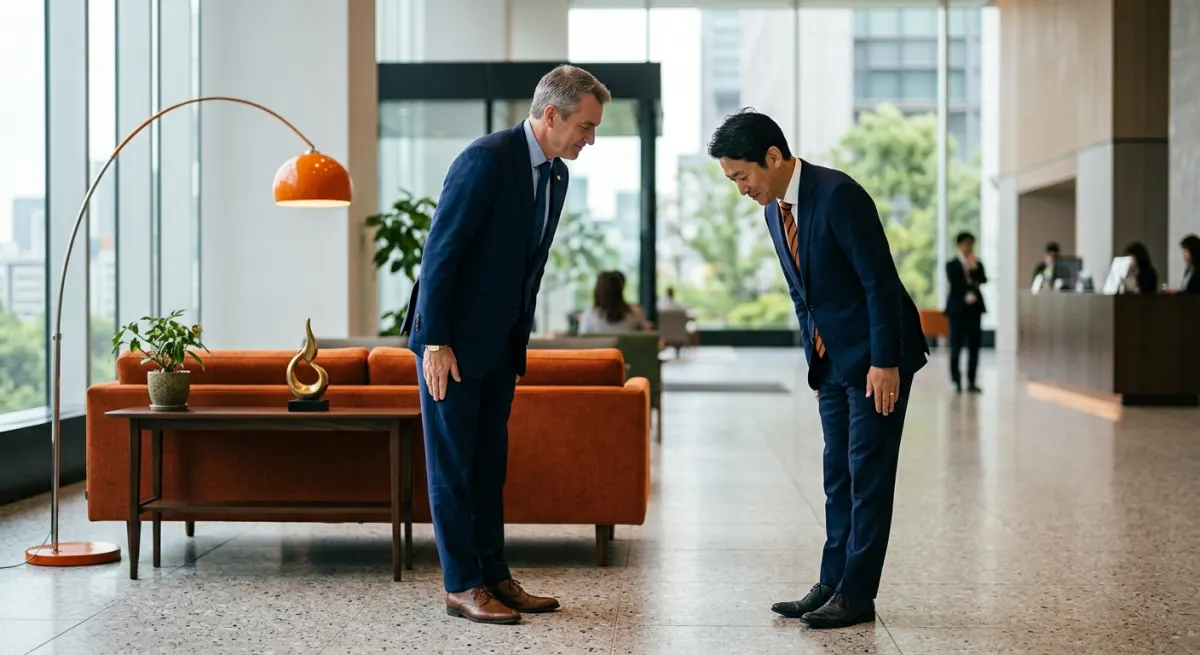
Omotenashi: Japanese Hospitality as a Service Standard
Omotenashi is hospitality that anticipates a need before it is expressed and expects nothing visible in return. A short reference on what the term means, where it came from, how Japanese companies use it commercially, and what standard it sets for a European firm selling into Japan.
Part of our Cross-Cultural Leadership series. Start with the full guide: Japanese Business Culture: A Working Guide for Europeans
- Omotenashi is hospitality that meets a need before the guest expresses it and expects nothing visible in return. Its cultural root is the tea ceremony
- What separates it from commercial service in the academic definition is the anticipation of an unspoken need, not the warmth of the delivery
- It is used as a commercial strategy, not only as a cultural value: Rakuten, Japan's leading e-retailer, grew on an omotenashi strategy
- The standard is ambient. A study comparing clothing retail in Japan and Sweden found Japanese customers held higher expectations of store and staff, and Japanese service to be more detailed, more socially driven and more frequent
- The commercial argument for meeting it runs through word of mouth, and the widely quoted figures come from a report that does not name its underlying survey, so the direction is reportable and the precision is not
- For a European firm the practical translation is that responsiveness is a deliverable rather than a courtesy, and it has to be priced
Omotenashi is hospitality that makes a guest comfortable and happy through a personalised experience, offered without asking for anything in return. In an academic comparison of Japanese hospitality it is distinguished from ordinary commercial service by one thing in particular: it anticipates needs the guest has not expressed. Its cultural root is the tea ceremony.
That definition is worth reading twice, because the two halves do different work. The anticipation is the mechanism. The absence of an expected return is what makes it hospitality rather than an upsell.
Where it shows up in business
The term is often introduced to Europeans as a piece of cultural colour, which undersells it. It is used as a commercial strategy. Rakuten, the leading e-retailer in Japan, is described in the Routledge Handbook of Japanese Business and Management as having grown rapidly on a strategy of omotenashi, providing high quality and intimate personal services.
For a European operator the more useful framing is not that Japanese firms are hospitable but that the hospitality is the product decision. Anticipating what a customer will need next is an operating choice with staffing and margin consequences, and Japanese firms have made it deliberately.
The standard you are measured against
The reason this matters commercially is that the standard is ambient. Your Japanese buyer is not comparing you to your European competitors; they are comparing you to what they experience every day.
A study comparing clothing stores in Japan and Sweden found that Japanese customers held higher expectations of the store and its staff than Swedish customers did, and that Japanese service was more detailed, more socially driven and more frequent than the Swedish baseline. That is clothing retail and one European comparison. It is a well-attested direction rather than a measurement of every Japanese market.
The commercial argument usually runs through word of mouth. An EU-Japan Centre report on digital marketing for Japan cites survey figures of 50.8 per cent of satisfied Japanese customers sharing that satisfaction by word of mouth against 4.1 per cent of dissatisfied ones. The report does not name the underlying survey, so the direction is reportable and the precision is reported rather than settled. Attentive service feeds a referral engine either way, and in a market where a recommendation from a known contact opens doors that a cold approach does not, that is the mechanism that pays.
What it does not license
Two claims travel with this term and neither is supported by anything solid. The first is that omotenashi has no equivalent outside Japan. The second is that it cannot be trained. Neither belongs in a business case, and the second is contradicted by the fact that Japanese service industries train it.
There is also a real cost question. Matching the ambient standard on every account is an expense, and for a European firm competing on price in a low-margin category it may not be recoverable. The sourcing here points at retail and consumer commerce rather than industrial B2B, so omotenashi sets the expectation a buyer walks in with, and how much of it you buy is a pricing decision.
What a European firm should actually do
Reply within hours rather than days, and treat the reply time as a service level you have committed to rather than a reflection of how busy the week is. Send promised material before the promised date. Confirm in writing what was agreed, without being asked. Anticipate the next question in the same message that answers the current one. Never make a partner chase you for something you owe them.
None of that is exotic, which is the point. The gap between European and Japanese practice here is rarely a gap in capability. It is a gap in what counts as normal, and closing it is mostly a matter of deciding that the responsiveness is part of what you sell.
Related concepts
- The customer is god: what the Japanese service phrase actually means, the phrase most often confused with this one
- Silent churn: why Japanese customers leave without complaining, what happens when the standard is not met
- Meishi: the Japanese business card exchange, explained, the same anticipation applied to a first meeting
- Japanese business terms: a glossary for European executives, the wider vocabulary
The cultural layer underneath all of them is in our working guide to Japanese business culture.
Where this comes from
The definition, including the tea-ceremony root and the anticipation of unspoken needs, comes from an academic comparison of Japanese hospitality held in our verified claims database; the source record does not name the underlying paper, so it is attributed here as an academic comparison rather than to a named author. The Rakuten example comes from Usui in Haghirian (ed.), The Routledge Handbook of Japanese Business and Management (2016), citing Mikitani (2013). The service-expectation comparison comes from a master's thesis on Japanese service culture in clothing stores. The word-of-mouth figures come from an EU-Japan Centre report on digital marketing for Japan, which does not name the survey behind them.
Stay Ahead in Cross-Cultural Marketing
Get monthly insights on international growth strategies, cultural intelligence, and digital marketing trends delivered to your inbox.
We respect your privacy. Unsubscribe at any time.