Persuading Japanese Stakeholders: Reading Between the Lines
A tactical playbook for European professionals on how Japanese persuasion and indirect communication actually work: reading a soft no, telling a real yes from a polite one, using silence, and making your case in a high-context room.
Part of our Cross-Cultural Leadership series. Start with the full guide: Japanese Business Culture: A Working Guide for Europeans
- Japanese business runs on high-context communication; the message lives in the relationship, the setting, and what is left unsaid, not only in the words. The United States and Japan are often cited as the two extreme poles of low-context and high-context cultures
- "Yes" is not agreement. The Japanese hai can mean anything from yes to no and often signals only that the listener is paying attention; treat it as acknowledgement until operational questions confirm real commitment
- A soft no is the default refusal. One linguist counted sixteen ways Japanese expresses no without the word; "that is difficult" (muzukashii) and "we will study it" (kentou shimasu) are almost always polite declines
- Silence is content, not a gap to fill. After a proposal it usually signals reservation the group will not voice openly; let it sit rather than rushing to discount or re-pitch
- You make your case before the room, not in it. In a high-context, consensus culture the persuading happens in one-on-ones and pre-reads; the meeting confirms a position that is already settled
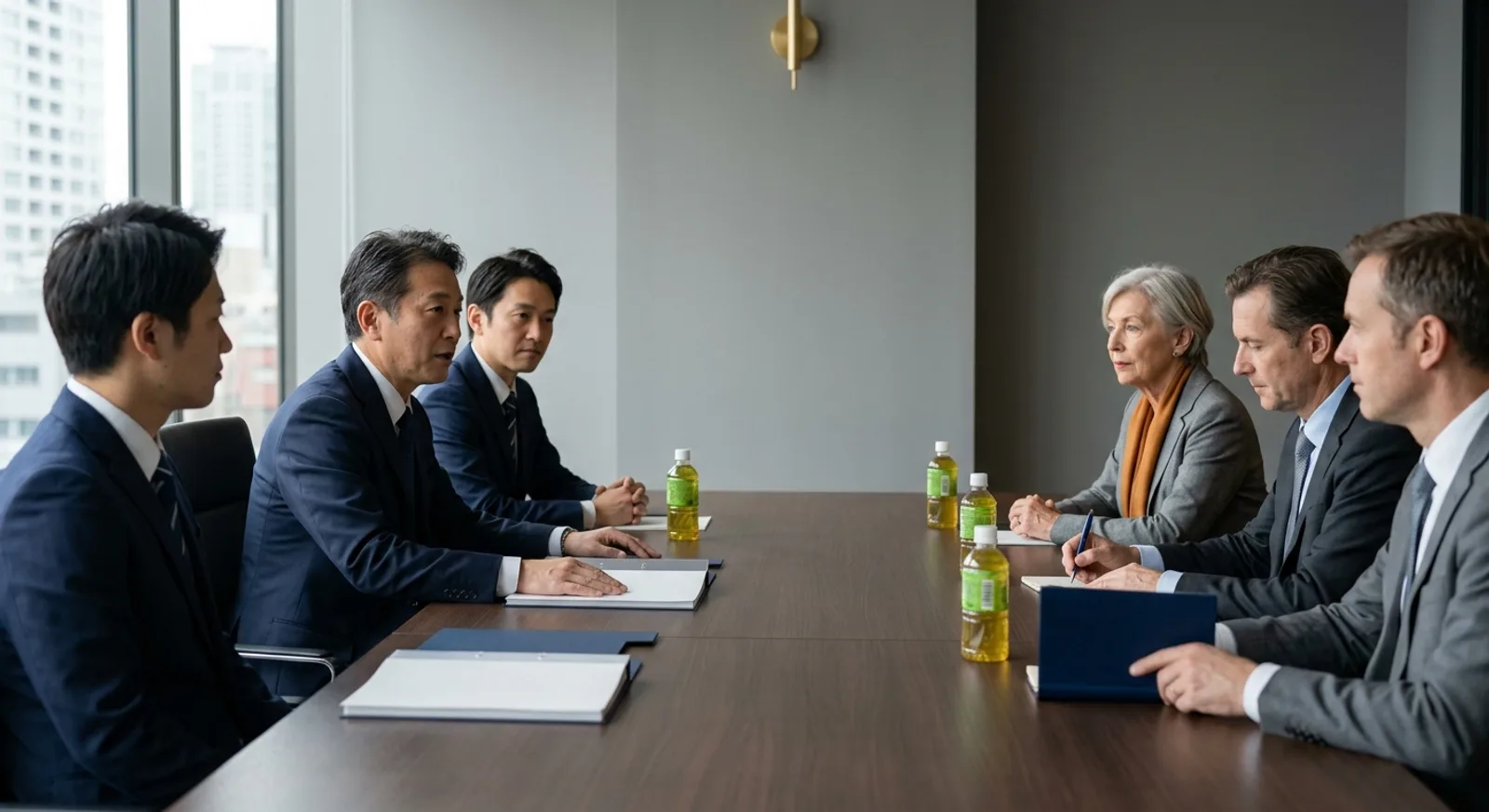
A European sales director flies to Tokyo, presents a sharp proposal, and reads the room as a success. The counterparts nodded throughout. One senior person said the work was very interesting and that they would study it carefully. Nobody objected. She flies home, forecasts the deal, and waits. Nothing moves. Six weeks later a mutual contact mentions, quietly, that the Japanese side had concerns about the timeline from the first meeting, concerns that were never spoken aloud in the room.
Nothing went wrong with the proposal. What went wrong is that she was persuading in the wrong place, listening for the wrong signals, and reading agreement into communication that was never meant to carry it. This is the single most expensive misread in European-Japanese business, and it is avoidable once you understand how Japanese persuasion and indirect communication actually work.
What follows is a tactical playbook for that, written for European professionals specifically. It covers how to tell a real yes from a polite one, how to recognise a soft no, what silence is doing, where the persuading really happens, and how to make your case in a high-context room. It is the reference we hand to European teams before a serious Japan engagement, drawn from more than a decade of cross-cultural growth work between Europe and East Asia and Silkdrive's work with the EU-Japan Centre for Industrial Cooperation.
She was persuading in the wrong place, listening for the wrong signals, and reading agreement into communication that was never meant to carry it.
Why Japanese communication runs on a different operating system
Before any tactic makes sense, you need the underlying model, because the tactics are just consequences of it.
The single most useful concept for understanding cross-cultural differences in business communication is Edward T. Hall's distinction between low-context and high-context cultures (Hooker, Cultural Differences in Business Communication, 2012).1 In a low-context transaction, almost all the meaning sits in the explicit message: you say what you mean, the words carry the content, and anything not stated is assumed not to matter. In a high-context transaction, most of the information is preprogrammed in the receiver and in the setting, with only minimal information in the transmitted message (Kittler, Rygl and Mackinnon, Beyond culture or beyond control?, 2011).2 The meaning lives in the relationship, the history, the seating, the timing, and the gaps, not only in the sentence.
The United States and Japan are often described as the two most extreme cases of low-context and high-context cultures (Hooker, 2012),1 and on Erin Meyer's Communicating scale, Japan has the distinction of being the highest-context culture in the world (Meyer, The Culture Map, 2014).3 Most European business cultures sit somewhere left of centre, with the Netherlands, Germany, and the Nordics among the lowest-context, most explicit communicators anywhere. That gap is the whole problem and the whole opportunity.
High and low context map onto a deeper distinction: rule-based cultures versus relationship-based cultures (Hooker, 2012).1 Low-context European communication treats the deal as a set of explicit terms that stand on their own. High-context Japanese communication treats the deal as inseparable from the relationship around it, which is why a Japanese counterpart may be reluctant to pursue a joint task until a relationship has been established (JETRO, Communicating with Japanese in Business, 1999).4 You are not just exchanging information. You are reading and being read.
Two cultural principles govern the indirectness this produces: wa (harmony) and face (Ciubancan, Principles of communication in Japanese indirectness, 2015).5 The Japanese prefer indirect, roundabout communication rather than direct statements (Ciubancan, 2015),5 and this indirectness is critical for Japanese people in order to maintain harmony and save face (Adachi, Business Negotiations between the Americans and the Japanese, 2010).6 Read that twice, because it inverts a European instinct: in much of Europe, directness is the respectful, efficient, honest choice and ambiguity is evasive. In Japan, indirectness is the considerate, functional, trust-preserving choice and bluntness is the thing that breaks the room.
There is even a cognitive layer underneath the cultural one. East Asians tend toward holistic thought, attending to the entire field and the relationships within it, while Westerners tend toward analytic thought, detaching the object from its context to judge it on its own attributes (Nisbett, Peng, Choi and Norenzayan, Culture and Systems of Thought, 2001).7 A European pitch that strips the proposal down to a clean, context-free value proposition is, to a holistic reasoner, missing most of the picture. The context is the argument itself.
The first skill: a real yes versus a polite yes
Start with the signal Europeans get most wrong, because it costs the most.
In a Japanese meeting you will hear "hai" and see nodding throughout your presentation. The European brain logs this as agreement and builds a forecast on it. But the Japanese hai (yes) can mean almost anything on the continuum from yes to no (Ciubancan, 2015).5 Most of the time, during your pitch, it means "I am following you," not "we accept this." It is a continuity signal that keeps the conversation flowing, the same role "mm-hm" plays in English, except a European ear weights it far more heavily than it deserves.
So how do you tell a real yes from a polite one? Stop listening to the affirmations and watch for one thing: operational questions. Genuine interest generates specifics. When a Japanese counterpart actually intends to move forward, they start asking how the thing works in practice. What is the timeline for phase two? How does pricing behave at scale? Who on our side would own this? Can you send the technical documentation? Those questions are the real yes, because they only make sense if the person has already, internally, decided the proposal is worth operationalising.
A polite yes, by contrast, stays abstract and forward-deferring. "This is very interesting. We will consider it carefully. Let us take it back internally." Warm, encouraging, and almost always a soft no or, at best, an honest signal that the decision now moves elsewhere. The tell is the absence of operational detail. Enthusiasm without questions is acknowledgement, not commitment.
The practical rule: never forecast on affirmations. Forecast on operational questions. If you leave a meeting with lots of nodding and zero specifics about execution, you have only a polite audience.
The second skill: reading a soft no
Indirect refusal is the default in Japanese business. The clearest single fact a European can carry into the room comes from a linguist named Ueda, who found that Japanese has sixteen distinct ways to express "no" without ever saying the word (cited in Kadoi, Japanese Negotiation Styles in Business, 2015).8 Sixteen. The word itself is almost never the carrier of a refusal, which means a European listening only for an explicit no will never hear one, and will mistake every soft decline for an open question.
Here is a decoder for the signals you will actually encounter. The left column is what is said; the right is what it usually means.
| What you hear | What it usually means | What to do |
|---|---|---|
| Muzukashii desu (it is a little difficult) | A polite no. 'Difficult' rarely means 'hard but possible'; it means 'not going to happen.' | Stop pushing the current shape. Ask, privately, what would make it less difficult. |
| Kentou shimasu (we will study it carefully) | Almost always a decline, unless paired with operational questions. The proposal is being closed politely. | Do not forecast. Follow up one-on-one to learn the real reservation. |
| Maemuki ni kentou shimasu (we will consider it positively) | Softer than a flat no, but still no firm commitment. Often a face-saving holding pattern. | Treat as 'not yet.' Keep the relationship warm; reduce pressure. |
| Ganbarimasu (we will do our best) | We will try, but do not expect the outcome you want. Effort is promised, not the result. | Clarify the specific deliverable and date in writing, gently, through a private channel. |
| Omoshiroi desu ne (that is very interesting) | Acknowledgement, not enthusiasm. It registers your point without endorsing it. | Look for follow-on operational questions. If none come, interest is surface-level. |
| A long pause, or air drawn through the teeth (saa...) | Strong reluctance. The hesitation is the message, before any words arrive. | Do not fill the silence with a discount or re-pitch. Note it and probe later, privately. |
| We must confirm internally | The decision-makers were not in the room, or consensus is not built. Rarely a stall, rarely a yes. | Make the internal process easy: supply written material, identify who to brief, give time. |
The unifying pattern is that a soft no is abstract, deferring, and relationship-preserving, while a real yes is concrete, operational, and forward-moving. When you cannot tell which you are looking at, default to treating it as a soft no and go find the real answer through a different channel. Over-reading polite language as agreement is the single most common European error, and it is the one that produces the phantom pipeline.
The deeper foundation here is the honne-tatemae distinction: Japanese counterparts maintain a gap between their true feeling (honne) and what is appropriate to say in public (tatemae) as a way of keeping the group functioning (JETRO, 1999).4 A soft no is tatemae doing its job. Honne is the actual position, and you reach it through private settings, time, and trust, not by pressing for candour in the meeting. We cover that gap in depth in our guide to how to read honne and tatemae in Japanese business communication.
The third skill: using silence
Silence is where European composure breaks down fastest, and where the most damage gets done in a single reflex.
In a low-context European meeting, a silence after you have spoken means one of three things: people agree, people are indifferent, or the moment is awkward and someone should rescue it. All three push a European to fill the gap, usually by restating the point, sweetening the offer, or moving on. In a high-context Japanese meeting, that reflex is a mistake, because the silence is usually carrying content: after a proposal, a pause often signals reservation the group is unwilling to voice openly, the need to consult someone who is not in the room, or genuine consideration that the European is about to trample.
When you fill a Japanese silence, three bad things happen at once. You destroy the information the silence was about to deliver. You signal that you cannot read the room, which is itself a trust cost in a high-context culture. And, fatally common, you negotiate against yourself, dropping the price or weakening the terms in response to a pause that was never an objection in the first place.
The discipline is simple to state and hard to do: let the silence sit. Count to ten internally if you must. Watch who eventually breaks it and how, because the most senior person breaking a silence to redirect the topic is telling you something the words never will. Then take the real diagnosis offline. A silence you could not interpret in the room is a flag to follow up privately, one-on-one, where the reservation behind it can surface as honne.
Where the persuading actually happens
Here is the reframe that makes everything above actionable: in a Japanese organisation, you do not persuade in the meeting. You persuade before it.
Japanese decision-making requires consensus from the group, effectively, as a precondition rather than an outcome (Kadoi, 2015).8 Consensus is built informally, one stakeholder at a time, before anyone is asked to take a public position. By the time the formal meeting convenes, the persuading is supposed to be finished and the decision settled; the meeting confirms it. This is the nemawashi process, and we cover its mechanics in detail in our guide to how Japanese companies build consensus before the meeting and the formal ringi approval process that documents the result.
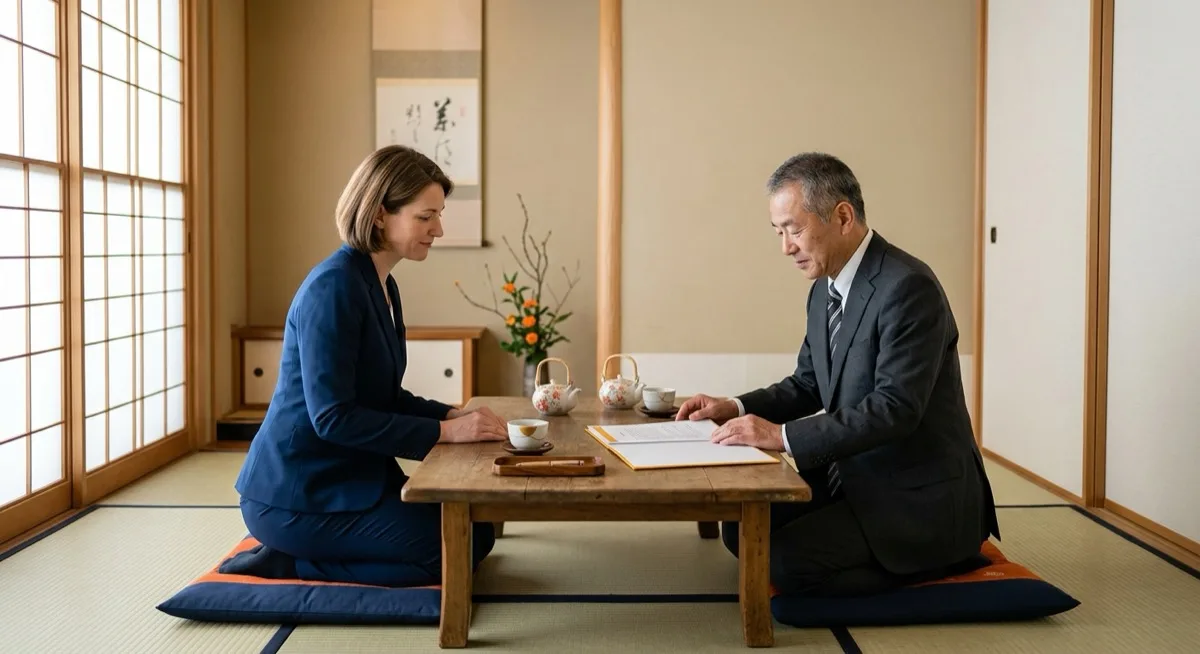
For a European trying to persuade, this changes the entire job. The room is where minds that have already been changed are revealed. So the persuasion work moves to the channels where honne lives:
- 1
Map every stakeholder
Not just the senior decision-maker. Identify everyone whose view, cooperation, or sign-off affects the outcome, including technical staff and adjacent department heads who may carry quiet influence.
- 2
Pre-read in writing, a week ahead
Send the proposal early so the Japanese side can circulate it internally and start forming a view before they ever meet you. High-context readers want the full context, not a teaser.
- 3
Persuade one-on-one, privately
Meet stakeholders individually where group dynamics do not apply. This is where real objections surface and where you actually move positions, away from the face costs of the group setting.
- 4
Surface and absorb objections
Listen for the soft no, ask what would make the proposal less difficult, and adjust. A proposal that incorporates their concerns is one they can support without losing face.
- 5
Use intermediaries for sensitive gaps
A trusted third party can carry a concern between sides that neither could raise directly, resolving it without anyone being forced into a public position.
- 6
Let the meeting confirm
Present the now-aligned proposal in the room as something the group shapes rather than approves or rejects. The meeting ratifies the consensus you already built.
The European who skips this and tries to win the argument live will find a room that is polite, attentive, and immovable, because the people in it cannot commit to something their colleagues have not been brought along on, no matter how good the proposal is. Persuasion that ignores the pre-meeting process is only a presentation to an audience that already knows the answer.
Making your case in a high-context room

When you do present, present for the audience you actually have. Three adjustments separate a case that lands from one that bounces off.
Lead with context, not the headline. A low-context European pitch opens with the ask and the value proposition, then supplies background only if challenged. A high-context, holistic-reasoning audience expects the reverse: the relationship history, the surrounding situation, the reasoning, and the people, with the ask arriving inside that field rather than detached from it (Nisbett et al., 2001).7 Skipping the context to "save time" reads as missing the point, because to a holistic reasoner the context is the point.
Lower the confrontation. European business often treats vigorous debate as a sign of engagement and respect, and irony or rhetorical challenge as intellectual warmth. In a Japanese room these read as confrontation that threatens wa, not as rapport. Stay away from irony, avoid forcing anyone into a public yes or no, and never frame your proposal as a binary the group must accept or reject in the moment. Frame it as something they can shape, which gives every stakeholder a face-preserving way to engage without committing prematurely.
Mind the language-and-power layer. When a meeting runs in a European language, the side speaking its native tongue gains status it would not otherwise hold, and the occasional use of the local European language in meetings is a documented obstacle for Japanese participants (Fujio, Challenges Facing Globally-Minded Leaders in a Japanese-European Joint Venture Company, 2018).9 The persuasive move is to slow down, check comprehension without condescension, provide written material the other side can process at their own pace, and never weaponise your linguistic home advantage. The status it confers is exactly the status that makes a Japanese counterpart more cautious, not more persuadable.
Why European directness backfires, and how to keep your edge
This is where the cultural wiring creates the most friction, and where the fix is most counterintuitive.
The Netherlands scores 80 on Hofstede's individualism dimension; Japan scores 46 (scores from Hofstede Insights, theculturefactor.com; dimension framework per Hofstede, Dimensionalizing Cultures, 2011).10 Individualism here describes the degree to which people are integrated into groups, with low-individualism cultures embedding the person more tightly into the collective (Hofstede, 2011).10 High-individualism European cultures prize the clear personal position, stated plainly. Lower-individualism Japan prizes the group surface and routes disagreement through private, hierarchically appropriate channels. When a Dutch or German executive asks "so, does everyone agree?" in a room of Japanese stakeholders, they think they are being clear and inclusive. What they are actually doing is forcing a public commitment that triggers maximum tatemae: no one will dissent in front of the group, especially in front of a foreign partner, so everyone nods or stays silent, and the European reads false consensus.
The trap then runs on rails: the European pushes for a direct answer, the Japanese side gives tatemae agreement to preserve harmony, the European leaves believing they have commitment, nothing happens, the European chases, the Japanese side gives another tatemae response to manage the situation, and the relationship sours as each side reads the other as either dishonest or disrespectful.
The fix is to relocate your directness. Keep every hard question, but ask it in the right setting, of the right person, at the right time, which means in private, after the pre-read, before the public meeting. Directness is a real asset; it just belongs in the one-on-one, not the group. Notably, the two axes are independent: how directly a culture gives negative feedback is separate from how explicit its communication is (Meyer, 2014),3 so you can be clear and well understood in a private Japanese conversation while still cushioning negative feedback far more than you would at home.
The size of the adjustment depends on where you start, so calibrate rather than copy a generic playbook.
Dutch (NL)
Largest delta. Flat-hierarchy frankness reads as rudeness; the individualism gap (80 vs 46) is wide. Move every blunt question into the one-on-one and cushion it; never demand a public yes.
German (DE)
Precision and preparation already match Japan well. The trap is Klartext plain-speaking: a flat 'this will not work' lands as aggression. Substitute 'this may be difficult; could we study it together.'
French (FR)
Relationship-building and formality map well. The risk is treating debate and intellectual challenge as rapport; in a Japanese room that reads as confrontation. Keep the warmth, drop the rhetorical sparring.
One caution against over-applying any of this: younger and internationally experienced Japanese negotiators increasingly communicate directly, and foreigners may now encounter Japanese counterparts who are clear in their speech (Kadoi, 2015).8 The signals in this guide are the default to read for, not a stereotype to impose. Read the person in front of you; let them set the directness level, and match it.
A worked example: the same meeting, read two ways
Return to the Tokyo meeting from the opening, and run it twice.
The misread version. The European presents a tight, headline-first proposal, asks at the end whether everyone is aligned, hears "this is very interesting, we will study it carefully," logs the nods as agreement, and forecasts the deal. The silence after the pitch she fills by adding a discount nobody asked for. She never has a private conversation with the technical lead who quietly held the timeline concern. She waits for a formal yes that was never coming in the form she expected.
The fluent version. A week before the meeting, she sends the full proposal in writing so the Japanese side can begin its internal consensus process. She maps the stakeholders beyond the senior decision-maker and arranges short one-on-ones, where the technical lead's timeline reservation surfaces as honne and she adjusts the plan to absorb it. In the room she leads with context and relationship, presents the now-aligned proposal as something the group shapes, asks for no public commitment, and lets the one silence sit rather than discounting into it. She reads the absence of operational questions from one stakeholder as a remaining soft no and follows up privately afterwards. The meeting confirms a decision that was effectively made before anyone sat down.
Same proposal. Same people. The difference is in where the persuading happened and which signals were read. That difference is learnable, and it is what separates a European company that earns a second meeting in Tokyo from one that quietly drops off the Japanese side's list.
How to build this skill in a European team
Reading a guide is necessary but not sufficient, because these signals only become legible when a team has practised them against its own cultural defaults. The working method we use with European teams has three parts.
- Baseline first. Identify the team's home-country defaults and where they diverge most from Japan. A Dutch team and a French team need different drills even for the same meeting, because they start from different points and over-correct in different directions.
- Signal rehearsal. Practise distinguishing a real yes from a polite one, decoding a soft no, and holding silence, using realistic dialogue rather than theory. The first real meeting should not be the first time anyone has sat with a deliberate ten-second pause.
- Sequence the persuasion. Map stakeholders, draft the pre-read, and plan the one-on-ones for an actual upcoming engagement, so the team internalises that the decision gets built before the meeting, not in it.
This is the substance of Silkdrive's cross-cultural communication training for European teams, which sits within our broader intercultural training programmes. The communication skills here are inseparable from the wider etiquette and decision-making system; for the protocol layer see our definitive guide to Japanese business etiquette for European executives, and for the cultural foundations underneath all of it, our working guide to Japanese business culture. Teams entering the market rather than visiting should also read the Japan market entry guide for European companies.
The bottom line
Persuading Japanese stakeholders is about reading a communication system that carries most of its meaning outside the words and doing the persuasion where it actually happens, before the meeting, in private, one stakeholder at a time. Treat "yes" as attention until operational questions prove otherwise. Treat the soft no as the default refusal and go find the real answer privately. Treat silence as content, not a gap. And move your European directness out of the public room and into the one-on-one, where it becomes an asset instead of a liability.
Get those four things right and the Japanese side stops being unreadable. The signals were there the whole time. You just have to know where to look.
This guide is written by Patric Sawada, founder of Silkdrive and an EU-Japan Centre for Industrial Cooperation expert, drawing on more than a decade of cross-cultural growth work between Europe and East Asia. The cultural claims are anchored to peer-reviewed and institutional sources rather than business-traveller folklore.
References
-
Hooker, J. N. (2012). Cultural Differences in Business Communication. In The Handbook of Intercultural Discourse and Communication. On Hall's low-context/high-context distinction as the single most useful concept, and the rule-based versus relationship-based distinction beneath it. ↩ ↩2 ↩3
-
Kittler, M. G., Rygl, D., and Mackinnon, A. (2011). Beyond culture or beyond control? Reviewing the use of Hall's high-/low-context concept. International Journal of Cross Cultural Management, 11(1), 63-82. On the definition of high-context communication. ↩
-
Meyer, E. (2014). The Culture Map: Breaking Through the Invisible Boundaries of Global Business. PublicAffairs. On Japan as the highest-context culture on the Communicating scale, and the independence of the Evaluating and Communicating scales. ↩ ↩2
-
JETRO; Gundling, E. (1999). Communicating with Japanese in Business. JETRO. On the honne and tatemae distinction and relationship-first engagement. ↩ ↩2
-
Ciubancan, M. (2015). Principles of communication in Japanese: indirectness and hedging. Romanian Economic and Business Review. On wa and face, the preference for indirect communication, and the ambiguity of hai. ↩ ↩2 ↩3
-
Adachi, Y. (2010). Business Negotiations between the Americans and the Japanese. Global Business Languages, Vol. 2. On indirectness as critical to maintaining harmony and saving face. ↩
-
Nisbett, R. E., Peng, K., Choi, I., and Norenzayan, A. (2001). Culture and Systems of Thought: Holistic Versus Analytic Cognition. Psychological Review, 108(2). On holistic versus analytic cognition. ↩ ↩2
-
Kadoi, M. (2015). Japanese Negotiation Styles in Business. Ural Federal University. On the requirement of group consensus, Ueda's count of sixteen ways to express refusal without the word no, and the emergence of more direct younger negotiators. ↩ ↩2 ↩3
-
Fujio, M. (2018). Challenges Facing Globally-Minded Leaders in a Japanese-European Joint Venture Company. Business Communication Research and Practice, 1(1). On linguistic power conferring status and the obstacle posed by meetings run in a local European language. ↩
-
Hofstede, G. (2011). Dimensionalizing Cultures: The Hofstede Model in Context. Online Readings in Psychology and Culture, 2(1). Individualism dimension definition; Japan and Netherlands scores referenced from Hofstede Insights (https://www.theculturefactor.com/country-comparison-tool). ↩ ↩2
Stay Ahead in Cross-Cultural Marketing
Get monthly insights on international growth strategies, cultural intelligence, and digital marketing trends delivered to your inbox.
We respect your privacy. Unsubscribe at any time.